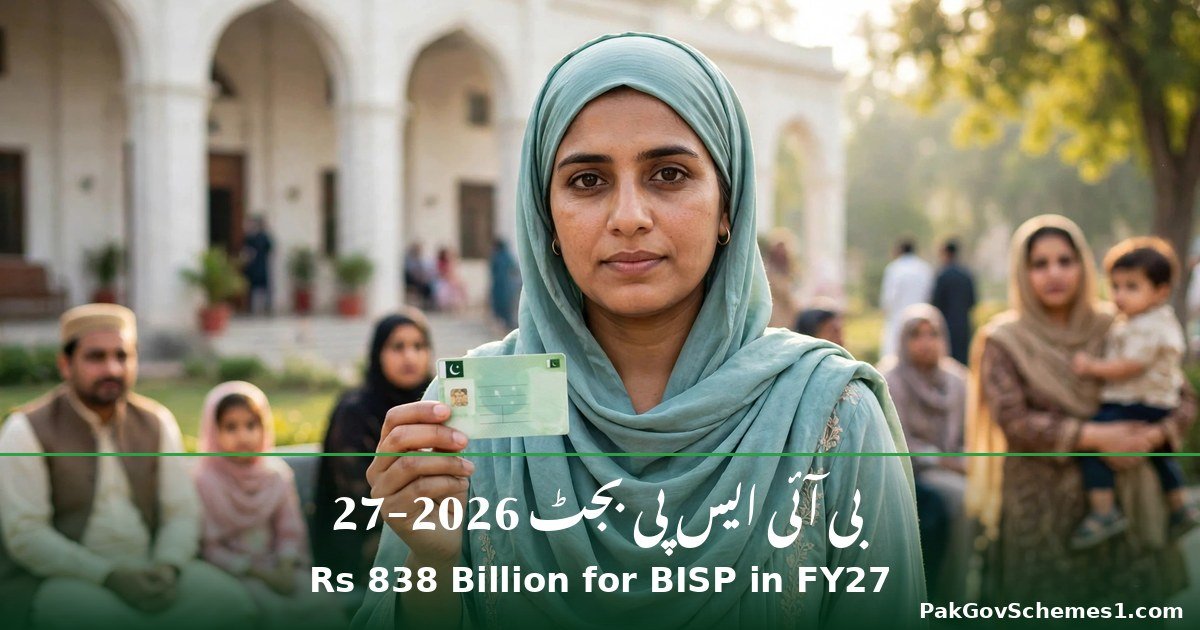
The BISP Budget 2026-27 gives the Benazir Income Support Programme (BISP) an allocation of Rs 838 billion for the fiscal year 2026-27. It is one of the largest social protection budgets Pakistan has ever set, and it directly affects millions of low-income families who depend on the quarterly Benazir Kafaalat payment. This article explains what the budget actually decided, what it means for current beneficiaries, and what it does not mean. All figures below are separated into what is official, what is reported by reputable news sources, and what is still unconfirmed, so you can tell the difference between a budget allocation and a payment announcement.
Quick Overview
| Information | Details |
|---|---|
| Programme Name | Benazir Income Support Programme (BISP) |
| Responsible Department | Benazir Income Support Programme, Government of Pakistan |
| Budget Allocation FY 2026-27 | Rs 838 billion |
| Increase Over FY 2025-26 | About 17% above the original FY26 allocation of Rs 716 billion |
| Current Confirmed Quarterly Payment | Rs 14,500 (Benazir Kafaalat) |
| Reported January 2027 Proposal | Rs 18,000 per quarter — IMF-linked commitment reported by news sources, NOT a confirmed payment |
| Families Expected to Be Covered | Around 12 million families (reported, from the budget speech) |
| Budget Year | 1 July 2026 to 30 June 2027 |
| Payment Status Check | 8171 web portal or SMS your CNIC to 8171 |
| Official Helpline | 0800-26477 (toll-free) |
| Official Website | bisp.gov.pk |
| Last Updated | 26 October 2026 |
Latest Update: What the Budget Actually Decided
Finance Minister Muhammad Aurangzeb presented the federal budget for 2026-27 in the National Assembly on 12 June 2026, and Parliament later passed the Finance Bill 2026 with a total federal outlay of Rs 18.771 trillion. Within that budget, BISP received Rs 838 billion for FY 2026-27. The budget took effect on 1 July 2026, the first day of the fiscal year.
That single decision is the confirmed news in this article. Everything else — including any talk of a higher quarterly payment — is either a reported commitment or an unconfirmed claim, and this article keeps those categories separate. As of 26 October 2026, no newer announcement was found that changes or replaces the Rs 838 billion figure.
One important clarification: a budget allocation is not the same thing as a payment announcement. The allocation is the total money set aside for the whole programme for the whole year. It covers Kafaalat cash payments, education stipends for children, administration, and other programme costs. The amount that lands in your account each quarter is decided separately, and right now that confirmed amount is Rs 14,500.
The Rs 838 Billion Figure, Explained
The Rs 838 billion allocation is about 17% higher than the outgoing year’s original allocation of Rs 716 billion. That is the figure Finance Minister Muhammad Aurangzeb cited, and it is the comparison used by Profit (Pakistan Today) and Business Recorder in their June 2026 budget reporting.
You may see different figures for last year’s BISP budget, and that is not a mistake in this article — the official documents genuinely disagree. Federal budget documents list the original FY 2025-26 allocation at Rs 716 billion, later revised down to Rs 706 billion, while the Pakistan Economic Survey 2025-26 reported it at Rs 722.49 billion. This article uses Rs 716 billion as the base for the 17% comparison because that is the figure used in the budget speech and in the IMF programme review of May 2025, but you should know the range exists.
Two claims circulating online should be ignored. First, some posts describe the increase as 20%. That is wrong: 20% is roughly the increase that would have been needed to fully fund the reported January 2027 proposal (see below), not the increase actually budgeted. Second, some old blogs still quote an outdated FY26 figure of Rs 592.48 billion. That figure belongs to an earlier year and should not be used for the 2026-27 comparison.
What the Bigger Budget Means for Beneficiaries
For families already receiving BISP support, the bigger budget mainly means stability and wider coverage, not an automatic pay rise. A larger allocation protects the programme’s ability to keep paying the current quarterly amount to a growing number of families, even as prices rise.
According to the budget speech, reported by APP, the programme is expected to cover around 12 million deserving families across Pakistan in FY 2026-27. Educational stipends under Benazir Taleemi Wazaif are expected to reach around 9.2 million children. These are reported figures from the budget speech, not a guarantee that any individual household will be added — inclusion still depends on your household’s survey record and eligibility status.
The News also reported in June 2026 that a political dispute over BISP’s future has been settled: the programme stays federal and was expanded rather than devolved to the provinces or cut. For beneficiaries, that means no change in where you go for help — your BISP tehsil office and the 8171 service remain the correct channels.

The January 2027 Question: Rs 18,000 Reported, Not Confirmed
This is the part of the story where most confusion — and most fake news — comes from, so read it carefully.

According to the IMF’s latest report on Pakistan, reported by Profit and Business Recorder in June 2026, Pakistan committed to the IMF that it would raise the quarterly Kafaalat stipend from Rs 14,500 to Rs 18,000 per beneficiary from January 2027, for 10.2 million beneficiaries. That is a commitment made to the IMF and reported by reputable newspapers. It is not, by itself, a BISP payment announcement.
Here is the problem the same reporting exposed: raising the payment by Rs 3,500 per quarter for 10.2 million beneficiaries would cost an extra Rs 142.8 billion a year. Added to the Rs 716 billion base, the programme would need about Rs 858.8 billion in FY27 to fund that increase. The budget allocated Rs 838 billion — which is Rs 20.8 billion short of what the reported increase would require.
So the honest position, as of 26 October 2026, is this: the increase to Rs 18,000 from January 2027 is a reported IMF-linked commitment that is not fully funded in the budget passed so far. It may still happen — the government could find the extra money, revise the allocation, or announce the new rate formally — but until BISP or the federal government announces a new payment rate through an official notification, Rs 18,000 must not be treated as a confirmed payment.
Be especially careful with third-party blogs and social media posts that present Rs 18,000 as already “confirmed by the budget” or as “announced”. Some of them even list it as the confirmed amount for the January–March 2027 quarter. That framing is wrong. The budget confirmed the Rs 838 billion allocation; it did not confirm a Rs 18,000 payment rate. The current confirmed payment remains Rs 14,500, including for the October–December 2026 quarter.
Who Benefits: Eligibility and Beneficiary Impact
The budget does not change BISP’s eligibility rules. BISP supports low-income families, with payments made to the eligible woman of the household in most cases. Whether a household qualifies is decided from its National Socio-Economic Registry (NSER) survey record and the programme’s poverty score, not from the budget announcement.
In practical terms, the FY27 budget affects three groups differently:
- Current beneficiaries: Your quarterly payment continues at the confirmed Rs 14,500 rate. The larger budget supports continued payments and wider coverage. No action is needed from you because of the budget.
- Households surveyed but not yet included: A larger allocation and a reported target of around 12 million families may mean more room for eligible surveyed households, but inclusion is not automatic and no date has been officially announced for any expansion round.
- Households never surveyed: You still need to complete the NSER survey at your nearest BISP tehsil office. The budget itself does not register you, and there is no online registration form created by the budget.
If your household’s situation has changed — for example, income has fallen, or a family member has died or become disabled — visit your BISP tehsil office and ask about updating your survey record. Take your original CNIC. The survey and all BISP services are free.
How the Allocation Works
It helps to understand the path the money takes, because it explains why a June budget does not change your next payment overnight:
- Parliament approves the allocation. The Rs 838 billion is set aside for BISP for the whole fiscal year (July 2026 to June 2027).
- BISP plans its spending. The programme divides the allocation across Kafaalat cash payments, Taleemi Wazaif education stipends, and running costs for the four quarters.
- Payments are released quarter by quarter. Each quarter’s payment is released in phases by district, which is why beneficiaries in different districts may receive the same quarter’s payment on different dates.
- You are paid through the official channel. Payments go to the beneficiary’s account or wallet and are collected through the payment points communicated through 8171.
Because the allocation covers the full year, a shortfall against one proposal (like the Rs 20.8 billion gap) does not stop current payments. It means the reported proposal needs extra funding or a revision before it can be paid at the higher rate.
How to Check Your BISP Payment and Status via 8171
The budget does not change how you check your status. Use only the official channels:
Method 1: 8171 Web Portal
- Type 8171.bisp.gov.pk in your browser yourself. Do not click links forwarded on WhatsApp or social media.
- Enter your 13-digit CNIC number without dashes.
- Enter the code shown in the image (captcha) and submit.
- Read your eligibility and payment status on the screen.
Method 2: SMS to 8171
- Open the SMS app on your phone.
- Type your 13-digit CNIC number without dashes or spaces.
- Send it to 8171.
- Read the reply. It tells you whether you are eligible and whether a payment is waiting or your survey needs updating.
Real BISP messages come only from 8171. Any message from another number claiming to be BISP is fake, even if it mentions the budget or the Rs 18,000 figure.

Payment Details and Schedule
| Detail | Verified Information |
|---|---|
| Current Quarterly Amount (Confirmed) | Rs 14,500 per beneficiary (Benazir Kafaalat) |
| October–December 2026 Quarter | Rs 14,500 — the confirmed rate; district-wise release dates are Not officially announced |
| January 2027 Proposal (Reported, Not Confirmed) | Rs 18,000 per quarter from January 2027 — IMF-linked commitment reported by Profit and Business Recorder; not fully funded in the Rs 838 billion budget (Rs 20.8 billion short) |
| Payment Schedule | Quarterly, released in phases by district; exact dates for the current quarter are Not officially announced |
| Payment Method | Through the beneficiary’s official account/wallet and authorized payment points communicated via 8171 |
| Payment Status Check | 8171 web portal or SMS CNIC to 8171 |
| Deduction Complaints | Helpline 0800-26477 or your BISP tehsil office |
Do not plan your household budget around Rs 18,000 yet. Until BISP announces a new rate officially, the only safe figure for planning is Rs 14,500 per quarter.

Required Documents
The budget does not add new document requirements. For the usual BISP-related visits, keep these ready:
- Your original valid CNIC (an expired CNIC can block payment processing — renew it at NADRA first).
- Children’s B-Forms, if you are updating your household record or asking about Taleemi Wazaif.
- Your registered mobile number — the phone that receives messages from 8171.
- Any previous payment or complaint receipt, if you are following up on an earlier issue.
- For a survey update, any household information the tehsil office asks for about your family and income.
BISP may ask for additional documents for specific cases. Never hand your original CNIC to an agent or stranger, and never share photos of your CNIC, your OTP, or your bank PIN with anyone.
Troubleshooting: Common Problems
- CNIC record not found: Check the 13 digits carefully and try again. If the problem continues, your household may never have been surveyed — visit your BISP tehsil office with your original CNIC.
- Status shows ineligible: This is decided from your survey record. If your household situation has worsened, ask at the tehsil office about updating your survey. A complaint alone does not change eligibility.
- Payment delayed: Payments are released district by district. Wait for the 8171 SMS for your district before travelling to a payment point. If your district’s phase has passed and nothing arrived, call 0800-26477.
- Amount received is less than Rs 14,500: Report it at once to 0800-26477 or your tehsil office. No agent or retailer may deduct any part of your payment.
- Portal not working or SMS not received: Try the portal again later, or use the SMS method instead. If both fail, visit your tehsil office rather than paying someone to “check” for you.
- Biometric failure at payment: Ask the payment point staff about the alternative verification process, and if it cannot be resolved, visit your tehsil office. Fingerprint updates are done through NADRA.
- Confused by Rs 18,000 messages: Remember the rule in this article — Rs 18,000 from January 2027 is reported, not confirmed. Do not pay anyone who promises to “register” you for the higher amount.
Official Helpline and Complaint Procedure
If you need help, use these official routes only:

- BISP toll-free helpline: 0800-26477 — free from all networks. Use it for delayed payments, deductions, and questions about your record.
- BISP tehsil office: A Benazir registration centre operates in every tehsil office. Take your original CNIC and the phone that receives BISP messages. Ask for a token or complaint number and keep it safe.
- 8171 service: The web portal (8171.bisp.gov.pk) and SMS to 8171 for eligibility and payment status checks.
When you complain, explain clearly what happened: your CNIC number, the quarter involved, the amount expected, and the amount received (if any). Keep your complaint number for follow-up. Complaint resolution time varies with the type of issue; no one can honestly promise a fixed number of days for every case.
Common Mistakes to Avoid
- Believing Rs 18,000 is already confirmed: It is a reported IMF-linked commitment, not a BISP payment announcement, and it is Rs 20.8 billion short of funding in the current budget.
- Paying agents for budget-related “registration”: The budget creates no new registration. All BISP services are free, and anyone charging a fee is running a scam.
- Trusting messages from numbers other than 8171: Real BISP messages come only from 8171.
- Sharing your CNIC photo, OTP, or PIN: BISP never asks for these by phone or SMS.
- Using old figures in arguments or applications: Do not quote the outdated Rs 592.48 billion figure or the wrong “20% increase” claim.
- Travelling to a payment point before your district’s phase: Wait for the 8171 SMS. Travelling early does not speed up payment.
- Confusing the budget allocation with your payment: Rs 838 billion is the programme’s whole-year budget, not an amount paid to any individual.

Frequently Asked Questions
What is the BISP budget for 2026-27?
The federal budget for fiscal year 2026-27 allocates Rs 838 billion to the Benazir Income Support Programme (BISP). Parliament passed the budget in 2026 and it took effect on 1 July 2026. The allocation covers the whole programme for the full year, including Kafaalat payments, education stipends, and running costs.
How much did the BISP budget increase?
The allocation rose by about 17% compared with the outgoing year’s original allocation of Rs 716 billion. Some official documents show different FY 2025-26 figures — revised to Rs 706 billion, or Rs 722.49 billion in the Economic Survey — so the 17% figure is based on the Rs 716 billion figure used in the budget speech.
Does the Rs 838 billion budget mean I will get more money now?
No. A budget allocation is the programme’s total yearly funding, not a change to your quarterly payment. Your confirmed payment remains Rs 14,500 per quarter. The bigger budget supports continued payments and wider coverage, but it does not by itself raise the amount any individual beneficiary receives.
Is the Rs 18,000 payment from January 2027 confirmed?
No. Profit and Business Recorder reported in June 2026 that Pakistan committed to the IMF to raise the quarterly Kafaalat payment from Rs 14,500 to Rs 18,000 from January 2027. That is a reported commitment, not a BISP payment announcement, and it is not fully funded in the Rs 838 billion budget. Wait for an official BISP announcement.
Why is there a Rs 20.8 billion shortfall?
Raising the payment by Rs 3,500 per quarter for 10.2 million beneficiaries would cost about Rs 142.8 billion per year, taking the required total to around Rs 858.8 billion. The budget allocated Rs 838 billion, which is Rs 20.8 billion less than that requirement. The reported increase needs funding or a budget revision before it can be paid.

Do I need to re-register to benefit from the new budget?
No. The budget creates no new registration and requires no action from current beneficiaries. If you are already receiving payments, they continue at the confirmed Rs 14,500 rate. Households that have never been surveyed still need to complete the NSER survey at a BISP tehsil office, which is the normal route, not a budget-linked process.
How many families will BISP cover in 2026-27?
The budget speech, reported by APP, said the programme would cover around 12 million deserving families across Pakistan, with educational stipends for around 9.2 million children. These are reported targets from the budget speech, not a guarantee for any individual household, since inclusion depends on each household’s survey record and eligibility status.
How can I check my BISP payment status?
Use the official 8171 service only. Visit 8171.bisp.gov.pk, enter your 13-digit CNIC number and the captcha code, and read your status. Or send your CNIC number by SMS to 8171. Real BISP messages come only from 8171, so ignore messages from any other number, even if they mention the budget or a new payment amount.
What should I do if my payment is delayed or deducted?
First check your status on the 8171 portal or by SMS, and wait for your district’s payment phase. If your district’s phase has passed, call the toll-free helpline 0800-26477 or visit your BISP tehsil office with your original CNIC. No agent may deduct any part of your payment, so report any deduction immediately and keep your complaint number.
Where can I verify BISP budget news myself?
Check BISP’s official website at bisp.gov.pk for programme announcements, and read the federal budget reporting from reputable newspapers such as Profit (Pakistan Today) and Business Recorder. Be cautious with blogs and social media posts that present reported figures as confirmed payments, and always look for the official announcement before acting on any claim.
Important Safety Notice
Use only verified official government portals: bisp.gov.pk and the 8171 portal (8171.bisp.gov.pk). Never share your OTP, password, bank PIN, or photos of your CNIC with unknown individuals, and never pay anyone for BISP registration, a payment check, or a promised increase. BISP services are free. PakGovSchemes1.com is an independent informational website and is not affiliated with any government department.
Conclusion
The BISP Budget 2026-27 is genuinely good news for social protection in Pakistan: Rs 838 billion, about 17% more than last year’s original allocation, to support around 12 million families and millions of schoolchildren. But its limits matter just as much as its size. Your confirmed payment today is still Rs 14,500 per quarter, and the reported rise to Rs 18,000 from January 2027 remains an IMF-linked commitment that is Rs 20.8 billion short of funding — not a confirmed payment. Check your status through 8171, and trust only an official BISP announcement when the payment rate finally changes.
Official Sources
- Profit (Pakistan Today), 13 June 2026 — “BISP gets Rs838bn for FY27, falling Rs20.8bn short of IMF-linked requirement”: profit.pakistantoday.com.pk
- Business Recorder — “BISP budgeted at Rs838bn”: brecorder.com
- Aaj English TV — “National Assembly passes Rs18.77 trillion budget for FY2026-27”: english.aaj.tv
- UrduPoint (APP), 13 June 2026 — “Beneficiaries Praise Govt For Raising BISP Budget By 17pc To Rs. 838bn”: urdupoint.com
- Benazir Income Support Programme — official website: bisp.gov.pk
Related guides on PakGovSchemes1.com: BISP Kafalat amount 2026, BISP 8171 payment update October 2026, BISP 8171 payment phase update 2026.
Disclaimer: PakGovSchemes1.com is an independent informational website and is not affiliated with any government department. Information is compiled from available official announcements and other identified sources and may change. Please verify eligibility, registration status, payment details, and deadlines through the relevant official government website before taking action.

