BISP Kafalat for Widows 2026 – Eligibility and Registration
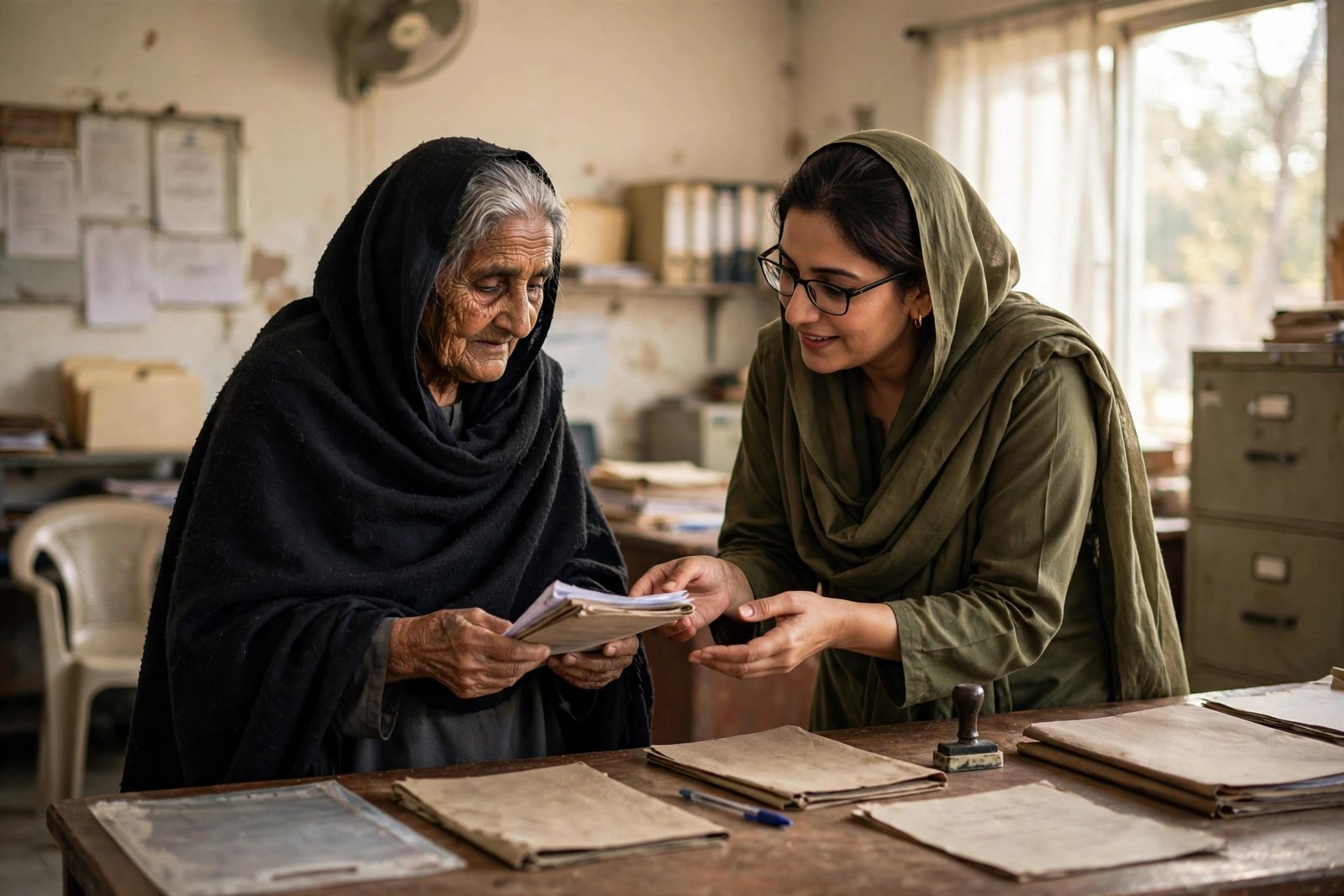
When a husband dies, a household loses its earner overnight — and in BISP’s design, that household moves to the front of the line. BISP Kafalat for widows is not a separate scheme with a separate form. It is the recognition, built into the main program, that female-headed households face the sharpest poverty — and the registration path runs through one document most widows already dread handling: the death certificate.
Here is how the process works, what changes in the record, and where widows get stuck.
Why Widows Are a Priority Group
BISP pays the Kafalat installment to the woman of the household — the program was designed around female beneficiaries from day one. When the husband dies, the widow becomes both the household head and the payee, and the household’s PMT score is reassessed on its new reality: one less earner, often the same number of mouths.
This matters because poverty measurement is household-based. A family that scored 34 with two earners can easily score under 32 with one — the formula reads the loss of income directly. The death certificate is what tells the system the loss happened.
One caution against a comforting myth: widowhood does not bypass the PMT score. There is no separate widow quota that ignores the poverty test. What widowhood does is change the household data the score is computed from — and for genuinely struggling families, that change is usually decisive.
The Document That Unlocks Everything
Before anything else, the husband’s death must be registered with NADRA and a NADRA death certificate obtained. This is the step where most widows stall — grief, distance from the NADRA office, or simply not knowing it is required.
Without the death certificate, BISP’s record still shows a living husband. The survey data stays frozen in the old reality, the PMT score does not reflect the loss, and the widow cannot be recorded as household head. Everything downstream — eligibility, payment, even the SIM registration — depends on this one paper.
If the death was never registered, visit the nearest NADRA center with the hospital death slip or the union council’s burial certificate. It takes one visit. Do it before the BISP office, not after.
Registration: Step by Step
With the death certificate in hand, the path is the standard Dynamic Survey with widow-specific documents added.
Step 1: Go to the nearest BISP Tehsil Office with your original CNIC, the NADRA death certificate of your husband, children’s B-Forms, and an active mobile number on a SIM registered in your own name.
Step 2: Tell the officer you are registering as a widow and household head. This matters — it ensures the survey records the household composition correctly, with you as the head.
Step 3: Complete the household survey honestly: current income sources (if any), dependents, housing, assets. Do not understate surviving support or overstate hardship; the biometric-linked record follows you, and false data can disqualify the household.
Step 4: Biometric verification and acknowledgment slip, as with every survey. Keep the slip.
Step 5: Wait for the 8171 SMS — verification typically takes four to eight weeks. If eligible, the Rs. 14,500 quarterly installment begins with the next payment cycle, paid to you directly.

| Situation | What to do |
|---|---|
| Husband recently died, never in BISP | Register fresh with death certificate at Tehsil Office |
| Already a BISP beneficiary, husband died | Request a re-survey with the death certificate to update household status |
| Death not registered with NADRA | Register the death at NADRA first, then approach BISP |
| Widow remarried | New household survey; eligibility reassessed on the new household |
The Traps Aimed at Widows
Let’s be direct: widows are disproportionately targeted by fraud. The pattern is consistent — someone near the office, or even a distant relative, offers to “get her registered quickly” for a fee, or claims her file needs “clearance money.” BISP registration is free. The survey is free. The installment, when approved, is paid in full with zero deductions.
A second trap is subtler: relatives who collect the widow’s installment “on her behalf” and keep a share. The payment is hers, in her name, verified by her thumbprint. No one else has a legitimate role in collecting it. If family pressure makes independent collection hard, BISP’s helpline 0800-26477 and the Tehsil Office both handle such complaints confidentially.
After Approval: Receiving Payments as a Widow
Once the 8171 SMS confirms eligibility, the mechanics are the same as for every beneficiary — with one difference that matters. The installment is paid to you, the widow, in your name, verified by your thumbprint. Not to your brother-in-law, not to the eldest son, not to whoever “handles family matters.”
Collect through a biometric ATM of HBL or Bank Alfalah, a retail agent, or a BISP payment camp — whichever you can reach safely. If mobility or family pressure makes independent collection difficult, consider the ATM at a quiet hour rather than a crowded camp. And from the first payment onward, the discipline is the same: count the full Rs. 14,500 before leaving, every single time.
If any relative suggests the money should flow through them “for safekeeping,” understand what is actually being proposed. The program deliberately pays women directly because decades of evidence showed household-level payments did not always reach the intended person. Your thumbprint is not bureaucracy — it is the lock on your own money.
It is also worth knowing that widow-headed households often qualify for linked programs faster once the BISP record is updated. Taleemi Wazaif enrollment for school-going children, for example, requires the mother to be an active Kafalat beneficiary — which is exactly what the updated record establishes. One correct survey can unlock several streams of support, which is why getting the death certificate and the re-survey done promptly matters more than it first appears.
Widows should also know about the B-Form link: children’s B-Forms must show the mother’s CNIC as the parent record for linked programs to work smoothly. If the B-Forms were made years ago under the father’s record, NADRA can update the parent linkage — a small correction that prevents big headaches when enrolling children in Taleemi Wazaif later.

BISP Kafalat for Widows: Quick Answers
Is there a special BISP Kafalat for widows quota? BISP Kafalat for widows works through the main program — widowhood updates the household record and PMT score, but the poverty test still applies. There is no separate widow-only scheme to apply to.
What documents does BISP Kafalat for widows need? The NADRA death certificate of the husband is essential for BISP Kafalat for widows, plus the widow’s own CNIC, children’s B-Forms, and a SIM in her own name.
How long does BISP Kafalat for widows approval take? After the survey, verification takes about four to eight weeks. Once approved, BISP Kafalat for widows pays the standard Rs. 14,500 quarterly installment to the widow directly.
Related Guides
- 8171 Web Portal 2026 – Check BISP Payment by CNIC
- BISP 8171 Complete Guide 2026 – Payments & Eligibility
- Asaan Karobar Finance Scheme 2026 – 0% SME Loans
Disclaimer: Procedures for widow registration can change with BISP announcements. Always verify current requirements on bisp.gov.pk or the toll-free helpline 0800-26477.

