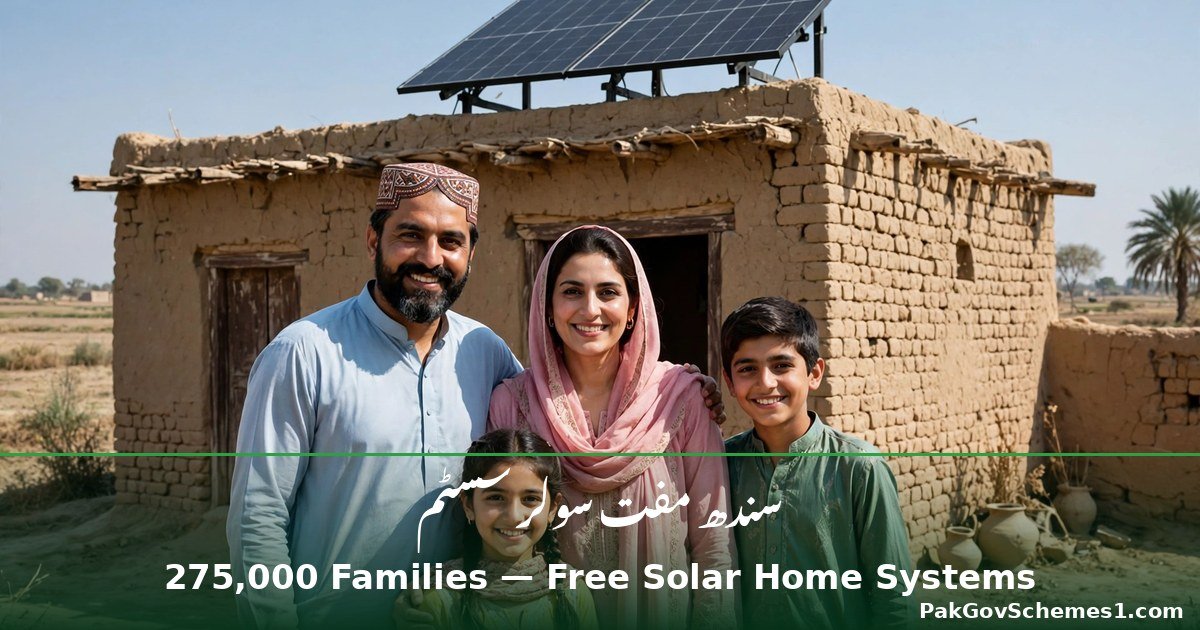
The Sindh Free Solar Home Systems 2026 initiative is one of Pakistan’s largest household energy schemes this year: under the Sindh Budget 2026–27, the province plans free solar home systems for 275,000 low-income families at a reported Rs 18.206 billion, with BISP-registered families getting priority. This guide separates what is confirmed, what is only reported, and what is not officially announced — including the key fact that no application procedure has been confirmed.
Quick Overview Table
| Information | Details |
|---|---|
| Program Name | Sindh Free Solar Home Systems (free solar home systems for 275,000 families) |
| Announced In | Sindh Budget 2026–27, presented by Chief Minister Syed Murad Ali Shah in June 2026 |
| Reported Budget | Rs 18.206 billion |
| Total Beneficiaries | 275,000 low-income families |
| Priority Group | BISP-registered / low-income families (reported) |
| Off-Grid Share | 132,000 households in remote, desert, mountain and riverine areas (reported) |
| On-Grid Share | 143,000 protected consumers using up to 100 units per month (reported) |
| Solar Kit | 180-watt solar panel, lithium battery, fan and LED lights, free of cost (reported) |
| Project Start | April 2025 (reported) |
| Planned Completion | June 2027 (reported) |
| Application Procedure | Not officially announced |
| Online Apply Link | Not officially announced — no official link has been confirmed |
| Last Updated | 27 October 2026 |
Latest Update: What the Sindh Budget 2026–27 Announced
When Chief Minister Syed Murad Ali Shah presented the Sindh Budget 2026–27 in June 2026, it included a Rs 18.206 billion initiative to distribute free solar home systems to 275,000 low-income families. July 2026 coverage from ProPakistani, Bloom Pakistan and Arab News Pakistan reported the announcement and headline figures. Be precise about status: the allocation and target are reported from the budget announcement, not from a separate detailed scheme notification verifiable at the time of writing.
The initiative did not start from zero in the 2026–27 budget. Reports state that the project began in April 2025 and is planned for completion by June 2027 — so the budget expanded a programme already under way, rather than opening a new registration drive. A budget announcement is not the same as an open application window, and no registration dates have followed from it.
By July 2026, news reports indicated installations were already happening in Karachi, Ghotki, Umerkot, Dadu, Tharparkar, Thatta and Shaheed Benazirabad. The reported installed count differed between reports — around 11,571 and more than 15,000 both appeared — so this article presents it as reported, not as a final or official total, most likely reflecting different reporting dates.
What Is in the Free Solar Home System Kit?
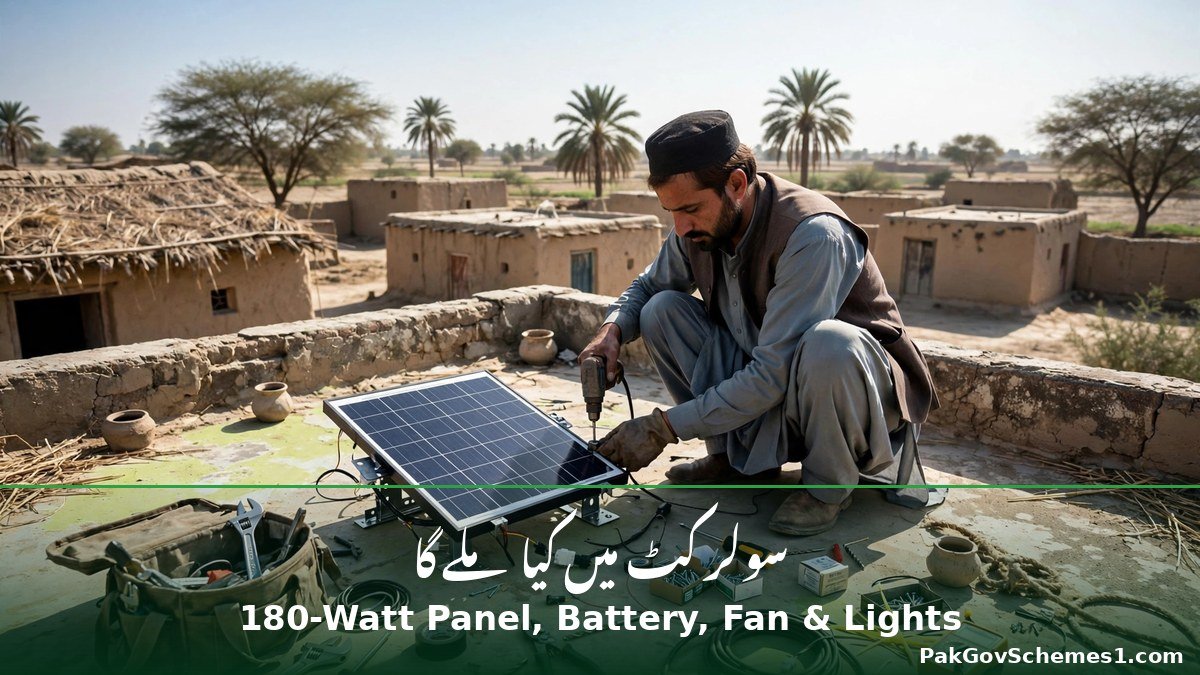
According to reported details, each beneficiary household receives one complete system free of cost: a 180-watt solar panel, a lithium battery, a fan and LED lights — designed to cover basic needs: evening lighting, a fan in hot weather, and a small amount of stored power after sunset.
A 180-watt system is a small home system, not a full rooftop power plant: it will not run air conditioners, heaters, large refrigerators or water pumps. Its value is greatest for families with no electricity at all or long load-shedding hours, because it guarantees light and a fan independently of the grid.
The kit is reported to be provided completely free of cost. No payment or fee has been officially announced, and anyone asking a family to pay for inclusion should be treated with suspicion. The separate subsidised rooftop-solar financing scheme for middle-income households is a different programme — it involves financing, not free kits.
Who Is Eligible? BISP Families, Off-Grid Homes and Protected Consumers
Eligibility is built around low income and energy need, not a general open application. The reported priority group is low-income families, with beneficiaries identified through BISP — so BISP-registered families are expected to get priority. The exact mechanism has not been officially announced: it is not confirmed whether BISP families will be enrolled automatically or must apply through a process yet to be published.
The reported split explains who the scheme is really for: around 132,000 systems for off-grid households in remote, desert, mountain and riverine areas where the grid does not reach or is unreliable, and 143,000 for on-grid protected consumers using up to 100 units per month — small consumers already in the protected, low-consumption category.
Put together, this is a scheme for poor households and small consumers, not a general household solar subsidy. Families with a large grid connection and high monthly consumption are not the target group; middle-income households should instead watch for the separate subsidised rooftop-solar financing scheme.


Off-Grid vs On-Grid: How the 275,000 Systems Are Divided
| Category | Reported Share | Who It Covers |
|---|---|---|
| Off-grid households | 132,000 systems | Families in remote, desert, mountain and riverine areas without reliable grid access |
| On-grid protected consumers | 143,000 systems | Grid-connected households using up to 100 units per month |
| Total | 275,000 systems | Low-income families across Sindh, with BISP families getting priority |
The off-grid share matters most in districts such as Tharparkar, where many villages have never had a reliable grid connection: for these families, a solar system is their first dependable source of light and power, not a saving on a bill. The on-grid share instead eases the burden on small consumers hurt most by rising tariffs and load-shedding.
District-wise quotas have not been officially announced. Reports have named districts where installations took place, but no published district-by-district allocation could be verified — so any list claiming an exact quota for a district is unofficial.
Registration Procedure: What You Can and Cannot Do Right Now
This is the section readers most want, and where honesty matters most: the application and registration procedure for the 275,000-family initiative has not been officially announced. No official apply link, SMS code, registration form or opening/closing date has been confirmed, so any site, page or agent offering “Sindh free solar registration” is not operating on an officially announced procedure.
What can readers do meanwhile? Keep BISP records and CNIC details up to date, since beneficiaries are reported to be identified through BISP. Follow announcements from the Government of Sindh and the Sindh Energy Department through official channels, not forwarded WhatsApp messages. And do not pay anyone who promises to add a name to the list — the kits are reported to be free of cost.
When an official procedure is announced, this guide will be updated with the verified steps. Until then: the scheme and budget are announced and installations are reported to be under way, but the public registration route is not officially announced.
CNIC Check and Application Status
Because no registration procedure has been officially announced, there is also no officially confirmed CNIC check or status portal specific to this scheme, and no SMS short code for it has been confirmed.
BISP families can check their general BISP status through the established BISP channels they already use, but a BISP record alone does not confirm selection for the solar scheme, and no official statement says BISP status guarantees a kit. If a third-party site asks for a CNIC photo or an OTP to “check solar eligibility,” do not provide it.

Progress So Far: Installations Reported by July 2026
July 2026 reports indicate the wider project had already installed thousands of kits, with work reported in Karachi, Ghotki, Umerkot, Dadu, Tharparkar, Thatta and Shaheed Benazirabad. The reported figures differed — around 11,571 and more than 15,000 — and should be read as a mid-2026 snapshot, not a final total or official progress report.
The reported timeline runs from April 2025 to a planned completion in June 2027 — a phased, district-by-district rollout, not a single-day distribution. Districts not yet named in reports are not necessarily excluded, but no district-wise delivery schedule has been officially announced, so no delivery date can be assumed.

Background: The World Bank Sindh Solar Energy Project
The initiative builds on the World Bank-supported Sindh Solar Energy Project (SSEP), whose predecessor phase is reported to have reached 200,000 households. That earlier work is why Sindh already had installation networks when the 2026–27 budget expanded the programme to 275,000 more families.
One line of context: ProPakistani reported in December 2025 that the Sindh cabinet had ordered a full audit of the Rs 28 billion SSEP over reported irregularities. This article does not litigate that audit, which concerns the earlier project rather than the new free-systems budget.
Documents You May Need (General Guidance)
Since the registration procedure has not been officially announced, no official documents list has been published either. The following is general guidance only, based on how similar Sindh and BISP-linked schemes normally work — not an official requirement list:
- Valid CNIC of the head of household
- BISP registration record, if the family is already registered with BISP
- Proof of residence in Sindh, such as a domicile or utility record, if asked for
- A registered mobile number for contact about delivery or installation
- For on-grid applicants, a recent electricity bill showing protected-consumer status may be relevant, if the announced procedure asks for it
Do not hand original documents or CNIC copies to unauthorised persons claiming to register households. When the official procedure is published, it will state exactly which documents are needed.

Troubleshooting: Common Problems and What to Do
No application form is available. This is expected, because the procedure has not been officially announced. It does not mean a family has been rejected — wait for an official announcement and ignore unofficial forms.
Someone asks for payment to include your name. Do not pay — the kits are reported to be free of cost, and no payment step has been officially announced.
A website claims you can apply online now. No official apply link has been confirmed — do not enter CNIC details or pay any fee there.
Your neighbours received a kit but you did not. Rollout is reported to be phased by district and category, and quotas have not been officially announced — a neighbour’s delivery does not mean you were rejected.
Your BISP record is out of date. Keeping BISP and NADRA records current is sensible advice for all BISP-linked support. Use the official BISP channels you already use for updates.
Official Helpline and Complaints
No dedicated helpline, complaint number or SMS code for this initiative has been officially announced, so this article does not publish one. Use the official channels of the Government of Sindh and the Sindh Energy Department, and be wary of helpline numbers circulated on social media that cannot be traced to an official announcement.

Common Mistakes to Avoid
- Trusting “apply online” links for a scheme whose procedure has not been officially announced.
- Paying an agent who promises guaranteed selection — the kits are reported to be free of cost.
- Sharing CNIC photos, OTPs or passwords with unknown websites or individuals.
- Confusing the free solar home systems with the separate subsidised rooftop-solar financing scheme for middle-income households.
- Confusing the new 275,000-family initiative with the earlier World Bank SSEP phase that reached 200,000 households.
- Treating a reported installation figure from July 2026 as the current or final total.
- Believing an unofficial district quota list that has not been published by the government.

Frequently Asked Questions
Who will get the Sindh free solar home systems?
Low-income families in Sindh, with BISP-registered families reported to get priority: 132,000 off-grid households and 143,000 on-grid protected consumers using up to 100 units per month.
How many families will benefit in total?
The Sindh Budget 2026–27 initiative covers 275,000 families at a reported cost of Rs 18.206 billion. This is the announced target, not the number of systems already delivered.
What is included in the free solar kit?
According to reported details, each kit includes a 180-watt solar panel, a lithium battery, a fan and LED lights, provided free of cost. It is a basic home system, not a full rooftop power plant.
How can I apply for the Sindh free solar scheme?
The application and registration procedure has not been officially announced, and no official apply link has been confirmed. Do not trust unofficial registration websites or agents claiming to enrol households.
Are BISP families enrolled automatically?
Not officially announced. Beneficiaries are reported to be identified through BISP, but whether BISP families are enrolled automatically or must apply has not been officially confirmed.
How many solar systems have already been installed?
July 2026 reports gave differing figures, around 11,571 and more than 15,000, in Karachi, Ghotki, Umerkot, Dadu, Tharparkar, Thatta and Shaheed Benazirabad. Treat these as reported mid-2026 snapshots, not final totals.

Is there a district-wise quota for my district?
District-wise quotas have not been officially announced. Any list claiming exact district allocations is unofficial and should not be relied upon.
Is this the same as the Punjab solar panel scheme?
No. This is a Sindh government initiative; Punjab’s separate solar schemes, including Roshan Gharana, operate under different rules and budgets.
Do I have to pay anything for the free solar system?
No payment has been officially announced for the free systems, which are reported to be provided free of cost. Anyone demanding payment for inclusion should be treated as suspicious.
When will the project be completed?
From April 2025 to a planned completion by June 2027, as reported. No district-wise delivery schedule has been officially announced.
Important Safety Notice
Only trust official Government of Sindh announcements. Never share your CNIC photo, OTP, password or bank details with unknown individuals or websites promising solar registration. PakGovSchemes1.com is an independent informational website, not affiliated with the Government of Sindh, the Sindh Energy Department or BISP — verify all details through official channels before acting or paying anyone.
Conclusion
The Sindh Free Solar Home Systems 2026 initiative is a large commitment — 275,000 free kits for low-income families under a reported Rs 18.206 billion budget, with BISP families getting priority and off-grid areas at the front of the queue. But what readers most need to know is what is still missing: the registration procedure, automatic BISP enrolment and district-wise quotas are all not officially announced, and no apply link exists. Until the government publishes those details, keep BISP records current and ignore paid agents and fake registration links.
Sources
- Bloom Pakistan — Sindh launches massive free solar initiative for low-income households (budget figure, 275,000 families, kit details)
- ProPakistani — Sindh announces free solar home systems for 275,000 families (July 2026 announcement, installation progress, SSEP audit context)
- Bloom Pakistan — 275,000 families to get free solar home systems in Sindh (off-grid/on-grid split, BISP targeting, timeline)
- Arab News Pakistan — Sindh to distribute 275,000 solar systems among households in FY27 (FY27 distribution plan, budget context)
Related Articles on PakGovSchemes1.com
- Punjab Solar Panel Scheme 2026 — Roshan Gharana
- Punjab Solar Tube-Well Scheme 2026 for Farmers
- Solar Panel Financing in Pakistan 2026
Disclaimer: PakGovSchemes1.com is an independent informational website and is not affiliated with any government department. Information is compiled from available official announcements and other identified sources and may change. Please verify eligibility, registration status, payment details, and deadlines through the relevant official government website before taking action.

