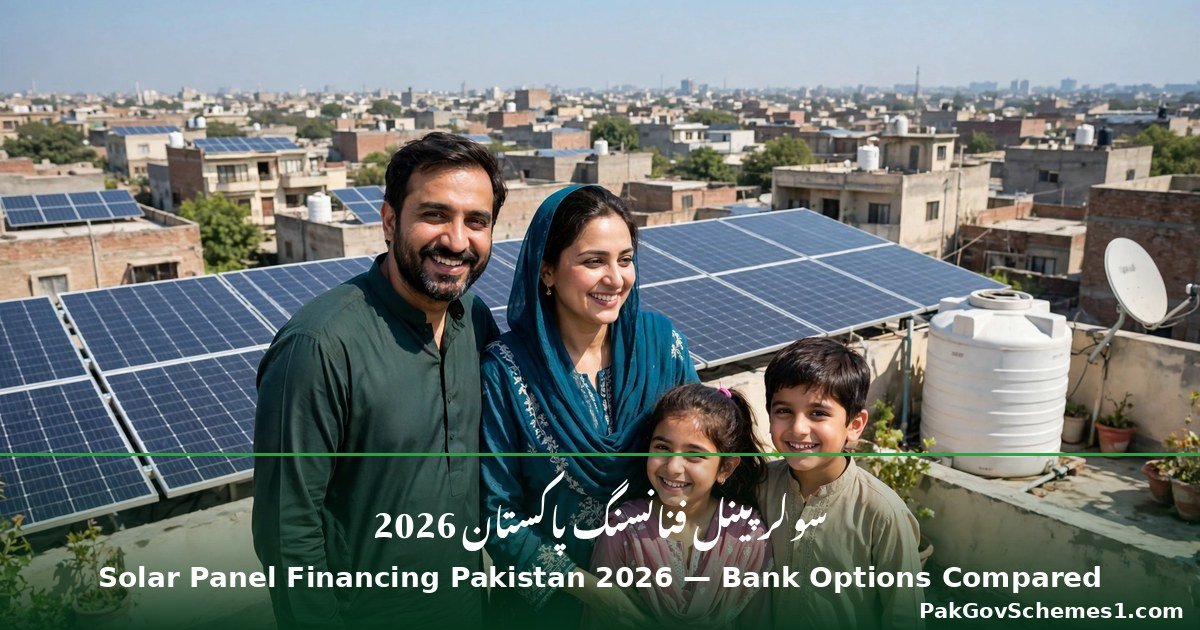
Solar panel financing Pakistan 2026 means borrowing from a bank to install a home solar system and repaying it in monthly installments instead of paying the full price upfront. With electricity bills still high, many homeowners are comparing bank solar loans — but the market changed sharply in 2026: the cheap 6% State Bank scheme that older guides still quote is contested, and NEPRA replaced net metering with net billing in February 2026. This guide compares the real bank products on verified terms and separates bank loans from the Punjab free-solar scheme.
Solar Panel Financing Pakistan 2026: Quick Overview
| Information | Details |
|---|---|
| Topic | Bank financing (loans) for home solar systems in Pakistan |
| Main banks | Meezan Bank (Solar), Bank Alfalah (Home Solar Finance), JS Bank (GharApna Solar), NBP (Roshan Ghar Solar), Bank of Punjab (Solar Loan), Faysal Bank (Islami Solar Finance), HBL (PersonalLoan) |
| Typical loan size | Rs 100,000 to Rs 7,000,000 depending on the bank |
| Typical tenure | 1 to 10 years depending on the bank |
| Markup / profit rate | Mostly KIBOR-linked, mid-to-high teens in 2026 (about 15–18%); the old 6% SBP rate is contested |
| Down payment | Usually 15–30% of the system cost |
| Grid export rule | Net billing since 9 February 2026 (NEPRA Prosumer Regulations 2026, SRO 251(I)/2026); exports credited at about Rs 10–11 per unit |
| Registration status | Bank solar loans are open year-round; the Punjab free-solar scheme’s registration is closed |
| Last updated | 16 November 2026 |
Latest Update: Net Billing Replaced Net Metering in February 2026
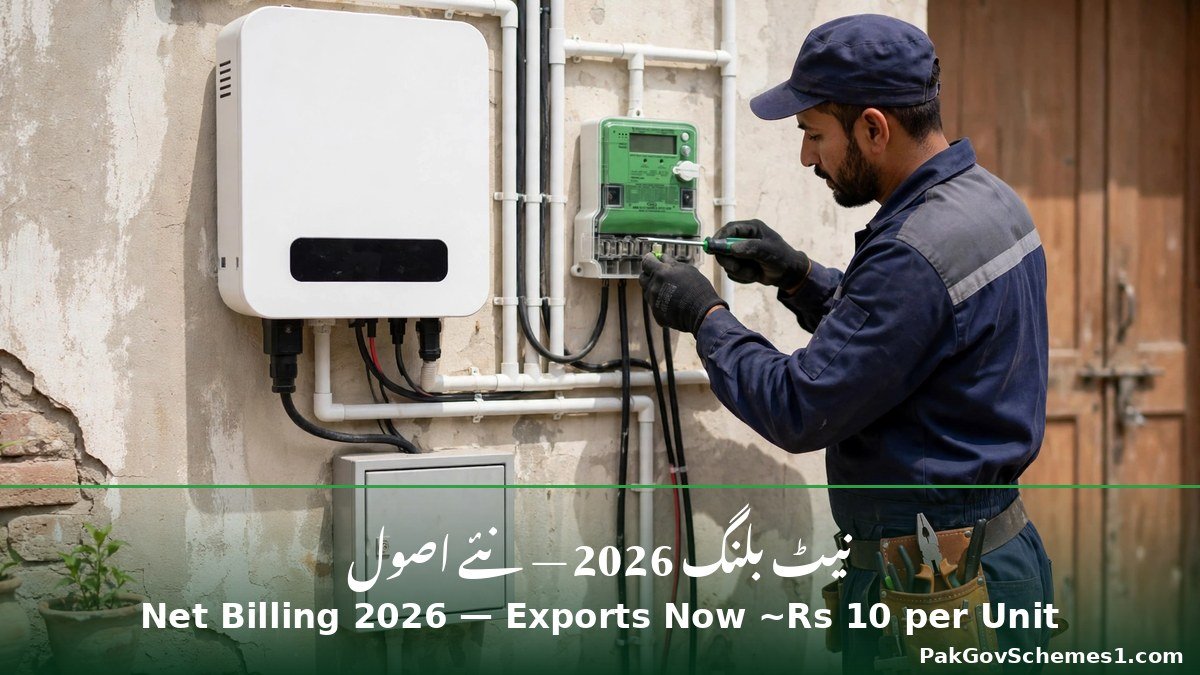
On 9 February 2026, NEPRA notified the (Prosumer) Regulations 2026 (SRO 251(I)/2026), replacing the 2015 net metering rules for all new applicants. Under old net metering, exported units were netted against imported units at close to the retail rate — about Rs 26–27 per unit. Under net billing, the two are priced separately: imports are billed at your normal retail tariff (roughly Rs 45–55 per unit at upper slabs), while exports are credited only at the National Average Energy Purchase Price (NAEPP), reported at about Rs 10–11 per unit at notification (IESCO’s circular of 25 February 2026 put NAEPP at Rs 8.13 per unit). NEPRA can revise this rate, so confirm the current figure with your own distribution company (DISCO) before buying panels.
If you signed a net metering agreement before 9 February 2026, you generally keep the old terms until it expires; new prosumer agreements run for five years (previously seven). A unit you use yourself is now worth two to four times more than a unit you export, so right-size the system to your daytime use. The second change concerns the famous 6% loan: the State Bank’s Financing Scheme for Renewable Energy historically lent for solar at 6% per annum, but 2026 guides disagree on whether new residential borrowers can still get it — several say it has been suspended since 2023, others say it survives on an allocation basis. We could not verify a live allocation on the SBP site, so treat any 6% promise as unconfirmed and ask the branch to put it in writing.
Solar Panel Financing Pakistan 2026: Bank Loans Compared
There is no single “government solar loan” — each bank sells its own product, and comparing two or three offers can save you lakhs. Terms below are verified on bank pages or reported by independent 2026 guides that checked those pages; where a bank publishes no rate, the table says so. Rates are KIBOR-linked unless stated otherwise — 1-year KIBOR was about 12.7% in early October 2026 and 13.03% on 2 November 2026, so “KIBOR + 3%” costs roughly 16% now. Always compare the total repayable amount on the written offer, not just the rate.
| Bank / Product | Max financing | Tenure | Markup / profit rate | Down payment |
|---|---|---|---|---|
| Meezan Solar (Islamic, Musawamah) | Rs 2.5 million (Rs 3 million for Premium Banking) | 1–5 years | Not published; about 14.87% derived from its own calculator | 15–50% (on-grid) |
| Bank Alfalah Home Solar Finance | Rs 5 million | 3–10 years | 1-year KIBOR + 3% salaried / + 4% self-employed (about 16% in Nov 2026) | Not stated on the page |
| JS Bank GharApna Solar Finance | Rs 300,000–7 million | 3–7 years | Not published — ask for the Key Fact Statement | 20% (30% above Rs 6 million) |
| NBP Roshan Ghar Solar Finance | Rs 400,000–5 million | Up to 7 years | Reported 1-year KIBOR + 2% | About 20% |
| Bank of Punjab Solar Loan (Shamsi Tawanai) | Reported up to Rs 5 million | Reported 5 years | Reported about 16.5% | Reported 20% |
| Faysal Islami Solar Finance (Islamic, Diminishing Musharakah) | Reported up to Rs 3 million | Reported 3–7 years | Quote-based; not published | Reported about 15% |
| HBL PersonalLoan (no dedicated solar product) | Rs 3 million | 12–48 months | Fixed markup up to 35.99% per annum | None (clean loan) |
Meezan Bank Solar — the Shariah-compliant option
Meezan Solar, verified from Meezan Bank’s own product page, is structured as Musawamah (a sale at a disclosed price), so there is no interest. Financing runs Rs 100,000 to Rs 2,500,000 (Rs 3,000,000 for Premium Banking customers), for systems of 1 kW to 1,000 kW, over 1 to 5 years. You must use an installer from Meezan’s approved Energy Partner list, and the property must be owned by you — a family owner becomes co-applicant. Batteries are not financed, and the net billing cost is yours. The product is available only in Karachi, Lahore and Rawalpindi/Islamabad, flats are not eligible, and you must be an active tax filer with an NTN; salaried applicants need Rs 100,000 a month gross with two years at the current employer. Processing is a flat Rs 6,000 plus FED, late charges are Nil. Meezan publishes no profit rate (independent analysis of its calculator puts it near 14.87%), so get the payment plan in writing. Call the 24/7 centre at 111-331-331 / 111-331-332.

Bank Alfalah Home Solar Finance — the longest tenure
Bank Alfalah is the only bank that publishes its solar loan spread. Home Solar Finance offers up to Rs 5 million over 3 to 10 years — the longest tenure, giving the lowest monthly installment — for systems from 3 kW, at 1-year KIBOR + 3% for salaried applicants and + 4% for self-employed (roughly 16% and 17% at November 2026 KIBOR). A hybrid option can fix the installment initially. Check the current KIBOR and spread at a branch before applying.
JS Bank GharApna Solar Finance — and a climate-fund line
JS Bank was one of the earliest banks to launch a dedicated solar product. GharApna Solar Finance covers Rs 300,000 to Rs 7 million over 3 to 7 years, with 20% down (30% above Rs 6 million). The bank requires hypothecation of the system, a personal guarantee and post-dated cheques; you must be an active tax filer with an NTN, aged 27 or older, earning at least Rs 75,000 a month if permanently employed. JS Bank publishes no rate, so ask for the Key Fact Statement. It also runs the Pakistan Distributed Solar Project, backed by the Green Climate Fund, at KIBOR plus spread over 3 to 7 years with no additional collateral — ask which product you are being offered.
NBP, Bank of Punjab and Faysal Bank — reported terms
NBP Roshan Ghar Solar Finance is reported at Rs 400,000 to Rs 5 million over up to 7 years, at 1-year KIBOR + 2% with about 20% down. Bank of Punjab’s solar loan (Shamsi Tawanai) is reported at up to Rs 5 million over 5 years at about 16.5%, with 20% down and a minimum gross salary of Rs 40,000. Faysal Bank’s Islami Solar Finance uses Diminishing Musharakah, reported at up to Rs 3 million over 3 to 7 years with about 15% down and a quote-based profit rate. None of these three banks publishes its rate, so treat these figures as reported, not confirmed — get the Key Fact Statement in writing first.
HBL — no dedicated solar product, and an expensive fallback
HBL sells no dedicated retail solar product — its consumer loans are PersonalLoan, CarLoan and Roshan Apni Car, and its website carries no solar page. The practical route is a general-purpose PersonalLoan of Rs 25,000 to Rs 3 million over 12 to 48 months at a fixed markup of up to 35.99% per annum, with a processing fee of Rs 6,000 or 1.25%, whichever is higher, and a minimum salary of Rs 35,000. That makes it one of the most expensive ways to finance solar, although it needs no security and includes free life insurance and a 50% processing-fee discount for female applicants. HBL also offers the SBP scheme through its SME window — a business facility, not a household product. Confirm terms at HBL Phone Banking, 111-111-425.
What a Solar System Costs in November 2026 — and the Installment vs Bill Math
Trackers disagree on exact prices because panel rates move with the dollar, so treat these as reported ranges, not fixed prices: Tier-1 N-type panels sell at about Rs 39–44 per watt at retail (some wholesale trackers quote Rs 28.50–32.50). A complete 5 kW on-grid system costs roughly Rs 5–9 lakh installed, and a 10 kW on-grid system roughly Rs 8–13 lakh; a lithium battery for a hybrid system adds roughly Rs 2–5 lakh. Get itemised quotations from at least three installers — the quotation is also a document the bank will ask for.
The decision comes down to one comparison: your average monthly electricity bill versus the loan installment. A worked example, using the author’s own arithmetic at a reducing-balance rate of 16% per annum (illustrative only — your bank’s offer is what counts): financing Rs 800,000 over 5 years at 16% gives an installment of about Rs 19,450 a month and total repayment of about Rs 11.67 lakh. Over 7 years the installment falls to about Rs 15,900 a month, but the total rises to about Rs 13.35 lakh. At the contested 6% SBP rate the same loan would cost about Rs 15,470 a month over 5 years. Compare the installment with your real average bill, not your highest summer bill — under net billing, the system saves you the most when you use the power yourself during the day.

Solar Panel Financing vs Roshan Gharana vs Net Billing: Do Not Confuse Them
- Bank solar financing (this article): you borrow money from a bank and repay it with markup or profit. The system is yours, you choose the size, and you pay for it over 1–10 years. Available year-round at the banks above.
- CM Punjab Free Solar Panel Scheme (Roshan Gharana): a Punjab Government programme giving free standalone solar systems to households using 0–200 electricity units a month, selected by computerised balloting. The target was up to 100,000 systems (550 watts for 0–100 units, 1,100 watts for 101–200 units), based on the June 2024 bill. Registration closed on 5 January 2025 and the portal states registrations are closed; the timeline was reported extended to December 2026 for distribution, with about 90,000 households reported to have received systems by June 2026. If your home used more than 200 units, you were never eligible. Read our full guide: Punjab Solar Panel Scheme 2026 – Roshan Gharana Guide.
- Net billing: not a loan and not a subsidy — simply the rule for how your DISCO pays you for exported units (about Rs 10–11 per unit since February 2026). It applies whether you paid cash or borrowed. Read our full guide: Solar Net Metering Pakistan 2026 – Net Billing Rules.
Other provinces run their own solar programmes: the KP solar schemes for household solarization and the Sindh free solar home systems programme. Farmers should also note the Punjab solar tube well scheme, which is different from household solar financing.
Who Can Get a Solar Loan? Eligibility Criteria
- Pakistani citizen with a valid CNIC, usually aged 20–65 (Meezan: minimum 20, maximum 60 at maturity; JS Bank: minimum 27).
- Own the property where the system will be installed. Tenants and flat owners are generally not eligible — Meezan explicitly excludes flats, and family-owned property requires the owner as co-applicant.
- Steady income: salaried applicants typically need Rs 35,000–100,000 a month gross depending on the bank (Meezan Rs 100,000; JS Bank Rs 75,000; HBL PersonalLoan Rs 35,000; BOP reported Rs 40,000). Meezan asks business applicants for 5 years in business and Rs 500,000 monthly gross income.
- Active tax filer with an NTN — Meezan and JS Bank both require it, and most banks now treat filer status as a condition.
- Clean credit history: banks run eCIB checks. A settled default stays visible for two years after settlement under SBP rules, so check your own record before applying.
- Debt burden ratio: Meezan caps total monthly obligations at 40–45% of income for salaried applicants (30–35% for business applicants).
- Approved installer and quotation: most banks, including Meezan, require the system to come from their approved vendor or Energy Partner list, with a quotation showing panel and inverter specifications.
- Electricity connection in your name (or the property owner’s name), with recent bills showing your consumption pattern — banks commonly ask for the last three electricity bills.
There is no PMT score or BISP-style poverty test for bank solar loans — those belong to welfare programmes, not commercial bank lending. If someone tells you a solar loan needs a BISP survey or an 8171 registration, that is false.
How to Apply for Solar Panel Financing: Step by Step
- Get a load assessment and itemised quotations. A reputable installer surveys your home, checks your last 6–12 months of bills, and quotes a right-sized system with panel brand, inverter, structure, wiring and net billing filing listed separately. Get at least three.
- Shortlist two or three banks. Compare the written offers: rate or profit formula, tenure, down payment, processing fee, insurance/Takaful, and total repayable. Ask each bank for its Key Fact Statement — the one document that shows the real rate and every charge.
- Check the SBP 6% question in writing. Ask the branch directly whether any concessional SBP renewable-energy allocation is open for residential borrowers today, and get the answer on the offer letter. Do not accept a verbal promise.
- Submit your application at the branch. Take your CNIC, income proof, property ownership documents, recent electricity bills, NTN/filer proof, photographs and the installer’s quotation. Some banks, such as Meezan, also require you to hold (or open) an account with them.
- Wait for verification and approval. The bank verifies your documents, runs the eCIB credit check, verifies your residence and workplace, and checks the installer’s credentials. Reported processing times run from about one week to a month.
- Installation and disbursement. The system is installed by the approved vendor, the bank verifies the installation, and the money is usually disbursed directly to the vendor. Your installments then begin as agreed.
- Apply for net billing through your DISCO. With the installer’s help, file the prosumer application with your distribution company (LESCO, IESCO, K-Electric or your local DISCO), which inspects the installation and fits the bi-directional meter. A reported concurrence fee of Rs 1,000 per kW may apply — confirm it with your DISCO in advance.

How to Check Your Loan and Net Billing Application Status
There is no single national portal for solar loans, because each bank processes its own applications. To check a bank loan application, contact the branch where you applied or the bank’s helpline with your application reference number — Meezan at 111-331-331 / 111-331-332, HBL Phone Banking at 111-111-425, and other banks through the helpline printed on your application receipt. Keep your reference number safe; banks will not discuss an application without it, and never share it with anyone who contacts you first.
To check a net billing application, contact your DISCO’s customer service or the office where you filed the prosumer application, using the tracking number your installer gave you. If the inspection is delayed, ask for the delay in writing and keep copies of every submission receipt. For the Punjab free-solar scheme (a different programme), results are checked on cmsolarscheme.punjab.gov.pk — do not confuse that portal with any bank’s loan tracking.

Documents You Will Need
- Valid CNIC (front and back) — and the co-applicant’s CNIC if the property is family-owned.
- Last 6 months’ salary slips or business income proof (12 months’ bank statement for self-employed), plus the last 6 months’ bank statement.
- NTN certificate and FBR Active Taxpayer List (ATL) proof — filer status is required by Meezan and JS Bank.
- Property ownership documents: registry, Fard-e-Malkiat or allotment letter for the house where the system will be installed.
- Last 3 electricity bills, to show your consumption pattern and sanctioned load.
- Installer’s quotation from an approved/AEDB-registered vendor, with panel and inverter specifications.
- Passport-size photographs (usually two) and two references, as the bank requires.
- The bank’s signed application form, and a Meezan Bank account (or one opened during the process) for Meezan Solar.
Prepare the whole set once and use it across banks — every bank asks for broadly the same package, and missing documents are the most common reason applications stall.
Troubleshooting: If Your Application Stalls
- Rejected for low income: check the bank’s minimum (Meezan Rs 100,000/month, JS Rs 75,000, HBL Rs 35,000). A smaller system, or a co-applicant’s income, may bring you within the limit. Do not inflate income figures — banks verify them.
- Rejected for credit history: ask which bureau record caused the problem, settle any outstanding dues, and remember a settled default stays on the eCIB record for two years.
- Not an active tax filer: register on the FBR portal and file your return before applying — Meezan and JS Bank require filer status.
- Installer not on the bank’s approved list: the bank will not finance that vendor. Choose an approved Energy Partner or switch to a bank that accepts your installer.
- Net billing inspection delayed: contact your DISCO in writing with your application number, and ask your installer to follow up. Confirm the concurrence fee (reported Rs 1,000 per kW) before the inspection.
Official Helplines and Complaints
- Meezan Bank: 24/7 call centre 111-331-331 / 111-331-332; also visit your nearest Meezan branch.
- HBL: Phone Banking 111-111-425 for PersonalLoan terms and application status.
- Other banks (Alfalah, JS, NBP, BOP, Faysal): use the helpline printed on your application receipt or the contact number on the bank’s official website. Do not trust a helpline number from a social media post or a WhatsApp forward.
- Net billing complaints: lodge them with your DISCO in writing, keeping the complaint number; for unresolved billing disputes, NEPRA is the regulator — check nepra.org.pk for its current complaint procedure.
- Roshan Gharana / free solar scheme: the official portal is cmsolarscheme.punjab.gov.pk and the official SMS short code is 8800. Nobody legitimate charges a fee to register for it.
Common Mistakes to Avoid
- Believing the “6% SBP solar loan” without proof. The concessional rate is historical and its availability to new borrowers is contested in 2026. If anyone promises 6%, get it in writing on the offer letter.
- Signing without the Key Fact Statement. Most banks do not publish their rate. The Key Fact Statement is the only document that shows the real rate, every fee, and when the rate can change. Never sign a loan on a verbal rate.
- Comparing only the rate, not the total repayable. A lower rate with heavy fees and insurance can cost more than a higher rate with low fees. Compare total repayment over the full tenure.
- Oversizing the system. Under net billing, exported units earn only about Rs 10–11 each while imported units cost Rs 45–55. A system bigger than your daytime use wastes loan money on panels whose output you sell cheap.
- Paying an agent or “registration fee”. Bank loans have only the bank’s published processing fee (for example Meezan’s flat Rs 6,000 + FED), and Roshan Gharana registration is free. Anyone demanding an advance fee to “approve” your loan is running a scam.
- Financing a battery that is not financed. Meezan does not finance batteries at all. If your plan depends on a battery, confirm in writing that your bank finances it, or budget for it separately.
- Sharing CNIC copies, OTPs or bank details with strangers. No bank asks for your OTP, password or CNIC photo over WhatsApp or a phone call. Applications happen at the branch or through the bank’s official channels only.

Frequently Asked Questions
Which bank offers the cheapest solar loan in Pakistan in 2026? Bank Alfalah’s Home Solar Finance publishes the lowest verifiable spread — 1-year KIBOR + 3% for salaried applicants, about 16% at November 2026 KIBOR — and the longest tenure at up to 10 years. Meezan Solar is the leading Islamic option. The contested 6% SBP rate would be cheaper if genuinely available, but get it in writing first.

Is the 6% SBP solar loan still available in 2026? It is unconfirmed. The State Bank’s Financing Scheme for Renewable Energy historically offered 6%, but several 2026 guides say it is closed to new residential borrowers, while others say it survives on an allocation basis through some banks. Ask your branch for written confirmation before counting on it.
How much does a 5 kW solar system cost in Pakistan now? Reported market ranges in November 2026 put a complete 5 kW on-grid system at roughly Rs 5–9 lakh installed, depending on panel brand, inverter and city. A 10 kW on-grid system is roughly Rs 8–13 lakh. Get itemised quotations from at least three installers, because prices move with the dollar.
What is net billing, and how is it different from net metering? Net metering (the old system) netted exported units against imported units at near the retail rate. Net billing, in force for new applicants since 9 February 2026, prices them separately: imports at your full tariff, exports at about Rs 10–11 per unit. Old agreements signed before that date keep their terms.
Can I get a solar loan if I am not a tax filer? Probably not from the main solar products — Meezan and JS Bank both require active filer status with an NTN, and most banks now treat it as a condition. Register with FBR and file your return first; it also improves the terms you are offered.
Do banks finance solar batteries? Not always. Meezan Bank explicitly does not finance batteries in on-grid or off-grid systems, and the net billing cost is also yours. Ask your bank in writing whether the battery is included before you finalise the system size and loan amount.
Is the Punjab free solar scheme the same as a bank solar loan? No. The CM Punjab Free Solar Panel Scheme (Roshan Gharana) gives free small systems (550W or 1,100W) to households using 0–200 units a month, chosen by balloting — and registration closed on 5 January 2025. A bank loan is for everyone else, for larger systems, and you repay it.
Which documents do banks ask for a solar loan? CNIC, income proof and 6 months’ bank statement, NTN and filer proof, property ownership documents, the last 3 electricity bills, the installer’s quotation from an approved vendor, photographs and two references. Prepare the full set once and use it for every bank you approach.

How long does solar loan approval take? Reported processing times run from about one week to a month depending on the bank, the completeness of your documents and verification of the installer. Incomplete documents are the most common cause of delay, so submit the full set at the start.

Important Safety Notice
Apply for solar financing only through a bank’s branch or its official website, and for the Punjab free-solar scheme only through cmsolarscheme.punjab.gov.pk or SMS to 8800. Never pay an agent or middleman to approve a loan or register you for a free scheme, never share your CNIC photo, OTP, password or bank details with anyone who contacts you first, and never trust a loan offer received on WhatsApp or Facebook. PakGovSchemes1.com is an independent informational website, not a bank and not a government department, and this article is general information, not financial advice.
Conclusion
Solar panel financing Pakistan 2026 is a bank loan market, not a government handout: Meezan Solar suits borrowers who want Shariah-compliant financing, Bank Alfalah offers the longest tenure and the only published spread, JS Bank and NBP offer competitive reported terms, and HBL’s PersonalLoan is an expensive fallback. The two facts that change the maths are the contested 6% SBP rate and February 2026’s switch from net metering to net billing — so compare written offers, right-size your system for daytime use, and verify every rate on the Key Fact Statement before you sign.
Official Sources
- Meezan Bank — Meezan Solar product page: https://www.meezanbank.com/solar-panel-financing/ (terms, eligibility, charges, helpline 111-331-331 / 111-331-332)
- State Bank of Pakistan — Financing Scheme for Renewable Energy: https://www.sbp.org.pk/ (scheme page; current residential availability not verified — see the article)
- NEPRA — (Prosumer) Regulations 2026, SRO 251(I)/2026: https://www.nepra.org.pk/ (notified 9 February 2026; net billing replaces net metering for new applicants)
- Government of Punjab — CM Punjab Free Solar Panel Scheme portal: https://cmsolarscheme.punjab.gov.pk/ (registration closed; SMS 8800)
- HBL — PersonalLoan product page: https://www.hbl.com/ (Rs 25,000–3,000,000, 12–48 months, fixed markup up to 35.99%; Phone Banking 111-111-425)
- Bank Alfalah, JS Bank, NBP, Bank of Punjab, Faysal Bank — product pages as cited in the independent 2026 bank comparisons in the research notes; rates are reported, not confirmed on their pages
Disclaimer: PakGovSchemes1.com is an independent informational website and is not affiliated with any government department. Information is compiled from available official announcements and other identified sources and may change. Please verify eligibility, registration status, payment details, and deadlines through the relevant official government website before taking action.

