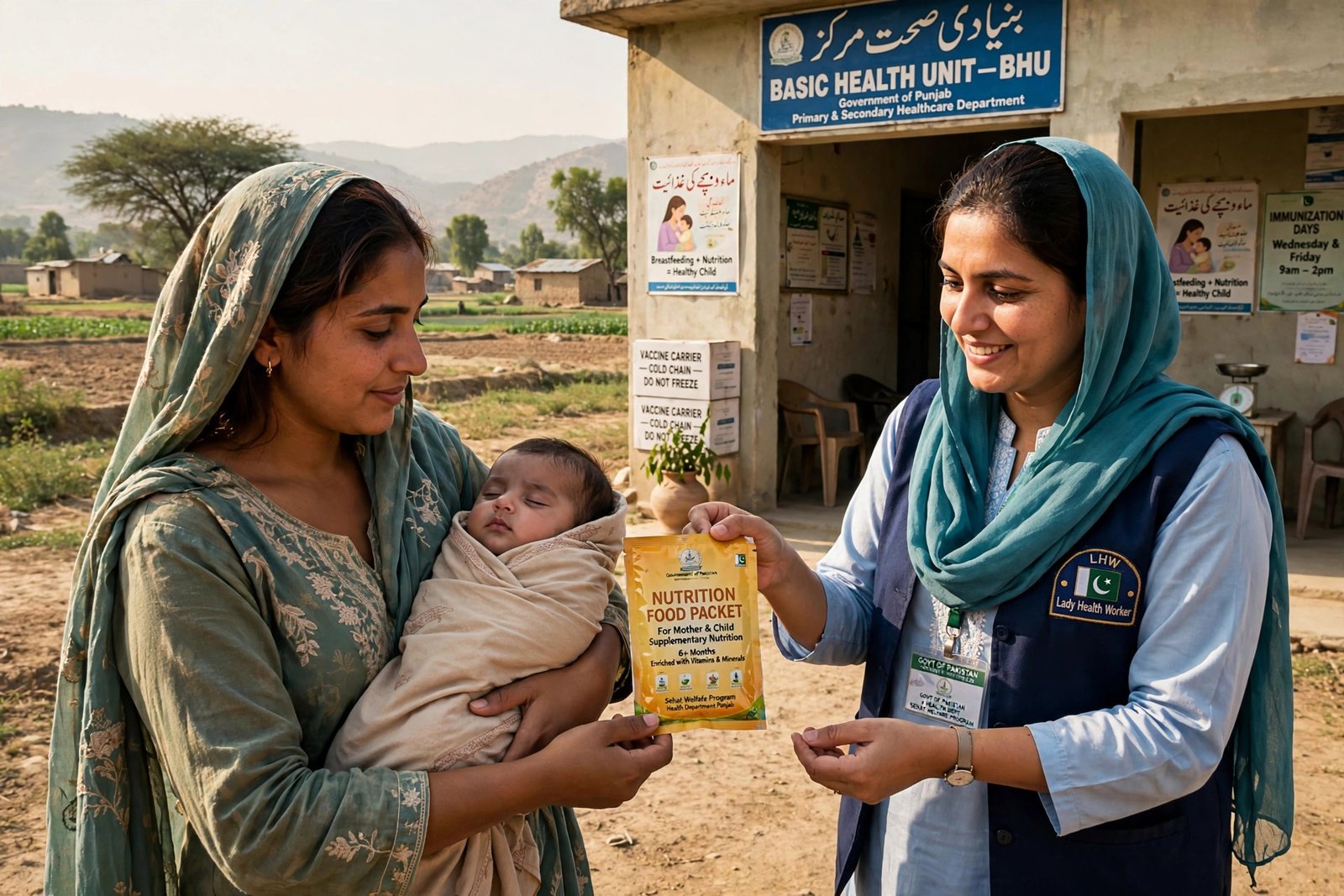
BISP Nashonuma Program 2026 – Nutrition Support for Mothers & Children
The first 1,000 days of a child’s life — from conception to the second birthday — decide more about their future health and brain development than any other period. The BISP Nashonuma Program 2026 exists for exactly this window: quarterly cash assistance plus specialized nutrition food for pregnant women, breastfeeding mothers, and children under two in Pakistan’s poorest households.
If your family is already enrolled in BISP, this program is separate money on top of your regular Kafalat installment — and many eligible mothers have never heard of it. This guide covers who qualifies, what you actually receive, and how to register.
What Nashonuma Actually Is
Nashonuma — the word means “nurturing” or “growth” — is BISP’s conditional nutrition program, run with the Ministry of Poverty Alleviation and Social Safety and health partners. It tackles child stunting and maternal malnutrition, two problems Pakistan has struggled with for decades.
The design is deliberate: instead of just handing out cash, the program pairs money with nutrition. Enrolled mothers and children receive specialized nutrition food sachets alongside the quarterly cash transfer, and the cash itself is conditional — it keeps flowing only if the family follows the required health checkups and the child follows the routine immunization schedule.
This is worth understanding because it shapes everything about the program. Nashonuma is not a second Kafalat payment you collect passively. It is a health program that happens to pay you for participating in it properly.
Who Qualifies
Eligibility is narrower than the main BISP program, and every condition is checked:
- The household must already be registered under BISP Kafalat. Nashonuma is a top-up for existing beneficiaries, not a standalone program. If you are not in the BISP system, you cannot enter Nashonuma directly.
- Pregnant women in BISP beneficiary households.
- Lactating (breastfeeding) mothers in BISP beneficiary households.
- Children aged 6 to 23 months in eligible families.
- Valid CNIC of the mother, registered with NADRA.
The program prioritizes the most vulnerable families within the BISP pool. If you are a BISP beneficiary and currently pregnant or nursing, you are the exact person this was built for.
What You Receive: The Benefits Table
| Beneficiary | Quarterly cash | Notes |
|---|---|---|
| Pregnant woman | Rs. 2,500 | Per quarter during pregnancy |
| Lactating mother | Rs. 2,500 | Per quarter while breastfeeding |
| Boy child (under 2) | Rs. 2,500 | Includes Rs. 500 travel allowance |
| Girl child (under 2) | Rs. 3,000 | Includes Rs. 500 travel allowance |
On top of the cash, enrolled mothers and children receive specialized nutrition food — nutrient-dense sachets designed to fill the specific deficiencies common in low-income Pakistani diets. Women and children collect these from the Nashonuma centers along with their health checkups.
A few honest notes on the money. These are quarterly figures, not monthly — Rs. 2,500 every three months works out to a modest supplement, not a livelihood. But combined with the nutrition food and free health monitoring, the package addresses the exact gaps — calories, micronutrients, antenatal care — that drive stunting. And crucially, this is separate from and additional to the regular Rs. 14,500 Kafalat installment.
How to Register: In Person Only
Here is the part that trips people up: there is no online registration for Nashonuma. Any website or WhatsApp message offering “Nashonuma online apply” is a scam. Verification is deliberately physical, because a doctor needs to confirm the pregnancy and assess the child.
The actual process:
- Visit the Nashonuma Center at your nearest Tehsil Headquarters (THQ) or District Headquarters (DHQ) hospital. Ask at the hospital’s information desk for the Nashonuma registration counter.
- Bring your original CNIC, the child’s NADRA B-Form, and the child’s immunization (EPI) card. For pregnant women, any available pregnancy medical record helps.
- A doctor verifies eligibility — confirming the pregnancy or the child’s age and health status. If the medical criteria are not met, the application is marked ineligible at the counter itself.
- Once approved, you start receiving the nutrition food packages and are enrolled for the quarterly cash transfers.
- You will typically receive a confirmation SMS from 8171 once registration is complete.
The medical screening is not bureaucracy for its own sake. The program needs to know the pregnancy is real and the child’s age is accurate, because the entire benefit structure — which sachets, how much cash, for how long — depends on it.
The Compliance Catch (Read This Before You Celebrate)
Now for the condition most summaries bury: the cash does not flow automatically after registration. Nashonuma is a conditional cash transfer, and the conditions are specific.
Pregnant and lactating women must attend their scheduled antenatal and postnatal checkups. Children must follow the routine immunization schedule on their EPI card. And at least 90% of the provided nutrition food must actually be consumed — compliance is monitored before each quarterly payment is released.
This is the program’s core bargain, so let’s be plain about it: if you register and then skip the checkups, the payments stop. The conditions are the point, not the fine print. Families who treat the hospital visits as part of the deal — free checkups, free nutrition food, plus cash — get the full value. Families who see only the cash usually lose it within a quarter or two.
Why In-Person Registration Is Actually Good News
It is tempting to wish this could be done from a phone. But consider what the in-person requirement prevents: ghost beneficiaries, age fraud, and the middlemen who plague purely digital enrollments. The doctor’s verification means the money reaches real pregnant women and real children under two.
It also means your first visit doubles as a free health screening. For many mothers in remote areas, the Nashonuma center visit is the first proper antenatal checkup they have ever had. The program’s designers understood something important: the journey to the hospital is itself part of the healthcare.
Nashonuma vs Regular Kafalat: What Is Different
It helps to see the two programs side by side, because confusion between them causes real problems — like mothers skipping Nashonuma registration because they assume their Kafalat enrollment covers it.
Kafalat is unconditional cash: once you qualify by PMT score, the Rs. 14,500 arrives every quarter with no further requirements beyond staying eligible. Nashonuma is conditional: smaller amounts, but tied to health behaviors — checkups attended, immunizations completed, nutrition food consumed. Kafalat covers the whole household’s poverty gap; Nashonuma targets one specific outcome, the health of mother and child in the first 1,000 days.
The practical takeaway: being in Kafalat does not enroll you in Nashonuma automatically. You must register separately at the hospital center, and you must keep meeting the health conditions. Think of Kafalat as the foundation and Nashonuma as the specialized layer built on top of it for the families who need it most.
BISP Nashonuma Program 2026: Quick Answers
Who qualifies for the BISP Nashonuma Program 2026? Pregnant and breastfeeding women, and children under two, from households already registered in BISP Kafalat. The BISP Nashonuma Program 2026 is not standalone — Kafalat registration comes first.
How much does the BISP Nashonuma Program 2026 pay? Rs. 2,500 per quarter for women and boys, Rs. 3,000 per quarter for girls, plus nutrition food packets. Every BISP Nashonuma Program 2026 payment is linked to health checkups and immunization.
Where do I register for the BISP Nashonuma Program 2026? In person at a Nashonuma Center in your district THQ or DHQ hospital, carrying your CNIC, the child’s B-Form, and the EPI vaccination card. There is no online registration for the BISP Nashonuma Program 2026.
Related Guides
- 8171 Web Portal 2026 – Check BISP Payment by CNIC
- BISP 8171 Complete Guide 2026 – Payments & Eligibility
- Asaan Karobar Finance Scheme 2026 – 0% SME Loans
Disclaimer: Benefit amounts, eligibility rules, and center locations can change with government announcements. Always verify current details on the official BISP channels — bisp.gov.pk, the 8171 SMS service, or the toll-free helpline 0800-26477 — or at your nearest Nashonuma Center before acting.

