
Solar Net Metering Pakistan 2026 changed completely on 9 February 2026, when NEPRA replaced the old net metering system with net billing. If you already have solar panels, or you are planning to install them, the new rules change what you are paid for the electricity you send to the grid. Under the old system, every unit you exported cancelled out one unit you imported. Under net billing, the two are priced separately: you pay your normal tariff for imports and are paid a much lower wholesale rate for exports. This guide explains the new rules, the buyback rate, and how to apply.
Quick Overview: Solar Net Metering Pakistan 2026
| Information | Details |
|---|---|
| Rules | NEPRA (Prosumer) Regulations 2026 — net billing (replaces net metering for new connections) |
| Responsible Department | National Electric Power Regulatory Authority (NEPRA); your local distribution company (DISCO) handles applications |
| Notification | SRO 251(I)/2026, notified 9 February 2026, effective the same day |
| What Changed | Unit-for-unit net metering ended for new connections; imports and exports are now priced separately |
| Export Buyback Rate (new) | National Average Energy Purchase Price (NAEPP), reported at about Rs 10–11 per unit at notification (figures differ by source — see rate section) |
| Export Rate (old agreements) | About Rs 25.32–27 per unit, kept only for valid agreements signed before 9 February 2026, until they expire |
| Import Tariff | Normal consumer tariff, reported at about Rs 37–55 per unit by slab, excluding taxes (Dawn, 10 February 2026) |
| Contract Length | 5 years for new agreements (was 7 years), renewable by mutual consent |
| System Size | 1 kW to 1 MW, not more than your sanctioned load |
| Registration Method | Application to your DISCO (LESCO, IESCO, K-Electric, MEPCO, FESCO, GEPCO, PESCO, HESCO, SEPCO or QESCO) |
| Required Documents | Valid CNIC, latest paid electricity bill, property/connection documents, panel and inverter details — see Documents section |
| Official Website | https://www.nepra.org.pk |
| Last Updated | 8 November 2026 |
Latest Update: Solar Net Metering to Net Billing 2026
On 9 February 2026, NEPRA notified the Prosumer Regulations 2026 (SRO 251(I)/2026). Dawn reported on 10 February 2026 that it took immediate effect and repealed the 2015 Net Metering Regulations, so new connections are approved under net billing only. Senators objected on 11 February 2026, because it at first also changed existing users’ terms, cutting their buyback from about Rs 27 per unit to less than Rs 10.
That first version did not last. After industry objections and the Prime Minister’s intervention, NEPRA issued an amendment on 2 April 2026 — SRO 547(I)/2026 — protecting people who had signed a valid agreement before 9 February 2026. They keep their old rate and billing method until expiry, retrospectively from 9 February 2026. Applications submitted up to 8 February 2026 are also processed under the old rules, per The Nation (3 April 2026).
Two more amendments followed. On 28 April 2026, SRO 709(I)/2026 set the NEPRA concurrence fee at nil up to 25 kW and Rs 1,000 per kW above that, backdated to 9 February 2026. On 6 August 2026, SRO 1330(I)/2026 removed the NEPRA concurrence step for systems of 25 kW or less — your DISCO now approves those itself. No further rule change was found as of 8 November 2026.
If you applied early in 2026, note the Power Division’s 25 August 2026 announcement that DISCOs and PITC must verify pending transition cases, especially demand notices paid before 9 February 2026. By 5 September 2026, 11,695 of 16,654 pending applications had been cleared.
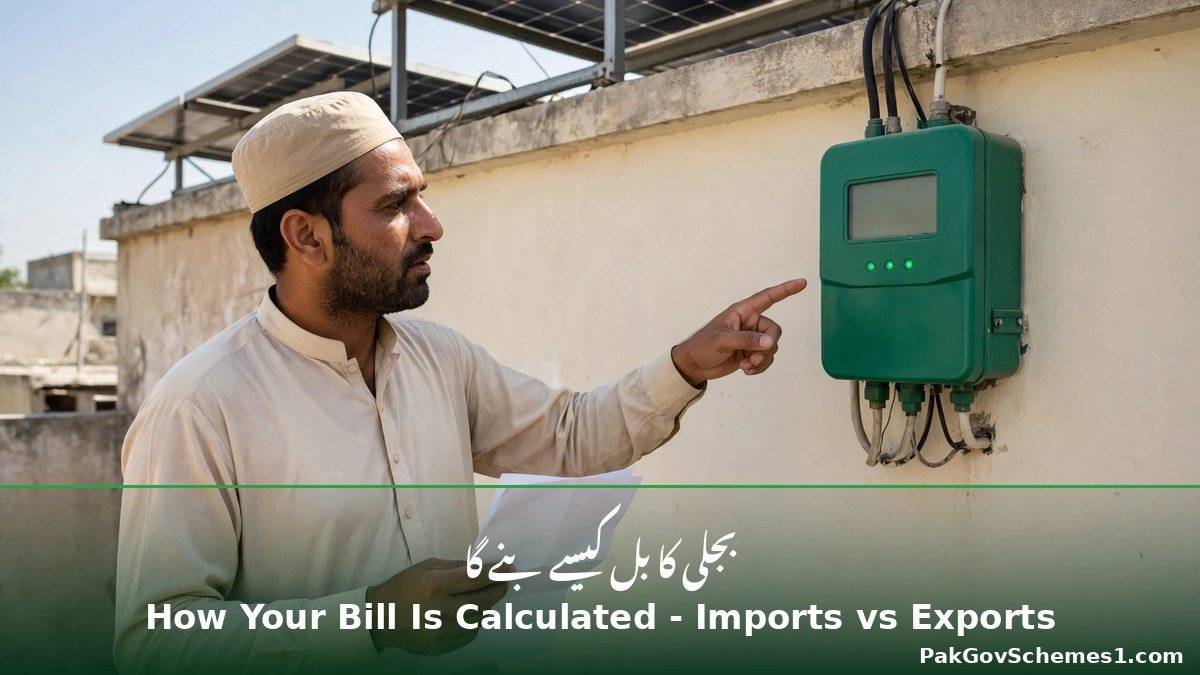
What Is Net Metering, and What Is Net Billing?
Net metering was the system Pakistan used from 2015. A bidirectional meter — often called a green meter — recorded both directions, and units you sent to the grid cancelled out units you took from the grid, one for one. If you exported 400 units and imported 500 in a month, you paid for only the difference. Extra units were bought at about Rs 25.32 to Rs 27 per unit.
Net billing, the system since 9 February 2026, ends that exchange. Imports and exports are priced separately: every unit you take from the grid is billed at your normal slab tariff (reported at about Rs 37 to Rs 55 per unit before taxes), and every unit you send to the grid is credited at the National Average Energy Purchase Price (NAEPP) — far lower than your retail tariff.
Under net billing, electricity you use yourself during the day is worth far more than electricity you export. A household running washing machines and water pumps in daylight saves much more than one exporting most of its generation and buying it back at night.

| Rule | Old Net Metering (2015 rules) | New Net Billing (from 9 February 2026) |
|---|---|---|
| How units are settled | Exported units offset imported units one for one | Imports billed at normal tariff; exports credited separately at NAEPP |
| Exported unit worth | About Rs 25.32–27 per unit | About Rs 10–11 per unit (reported range Rs 8–11 — see below) |
| Imported unit cost | Only the net difference was billed | Every imported unit billed at Rs 37–55 per unit by slab, excluding taxes |
| Agreement term | 7 years | 5 years, renewable by mutual consent |
| Surplus credit | Credited to the bill (credit period was 3 months) | Carried to the next 30-day bill or paid quarterly |
| Concurrence fee | None reported | Nil up to 25 kW; Rs 1,000 per kW above 25 kW (one-time NEPRA fee) |
| Approval (up to 25 kW) | Through NEPRA/DISCO process | By your DISCO directly since 6 August 2026 |
The Buyback Rate: Why You See Different Figures
If you search for the new buyback rate, you will find two figures quoted with equal confidence: about Rs 8.13 per unit, and about Rs 10 to Rs 11 per unit. Both come from the same benchmark.
The regulations do not print a rupee figure. They link exports to the NAEPP, which NEPRA can revise by notification at any time during your agreement. When the rules were notified in February 2026, newspapers reported the export rate at about Rs 10 to Rs 11 per unit — Dawn put it at Rs 11 for new prosumers — against about Rs 26 under the old contracts. IESCO’s circular of 25 February 2026 put the NAEPP figure at Rs 8.13 per unit, and NEPRA’s own 2026 forecast was also near Rs 8.13.
The rate that applies to you is the one printed on your own DISCO bill, and it can change. What matters is the gap: you buy at roughly Rs 37 to Rs 55 per unit and sell at roughly Rs 8 to Rs 11.
Example: importing 500 units at Rs 50 and exporting 400 at Rs 10 costs about Rs 5,000 under old net metering (only the 100-unit difference), but about Rs 21,000 under net billing (Rs 25,000 minus Rs 4,000 credit, before taxes). Illustrative figures only.
Who Keeps the Old Net Metering Terms?
This is the question most existing solar owners ask. Here is the position as verified on 8 November 2026.
- Valid agreement signed before 9 February 2026: You keep the old rate and the old billing method until your agreement expires, under SRO 547(I)/2026 (2 April 2026), retrospective to 9 February 2026. When the agreement ends, renewal is under the new net billing rules.
- Application submitted up to 8 February 2026: The Nation reported that NEPRA directed DISCOs to process these under the previous regulations, but verification was still ongoing in September 2026 — confirm your individual status with your DISCO.
- New application on or after 9 February 2026: Net billing only, on a five-year agreement.
- Material modification: If you change your system so its maximum electrical output changes — for example, adding more panels or fitting a bigger inverter — the old-terms protection ends. Get written confirmation from your DISCO before accepting any expansion quotation.
- Renewal after expiry: Once a protected agreement ends, it moves to net billing. The protection lasts for the life of the agreement, not forever.
One claim circulating online is false: the August 2026 amendment (SRO 1330) did not restore net metering for small new systems — it only changed who approves systems of 25 kW or less.
Who Can Apply? Eligibility Criteria
Net billing is not a subsidy scheme and it applies across Pakistan wherever your DISCO operates, including K-Electric. The points below come from the regulations as reported by specialist guides; your DISCO’s own form is the final authority.
- An existing electricity connection: You must already be a consumer of a DISCO. The applicant is reported to be a three-phase 400V or 11kV consumer — domestic, commercial, industrial, agricultural, general services or bulk supply. With only a single-phase connection, ask your DISCO whether a three-phase connection is needed first.
- Sanctioned load limit: Your system cannot be bigger than your sanctioned load; the maximum size under the regulations is 1 MW.
- Transformer capacity: Your DISCO may refuse if solar on your local transformer has reached 80 percent of its rated capacity. If so, it must give reasons.
- System size and studies: Systems of 250 kW or more need a load-flow study. Above 25 kW you need NEPRA concurrence and pay Rs 1,000 per kW once; systems of 25 kW or less are approved by your DISCO, with no NEPRA fee, since 6 August 2026.
- Certified equipment and installer: Panels and inverters must meet the technical standards in the regulations, and installer certification is still required.
- No income or poverty test: Unlike BISP, there is no PMT score or income limit.
How to Apply for Net Billing: Step by Step
Applications go through your DISCO, not NEPRA directly (except above 25 kW, where the DISCO forwards the case to NEPRA). The regulations set a deadline for each step, in working days; real timelines can be longer if documents are missing.
- Get the application documents. Ask your DISCO for the forms, provided free within 2 working days. Some DISCOs, such as LESCO, run an online net billing portal; others take applications at the subdivision office.
- Choose a certified installer and finalise your system size. Size it to your daytime usage, not to the maximum your roof can hold, because exports now earn far less than imports cost.
- Submit the application. File the form with your CNIC, a recent paid bill in the applicant’s name, property documents, and the technical details (panel and inverter datasheets, single-line diagram). The DISCO must acknowledge receipt within 5 working days.
- Technical review. The DISCO completes its review within 15 working days, checking transformer capacity and sanctioned load. If the connection is not feasible, it must give reasons within 3 days.
- Sign the agreement. You and the DISCO sign the standard interconnection agreement within 7 working days of approval. New agreements run for 5 years, renewable by mutual consent.
- Pay the connection charges. The DISCO issues the connection charge estimate (demand notice), including metering costs, within 7 working days. You pay within 7 working days. Exact charges vary by DISCO and were not verified from an official price list.
- Meter installation and commissioning. The DISCO installs the interconnection and the bidirectional meter within 15 working days of payment. In some areas, including LESCO, the old green meter has been replaced by an AMI smart meter.
- Systems above 25 kW only: NEPRA concurrence. The DISCO forwards your case to NEPRA, which can decide within 7 working days, for a one-time fee of Rs 1,000 per kW. You must start generating within six months of concurrence, or a fresh one is needed.
- Start generating and check your first bill. Net billing starts after approval and commissioning. Read your first bill carefully: imports and exports should appear as separate lines.

How to Check Your Application and Bill Status
There is no 8171-style SMS check and no single national portal for net billing — your status is held by your own DISCO. First, check your bill: under net billing it should show imported and exported units as separate lines, with the export credit at the NAEPP rate. If it shows a single net figure, or no export credit, your system may not yet be commissioned.
Second, use your DISCO’s own channel. LESCO reported in June 2026 that applications after 9 February go through its Net Billing Portal; others may still use the subdivision office. Existing users should check their agreement’s date: signed before 9 February 2026, you should be billed under the old rate until expiry, under SRO 547(I)/2026.
Never share your CNIC number, reference number, password or OTP with anyone who messages you offering to check your status or speed up your approval. DISCOs do not ask for these details through WhatsApp or Facebook.
Payment and Bill Details: How Net Billing Works on Your Bill
| Detail | Verified Information |
|---|---|
| Import charge | Every imported unit billed at your normal applicable tariff — reported at about Rs 37–55 per unit by slab, excluding taxes (Dawn, 10 February 2026) |
| Export credit (new) | National Average Energy Purchase Price (NAEPP) — reported at about Rs 10–11 per unit at notification; IESCO circular / NEPRA 2026 forecast put it at Rs 8.13. NEPRA can revise it at any time. |
| Export credit (old agreements) | About Rs 25.32–27 per unit under the old mechanism, until the agreement expires (SRO 547(I)/2026) |
| Billing cycle | 30-day billing cycle; imports and exports calculated separately each cycle |
| Surplus credit | If export credit is larger than the import charge, the extra is carried to the next bill or paid quarterly (reported) |
| Payment schedule | Monthly bill as normal; no separate payment date for solar exports |
| Payment status check | On your DISCO bill (separate import/export lines) or through your DISCO’s portal or office |
| Agreement term | 5 years for new agreements; old agreements keep their original term until expiry |
The most important number on your bill is the difference between what you pay and what you earn. At roughly Rs 50 to buy and roughly Rs 10 to sell, every unit you use yourself during the day saves you about Rs 50, while every unit you export earns only about Rs 10. That is why installers now recommend smaller systems matched to daytime use, with heavy appliances run in daylight hours.

One warning about payback claims: any installer who promises a fixed payback period is guessing. Payback depends on your system size, daytime usage, tariff slab and the export rate on your bill. Ask for the calculation in writing before you sign.

Required Documents
Your DISCO may ask for more, and its own form is the one that counts. These are the documents reported as standard.
- Valid CNIC — of the applicant, in whose name the electricity connection stands.
- Latest paid electricity bill — in the applicant’s name, showing the reference number and sanctioned load.
- Property or connection documents — proof of ownership or lawful occupation, as your DISCO requires.
- Panel and inverter details — technical datasheets, inverter serial number and manufacturer, and a single-line diagram of the proposed system.
- Equipment test reports — as required by the DISCO for the panels and inverter you have chosen.
- Registered mobile number — for application updates from the DISCO.
- Load-flow study — only for systems of 250 kW or more.
- NEPRA concurrence documents — only for systems above 25 kW, forwarded by the DISCO.
Troubleshooting: Common Problems and What to Do
Your application was refused because the transformer is full
Your DISCO may refuse if solar on your local transformer has reached 80 percent of its rated capacity. Ask for the refusal in writing, and whether a smaller system would be accepted. Do not pay anyone who promises to “clear” a refusal for a fee.
Your bill shows no export credit
Check first whether your bidirectional meter has actually been installed and commissioned. If the meter is still your old one-way meter, exports are not being recorded at all. If it is installed but no credit appears, take the bill to your subdivision office with your agreement and ask for correction in writing.
Your bill suddenly switched to the lower export rate
If you hold a valid agreement signed before 9 February 2026, SRO 547(I)/2026 says you keep the old rate and mechanism until expiry. Show the DISCO your agreement and ask for the billing to be corrected. Keep copies of every bill and written reply.
Your application has been pending for months
Pending transition cases were still being verified in September 2026 — 4,959 of 16,654 reported pending. Visit your subdivision office with your application number and ask for the current stage in writing.


Official Helpline and Complaint Procedure
No NEPRA helpline number specifically for prosumers could be verified during this research, so no number is given here. Do not trust helpline numbers posted in Facebook comments, WhatsApp groups or installer adverts.
The verified routes are these. First, your DISCO’s customer service centre or subdivision office, with your reference number and a written complaint — billing errors, meter problems and application delays must be raised there first. Second, NEPRA itself: its website is nepra.org.pk, and its “NEPRA Asaan Approach” app registers and tracks electricity complaints.
Common Mistakes to Avoid
- Believing net metering still exists for new systems: It does not. New applications since 9 February 2026 are on net billing, at the NAEPP rate.
- Trusting a single buyback figure: Sources report Rs 8.13 and Rs 10–11 for the same benchmark, and NEPRA can revise it. Check your own bill.
- Buying an oversized system: Exports earn roughly a fifth of what imports cost. Size the system to your daytime use, not to your roof.
- Expanding a protected old system without advice: A material modification that changes maximum output ends your old-terms protection under SRO 547(I)/2026. Get written confirmation first.
- Paying an agent for approval: Applications go through your DISCO, with forms provided free. No agent can speed up approval.
- Using uncertified equipment or installers: Check certification before you pay.
- Signing without a written payback calculation: If the installer will not put the import tariff, export rate and expected generation in writing, do not sign.
- Sharing CNIC, OTP or bill photos with strangers: Never send these to anyone on WhatsApp or Facebook who offers to check your status.

Frequently Asked Questions
What is solar net metering in Pakistan in 2026?
Net metering was the old system, in place from 2015, where exported units cancelled out imported units one for one. On 9 February 2026, NEPRA replaced it with net billing under the Prosumer Regulations 2026 (SRO 251(I)/2026). New connections are now on net billing only, while valid agreements signed before that date keep the old terms until they expire.
What is the new solar buyback rate in Pakistan?
New prosumers are paid the National Average Energy Purchase Price (NAEPP) for exported units. At notification in February 2026 this was reported at about Rs 10–11 per unit, while IESCO’s circular and NEPRA’s 2026 forecast put it at Rs 8.13. NEPRA can revise it, so the rate on your own DISCO bill is the one that applies to you.
Is net metering banned in Pakistan?
No, it was replaced, not banned outright. New connections since 9 February 2026 use net billing instead. Households with a valid net metering agreement signed before that date keep their old rate and billing method until the agreement expires, under the April 2026 amendment SRO 547(I)/2026.
Do old solar users keep the Rs 26 per unit rate?
Yes, if they hold a valid agreement executed before 9 February 2026. SRO 547(I)/2026, retrospective to 9 February, preserves the old rate and mechanism until the agreement’s term ends. The protection ends early if you materially modify the system so its maximum output changes, and renewal after expiry is under net billing.
How do I apply for net billing in Pakistan?
Apply to your local DISCO — LESCO, IESCO, K-Electric, MEPCO, FESCO, GEPCO, PESCO, HESCO, SEPCO or QESCO — with your CNIC, latest paid bill, property documents and your installer’s panel, inverter and single-line diagram details. The DISCO reviews the application, you sign a five-year agreement, pay the connection charges, and the DISCO installs the bidirectional meter.
What is the maximum solar system size allowed?
Systems from 1 kW to 1 MW are covered, but your system cannot exceed your sanctioned load. Systems of 25 kW or less are approved by your DISCO with no NEPRA fee since August 2026. Above 25 kW you need NEPRA concurrence and a one-time fee of Rs 1,000 per kW.
How long does net billing approval take?
The regulations set working-day deadlines: forms within 2 days, acknowledgement within 5 days, technical review within 15 days, agreement within 7 days, estimate within 7 days, payment within 7 days, and meter installation within 15 days of payment. In practice it can take longer if documents are missing, a site visit is needed, or your local transformer is at capacity.

Is solar still worth it under net billing?
It can be, but the maths has changed. You now save most by using your own solar power during the day, when each self-used unit replaces a grid unit costing about Rs 37–55. Exporting earns only about Rs 8–11 per unit. A system sized to your daytime usage pays back far faster than an oversized export-focused one.
Can I add more panels to my existing solar system?
You can, but be careful. If you hold a protected pre-February 2026 agreement, a material modification that changes your system’s maximum output ends the old-terms protection under SRO 547(I)/2026, and the whole system moves to net billing. Get your DISCO’s written confirmation of the billing treatment before accepting any expansion quotation.
Where can I complain about a wrong solar bill?
First, take the bill to your DISCO’s customer service centre or subdivision office with your agreement and reference number, and ask for a written correction. You can also register and track electricity complaints through NEPRA’s Asaan Approach mobile app or through nepra.org.pk. Keep copies of every bill, agreement and written reply for your record.
Important Safety Notice
Use only your DISCO’s official office or portal and NEPRA’s website (nepra.org.pk) for applications and complaints. Never share your CNIC image, password, OTP or bill photographs with unknown individuals on WhatsApp, Facebook or phone calls, and never pay an agent who promises guaranteed approval or the old rate for a new system. PakGovSchemes1.com is an independent informational website, not affiliated with NEPRA or any electricity distribution company.
Conclusion
Solar Net Metering Pakistan 2026 is now, for every new applicant, net billing: imports charged at your normal tariff of about Rs 37–55 per unit, exports credited at the NAEPP rate of about Rs 8–11 per unit, on a five-year agreement, with systems of 25 kW or less approved directly by your DISCO. The one exception is the protection for valid agreements signed before 9 February 2026, which keep the old rate until they expire — unless you materially expand the system. Before spending money on solar, check your sanctioned load and size the system to your daytime use.
Official Sources
- Official — NEPRA: https://www.nepra.org.pk (homepage checked 8 November 2026; live, with the NEPRA Asaan Approach complaints app. The SRO 251(I)/2026 text was not read directly from the site in this session — see research note.)
- News — Dawn, 10 February 2026: “Nepra pulls the plug on net-metering” — https://epaper.dawn.com/DetailImage.php?StoryImage=10_02_2026_001_004 (SRO 251(I)/2026, 9 February 2026; new exports ~Rs 11/unit vs Rs 26 old; imports Rs 37–55/unit; 1 kW–1 MW; 5-year contracts)
- News — Dawn, 16 February 2026: “A net-metering nightmare” — https://www.dawn.com/news/1973616 (existing contracts shift to net billing; export credit period cut from 3 months to 1 month; NAEPP ~Rs 10/unit)
- News — Dawn, 11 February 2026: “Senators livid as govt ‘backtracks’ on solar incentives” — https://epaper.dawn.com/DetailImage.php?StoryImage=11_02_2026_001_007 (buyback cut from Rs 27 to less than Rs 10)
- News — Business Recorder, 3 April 2026: “Nepra ensures existing net metering rates to continue” — https://epaper.brecorder.com/2026/04/03/1-page/1096453-news.html (SRO 547(I)/2026 text: old rate and mechanism until expiry; material-modification exception; retrospective to 9 February 2026)
- News — The Nation, 3 April 2026: “Reversing earlier decisions, Nepra exempts pre-Feb 9 prosumers from new regulations” — https://www.nation.com.pk/03-Apr-2026/reversing-earlier-decisions-nepra-exempts-pre-feb-9-prosumers-new-regulations (applications up to 8 February 2026 under old rules; 5,000+ pending applications, 250.822 MW)
- News — MM News, February 2026: “Pakistan ends net metering to protect strained power sector” — https://mmnews.tv/nepra-ends-net-metering-pakistan-2026/ (SRO 251(I)/2026; quarterly settlement of surplus; solar, wind and biogas up to 1 MW)
- Specialist guides (reported, citing NEPRA): ProSolarCalc (verified 20 July 2026 against nepra.org.pk; NAEPP ~Rs 11; 80% transformer cap; 250 kW+ load-flow study); Solar Citizen (updated 30 July 2026); SolarPanelMarket.pk (updated October 2026; SRO 547/1330); SolarNetMetering.pk (updated 21 September 2026; application deadlines; 3-phase applicant definition); PixerVoltic (October 2026; four SROs; Power Division 25 August 2026 announcement; 11,695 of 16,654 pending cases cleared); PakHisaab (updated 13 October 2026); BillHelp.pk (updated 19 October 2026)
Related Articles on PakGovSchemes1.com
- Punjab Solar Panel Scheme 2026 (Roshan Gharana) — Free Panels & How to Apply
- Solar Panel Financing Pakistan 2026 – Bank Options
- KP Solar Schemes 2026: Household Solarization and the PM Scheme for Merged Districts
- Sindh Free Solar Home Systems 2026: 275,000 Families to Get Free Solar Kits
- CM Punjab Green Credit Programme 2026: Earn Rewards for Eco-Friendly Actions
Disclaimer: PakGovSchemes1.com is an independent informational website and is not affiliated with any government department. Information is compiled from available official announcements and other identified sources and may change. Please verify eligibility, registration status, payment details, and deadlines through the relevant official government website before taking action.
Researched and written on 8 November 2026. The export (NAEPP) rate can be revised by NEPRA at any time — confirm the current figure on your own DISCO bill before making a decision.

