BISP Payment Schedule 2026 – Quarterly Phases & Expected Months
Four payments a year. That is the rhythm of the BISP payment schedule 2026 — one installment every quarter, Rs. 14,500 each time, released district by district rather than all at once. If you understand the rhythm, you stop panicking when your neighbor gets paid before you.
The confusion is understandable. BISP does not publish one fixed national pay-day. Payments roll out in phases across districts over several weeks, which means “when do I get paid” depends on where your district sits in the phase order. This guide explains the quarterly cycle, how the phases work, and how to know when your turn is coming.
The Four Quarters
BISP follows the calendar year in four quarters. Each quarter carries one Kafalat installment of Rs. 14,500 for eligible beneficiaries:
| Quarter | Period | Installment |
|---|---|---|
| Q1 | January – March | Rs. 14,500 |
| Q2 | April – June | Rs. 14,500 |
| Q3 | July – September | Rs. 14,500 |
| Q4 | October – December | Rs. 14,500 |
That is Rs. 58,000 across the full year for a continuously eligible household — the single largest cash transfer most beneficiary families receive.
A quick note on the amount, because older guides still show the wrong figure: the quarterly installment was raised from Rs. 13,500 to Rs. 14,500, a change widely reported in early 2026 including by ProPakistani in March 2026. If a shopkeeper, agent, or outdated website tells you the installment is Rs. 13,500, they are working from old information. Your full installment is Rs. 14,500.
Why Your District Gets Paid Later Than Others
Here is the part that causes most of the anxiety. When a quarter’s payments begin, BISP does not release every district on the same day. Payments go out in phases — early phases cover urban and higher-verification areas, mid-cycle phases add more districts, and the final phase covers the remaining areas.
This is deliberate. Releasing 9+ million payments at once would crash the biometric verification systems and create chaos at payment centers. Phasing spreads the load across several weeks so ATMs, retail agents, and camps can handle the volume.

So when your cousin in Lahore gets her installment and yours has not arrived in Rajanpur, nothing is wrong. Your district is simply in a later phase. The gap between the first and last district phases can stretch to several weeks within the same quarter.
What actually matters is your own status, not anyone else’s. Send your CNIC to 8171 or check 8171.bisp.gov.pk — if your payment shows as released, your phase has started. If it shows under verification or nothing yet, your district’s phase has not reached you. Either way, the installment does not expire: BISP holds unclaimed funds for up to six months, so a missed phase does not cancel your money as long as you stay eligible.
How to Know Your Phase Has Started
You might be wondering how to tell the difference between “my phase hasn’t started” and “something is wrong with my record.” Fair question — and the answer is the 8171 check.
Before your phase begins, the portal typically shows your eligibility status without payment details. Once your district’s phase rolls out and your installment is released, the status updates to show the payment. That change — from “eligible” to “payment released” — is your signal to visit the collection point.
The official 8171 SMS works the same way. BISP sends a payment notification to your registered mobile number when your installment is released. This is why keeping your registered SIM active and in your own name matters so much: beneficiaries who changed numbers without updating their BISP record miss the notification and travel to collection points blind.
One warning worth repeating: only trust messages from 8171 itself. Every payment quarter brings a wave of fake “your payment is ready, click here” messages from random numbers. Real BISP messages never contain links and never ask for your CNIC or OTP.
Collecting the Installment
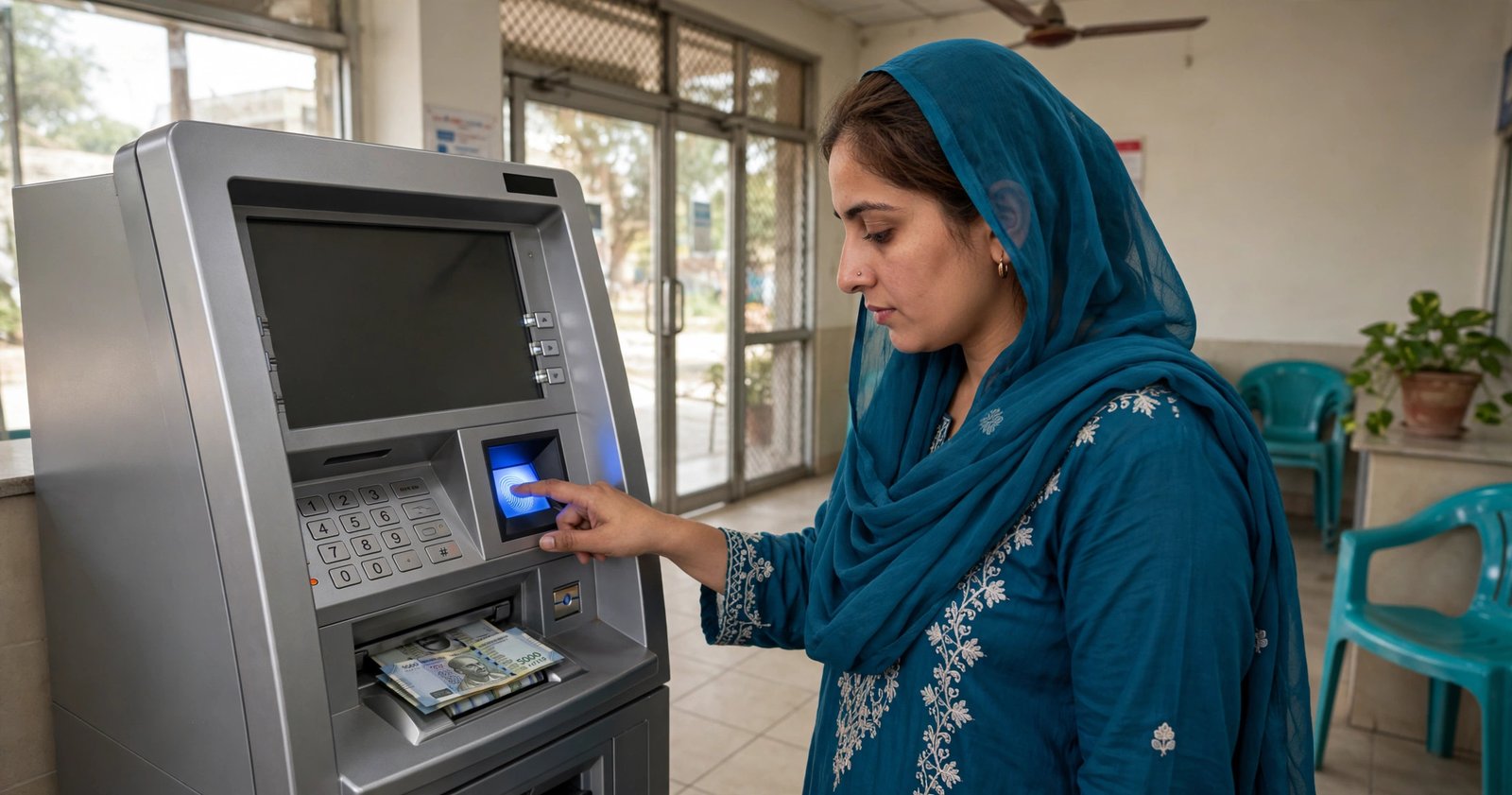
Once your payment shows as released, collect it through biometric verification — your thumbprint is your identity, and there is no BISP ATM card or PIN. The channels:
- Biometric-enabled ATMs of partner banks (HBL and Bank Alfalah)
- Bank retail agents (HBL Konnect and similar authorized agents)
- Designated BISP payment camps in remote areas
Bring your original CNIC. Count your full Rs. 14,500 before leaving the counter or ATM — every time. If an agent deducts even Rs. 100, that is illegal: report it immediately on the toll-free helpline 0800-26477 or at your nearest BISP Tehsil Office. The process is free from start to finish, and anyone demanding a fee is running a scam.
If your biometric verification fails at the machine, do not keep retrying at the same spot. Try another enabled ATM or visit a retail agent. Persistent failures usually mean your fingerprints need updating at NADRA — a free correction, not a reason to pay anyone.
One more timing question comes up every quarter: do the Taleemi Wazaif (education stipends for children) follow the same schedule? Broadly, yes — they ride on the same quarterly cycle as the Kafalat installment, since both are disbursed through the same BISP payment system. But the stipend amounts are separate and smaller, and they depend on the child’s school attendance record being verified. If your Kafalat installment arrives but the children’s stipend does not, the issue is usually attendance verification at the school level, not the payment phase — check with the school first, then the Tehsil Office.
What Can Delay Your Payment
Let’s be honest about the other side: sometimes the delay is not the phase order. A few things genuinely hold up installments.
An expired CNIC is the most common. If your card expired, renew it at NADRA first, then make sure BISP’s record reflects it — payments can stall silently on an expired card. A dead or changed mobile number means you miss the release SMS and the verification calls. A PMT score that changed after a re-survey can shift your eligibility. And biometric mismatches at collection time can bounce a payment back for re-verification.
The pattern here: every one of these is fixable, and every fix starts at either NADRA (for CNIC and fingerprints) or the BISP Tehsil Office (for records and complaints). None of them is fixed by paying a middleman. Anyone who offers to “release your stuck payment” for a fee is lying to you.
BISP Payment Schedule 2026: Quick Answers
How many payments does the BISP payment schedule 2026 include? Four quarterly installments of Rs. 14,500 — January–March, April–June, July–September, and October–December. The BISP payment schedule 2026 follows this cycle every year.
Why hasn’t my BISP payment schedule 2026 installment arrived yet? Payments release district by district in phases over several weeks. If your district is in a later phase, your BISP payment schedule 2026 installment is simply queued — check your status at 8171.bisp.gov.pk.

What if I miss a BISP payment schedule 2026 phase? Unclaimed installments are held for up to six months, so the BISP payment schedule 2026 does not punish you for collecting late — as long as your eligibility stays active.
Related Guides
- 8171 Web Portal 2026 – Check BISP Payment by CNIC
- BISP 8171 Complete Guide 2026 – Payments & Eligibility
- Asaan Karobar Finance Scheme 2026 – 0% SME Loans
Disclaimer: Phase timing and district order can shift with BISP’s operational announcements. Always verify your personal payment status on the official portal — 8171.bisp.gov.pk — or via SMS to 8171 before visiting a collection point.

