BISP PMT Score 2026 – How Your Eligibility Is Decided
Thirty-two. That is the number that decides whether a household receives Rs. 14,500 every quarter or nothing at all. The BISP PMT score — a single number between 0 and 100 — is the entire eligibility machinery of the Benazir Income Support Programme. No interview, no recommendation letter, no local official’s signature matters as much as this score.
Most beneficiaries have heard the term. Almost none understand it. Here is how it actually works.
What the Score Measures
PMT stands for Proxy Means Test. The idea is simple: directly measuring a household’s income in an economy where most work is informal is nearly impossible, so BISP measures the proxies of poverty instead — the observable facts of how a family lives.
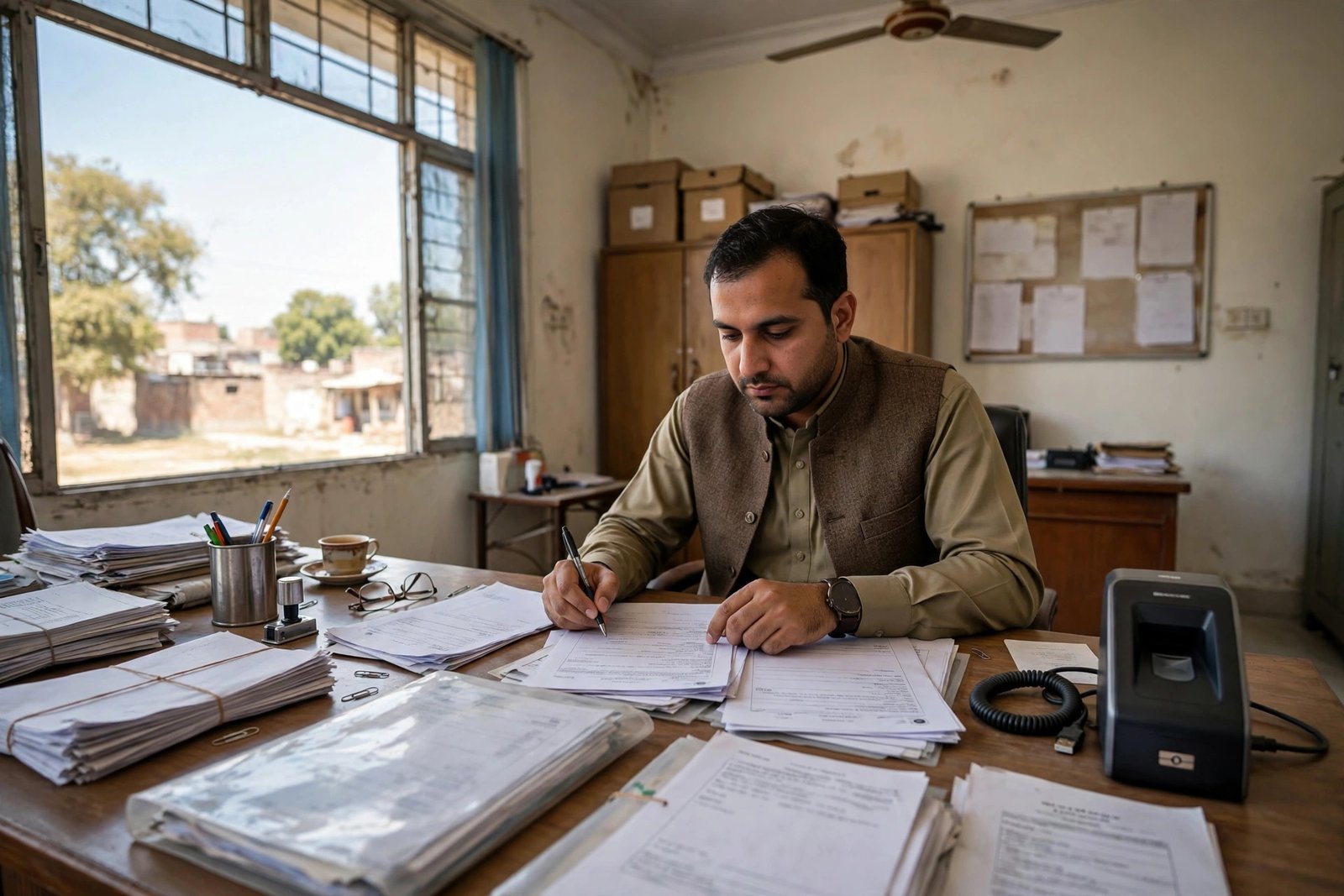
During the NSER survey, the officer records dozens of data points: household size and dependents, the education of the head, type of walls and roof, toilet facility, cooking fuel, ownership of a TV, fridge, motorcycle, or car, livestock, agricultural land, and employment type. Each answer feeds a statistical formula, and out comes the score.
Lower means poorer. A household scoring 10 lives in visibly harder conditions than one scoring 60. The formula does not care about your story, your connections, or how urgently you need help — it only reads the data. That coldness is the point: it is what keeps the selection fair across 40 million registered households.

The Cutoffs That Matter
| Household type | PMT cutoff | Meaning |
|---|---|---|
| General households | 32 or below | Qualifies for Benazir Kafalat |
| Household with a person with disability | 37 or below | Relaxed cutoff, disability certificate required |
Score 32 or below and the household qualifies. Score 33 and it does not — even if the difference came down to owning a slightly better roof. The line is absolute, which is why the survey answers matter so much.
For households that include a person with a disability, the cutoff relaxes to 37, recognizing the extra costs disability imposes. This requires a valid disability certificate presented during the survey.
You can see your own score on the 8171 web portal after entering your CNIC — it is displayed alongside your eligibility status. If you have never seen the number, check the portal. Knowing it changes how you think about every later step.
The Only Legitimate Way to Change It
Now the part that needs saying plainly, because an entire scam industry feeds on the opposite claim: nothing changes your BISP PMT score except a fresh survey with updated household information.
Not a phone call. Not a visit to a “BISP agent.” Not a fee paid to anyone, anywhere. No private person — no matter how confident, how well-connected they claim to be — can alter a PMT score. The score is computed from survey data inside BISP’s system, and the only input to that system is a new NSER Dynamic Survey at a Tehsil Office.
So when does a re-survey make sense? When the underlying facts genuinely changed: a death in the family, a new disability, lost employment, a sharp income drop, more dependents. Walk into the Tehsil Office, report the change honestly, and let the new data speak. If your circumstances have not changed, a re-survey will produce roughly the same score — and that is the system working as designed, not a malfunction.
Why People Get It Wrong
Three myths do the most damage.
Myth one: “My neighbor got in with a bigger house, so the system is rigged.” The PMT formula weighs many variables, and visible assets are only part of it. Household size, dependents, and education count heavily. A large joint family in a modest house can score lower than a small family in a slightly better one. The formula sees what eyes miss.

Myth two: “The office staff can adjust my score.” They cannot. Front-desk staff record survey answers; the score is computed centrally from that data. Anyone at or near an office offering to “adjust” it for cash is committing fraud — report them on 0800-26477.
Myth three: “A low score is permanent.” It is not. The Dynamic Survey exists precisely so scores track real life. Families fall into poverty and climb out of it; the registry is designed to move with them, in both directions.
A Worked Example: Two Households, Two Scores
Abstract formulas are hard to feel. So consider two real-shaped households — composites of the patterns survey officers see daily.
Household A: a widow with four children in a two-room mud house, no employed adult, one buffalo, no motorcycle, children in a government school. The formula reads: large dependent load, minimal assets, no steady income. Score: somewhere in the low 20s. Qualifies comfortably.
Household B: a couple with two children in a brick house, the husband drives a rickshaw he owns, they have a fridge and a motorcycle, one child in a private school. The formula reads: steady informal income, productive asset (the rickshaw), durable goods. Score: somewhere in the high 30s or 40s. Does not qualify — even though this family also struggles.

Neither outcome is a moral judgment. The formula rations a fixed budget to the poorest measurable households, and the rickshaw — an income-generating asset — counts heavily against household B. This is also why honest, complete answers matter: omitting the rickshaw would be fraud, but it is also the single fact most likely to move the score. Report it anyway. A score built on lies collapses the moment NADRA cross-checks catch it, and the disqualification that follows is worse than an honest rejection.
There is one more thing the number cannot tell you: it cannot tell you why, in plain language, your specific answers produced your specific score. BISP does not publish the formula’s weights — partly to prevent gaming. That opacity frustrates people, but consider the alternative: a published formula would be reverse-engineered within weeks, and survey answers would bend toward it. The black box is load-bearing.
BISP PMT Score: Quick Answers
What is the BISP PMT score? The BISP PMT score is a 0–100 poverty ranking computed from your NSER survey data — housing, assets, family size, income proxies. A lower BISP PMT score means poorer, and 32 or below qualifies for Kafalat.
What is the cutoff for the BISP PMT score in 2026? 32 or below for general households, 37 or below where a household member has a disability. If your BISP PMT score is above the cutoff, the household is marked not eligible.

Can I check my BISP PMT score online? Yes — enter your CNIC on the 8171 web portal and the BISP PMT score shows with your eligibility status. Anyone offering to “fix” your BISP PMT score for a fee is scamming you.
Related Guides
- 8171 Web Portal 2026 – Check BISP Payment by CNIC
- BISP 8171 Complete Guide 2026 – Payments & Eligibility
- Asaan Karobar Finance Scheme 2026 – 0% SME Loans
Disclaimer: PMT cutoffs and scoring methodology can change with BISP policy updates. Always verify current thresholds on bisp.gov.pk or the toll-free helpline 0800-26477.

