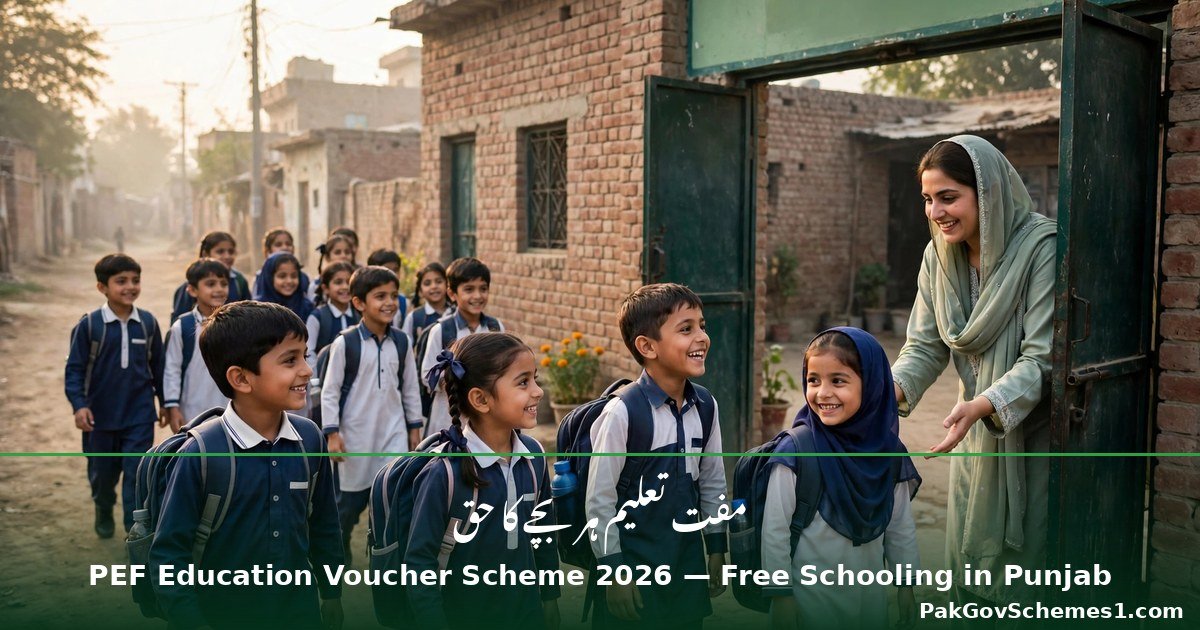
PEF Education Voucher Scheme 2026 is the Punjab Education Foundation’s programme that pays a private school’s fee so that a poor child can study free of cost. Instead of giving cash to parents, the foundation gives the child a voucher, and the chosen partner school claims the fee from PEF every month. This guide explains what the Education Voucher Scheme (EVS) is, who qualifies, how much PEF pays per child, how parents apply, and how EVS differs from PEF’s other programmes. All key facts come from the official PEF website, and anything unverified is marked clearly.
Quick Overview: PEF Education Voucher Scheme 2026
| Information | Details |
|---|---|
| Program Name | Education Voucher Scheme (EVS) |
| Responsible Department | Punjab Education Foundation (PEF), Government of Punjab |
| Program Purpose | Free education for poor and out-of-school children in private partner schools |
| Launched | 2006 (pilot in Sukh Nehar, Lahore) |
| Coverage | All 36 districts of Punjab (16 phases, per PEF) |
| Scale | Approximately 0.5 million children in more than 1,780 EVS partner schools (PEF overview page; figure is dated, not a 2026 count) |
| Eligible Beneficiaries | Children from poor, less affluent families in underprivileged areas, including out-of-school and dropout children |
| Voucher Value | Rs 550 primary, Rs 600 elementary, Rs 900 secondary arts, Rs 1,100 secondary science — per student, per month, paid to the school |
| Cash to Parents | No — PEF pays the partner school directly; parents pay no fee |
| Registration Status | No online parent application portal verified; registration through partner-school nomination and household survey |
| Application Deadline | Not officially announced for 2026 |
| Official Website | pef.edu.pk |
| Last Updated | 10 November 2026 |
Latest Update on PEF Education Voucher Scheme (November 2026)
The scheme is still running in FY 2026-27. The clearest proof is on PEF’s own tenders page: a tender for printing EVS voucher cards for FY 2026-2027 was published on 3 November 2026 and is now closed. Voucher cards are only printed while the scheme is active, so parents can be confident EVS has not been closed or merged into another programme.
No new EVS phase opening for 2026 could be verified. The PEF overview page records 16 phases across all 36 districts, but it does not date the latest phase, and no Phase 17 advertisement or last date was found on pef.edu.pk or in reputable news as of 10 November 2026. Parents should not trust social media posts claiming a new EVS registration date. In May 2026, Education Minister Rana Sikandar Hayat said enrolment across all PEF programmes had crossed 4 million — a figure covering every PEF programme together, not EVS alone. For how PEF’s newest school programme works, read our guide to the Nawaz Sharif Schools of Eminence 2026.
What Is the PEF Education Voucher Scheme?

The Education Voucher Scheme began in 2006, after PEF was restructured in 2004 to promote quality education through public-private partnerships. It started as a pilot in the urban slums of Sukh Nehar in Lahore, where survey teams found whole households living below the poverty line. The idea has not changed since: instead of building a new government school in every poor neighbourhood, PEF gives a poor family a voucher that pays the fee at an existing low-cost private school nearby.
The voucher works like a coupon for schooling. PEF registers an eligible child in its EVS database after NADRA verification and issues a voucher card for that child. The parent takes the card to an EVS partner school of their choice, and the child is admitted free of cost. The school then claims the monthly fee from PEF. One voucher is valid for only one student, and only at EVS partner schools — but at any EVS partner school, not just the one that nominated the child. PEF also provides free Punjab textbooks every year, and the school cannot charge the child for anything else: no admission charges, fines, stationery or photocopy charges, class tour charges, or leaving certificate or registration fees.
Who Is Eligible for the PEF Education Voucher Scheme?

EVS is a targeted programme, not a universal one. It is meant for children from poor and less affluent families in underprivileged areas — the slums and katchi abadis where PEF began, and the backward union councils the scheme later reached. The official PEF pages describe the target group in those words, and they do not publish a rupee income limit or a PMT poverty score for EVS, so parents should not believe any website that quotes an exact income threshold.

EVS is designed for out-of-school children who never attended school, dropout children who left because the family could not afford the fee, and children from deserving households identified in an area survey, including orphans and children of widows and single parents. The child must live in Punjab, in an area covered by an EVS partner school, and must be verified against NADRA records through the child’s B-Form. On age, the current PEF EVS pages publish no single age band; expansion announcements reported in Dawn in 2015 described the age group as 6 to 16 years, so confirm the age accepted in your district’s survey round with the partner school. PEF research found that missing B-Forms were the greatest barrier to enrolment for poor households, so getting the B-Form made is the most useful first step. Our guide to the NADRA birth certificate and child registration process explains how the underlying record is created. For older students, see the PEEF Scholarship 2026 guide.
How to Apply for the PEF Education Voucher Scheme: Step by Step

Parents cannot apply for EVS through an online form, because no verified online application portal for parents exists on pef.edu.pk. Any website or Facebook page offering an “EVS online apply” link is not using an official PEF facility. Registration happens through the three routes published in the official PEF FAQ.
- Find your nearest EVS partner school. Look for the PEF board displayed outside the school’s main gate.
- Visit the school with your child’s B-Form and your CNIC. Ask to register your child under EVS; the school can nominate eligible children to PEF.
- Wait for the household survey if your area is being surveyed. PEF teams conduct household surveys, and PEF also outsources surveys to a third party. Give correct information — a wrong address or age can delay registration.
- Complete NADRA verification. PEF verifies the child against NADRA records using the B-Form. If details do not match, get the record corrected at NADRA first.
- Receive the voucher card from PEF. Cards are distributed by PEF to parents and guardians. Keep the card safe — it belongs to one named child and cannot be transferred.
- Submit the voucher at the EVS partner school of your choice. You are not bound to the school that nominated your child. The child is admitted free of cost.
- Keep the child attending regularly. PEF monitors enrolment every month, and the school claims payment only for children who are enrolled and attending.
There is no application fee at any stage. PEF does not charge parents for registration, the voucher card, or admission, and no agent can speed up the process for money.
How to Check Your EVS Voucher and Enrolment Status
There is no SMS code and no public online portal for parents to check EVS voucher status. Many search results mix EVS up with BISP’s 8171 SMS service, but EVS has no 8171-style check, and sending your child’s details to any number found on social media will not give you a real status.
Check through the partner school instead. The school updates student records in PEF’s Student Information System (SIS), and it can tell you whether your child’s record is registered, verified, or still pending. If the school cannot give a clear answer, contact the PEF office for your district through pef.edu.pk, with the child’s B-Form number and the voucher card number if one has been issued. If the record is not found at all, the child was probably never nominated or surveyed, or the B-Form record does not match — return to the partner school and ask to be included in the next round. The article on BISP Taleemi Wazaif 2026 explains a separate education stipend with different rules.
Voucher Value and Payment Details

PEF pays the school, not the parent, and the amount depends on the child’s class level. The rates below are published on the current official PEF overview page and the official EVS FAQ.
| Class Level | Voucher Value (per student, per month) | Who Receives It |
|---|---|---|
| Primary classes | Rs 550 | EVS partner school |
| Elementary classes | Rs 600 | EVS partner school |
| Secondary — Arts | Rs 900 | EVS partner school |
| Secondary — Science | Rs 1,100 | EVS partner school |
Payment is made every month into the bank accounts of partner schools, after the school submits its monthly updates. The school is paid for children who are actually on its rolls, so attendance matters. The payment covers the fee only — there is no monthly cash payment to the family.

Two warnings about figures circulating online. First, older rates from 2014 and 2015 — Rs 450 for primary, Rs 500 for elementary and Rs 600 for secondary — still appear in old news articles and copied blog posts. Those rates are outdated. Second, higher secondary rates of Rs 1,200 for arts and Rs 1,500 for science appear on some secondary websites, but not on the current official PEF pages, so they are reported here as unconfirmed.
Documents Required for EVS Registration
No official document checklist for parents is published on the PEF EVS pages, so the list below is drawn from what the official pages say is actually checked. Keep originals with you and give copies only to the school or PEF team.
- Child’s B-Form (CRC): Issued by NADRA. This is the key document — PEF verifies every EVS student against it. If the child has no B-Form, apply for one before seeking nomination.
- Parent or guardian’s valid CNIC: Needed for the household record and for receiving the voucher card.
- Proof of residence: The school must be in the concerned union council. A utility bill, rent deed or domicile record may be asked for.
- School leaving certificate (if the child left another school): Where a partner school enrols children from a nearby government school, it must obtain the school leaving certificate, which is verified during voucher distribution.
- A working mobile number: The school may need to contact the family about the voucher card or a survey visit.
EVS Partner Schools: How Schools Are Selected
Schools are not chosen by favour. PEF advertises in national newspapers when a new phase opens, inviting applications from running private schools, and selection follows criteria approved by the PEF Board of Directors. A school must have a single owner, aged 21 to 65, holding at least an intermediate qualification. The school must have been functional in the union council under the present owner for at least six months, with at least 50 students already enrolled. The building must have at least three rooms for a primary school, five for a middle school and seven for a secondary school, and the school must be registered with the School Education Department or have applied for registration with documentary proof.
The application must include ownership documents or a rent deed, the school map, an attested copy of the owner’s CNIC, and an attested certificate from the relevant union council or municipal authority confirming the school has existed there for six months. Government servants cannot apply, and neither can anyone already a partner under any PEF programme, a PEF employee or their close relative, or a former partner who has been blacklisted. Incomplete, unsigned, altered, misleading or late applications are rejected.
How PEF Checks Quality in EVS Schools
A voucher is only useful if the school teaches well, so PEF runs two checks parents should know about. The first is the Quality Assurance Test (QAT), held once a year. At least 50 percent of the students must score at least 40 percent marks in all subjects. If a school fails two consecutive QATs, it gets a third attempt but its monthly payment is reduced to 50 percent. If it fails the third consecutive QAT, its partnership with PEF is cancelled.
The second check is monitoring. PEF carries out monthly monitoring for physical verification of students, and detailed monitoring of infrastructure and records twice in an academic session. The teacher-to-student ratio must not exceed 30 students per teacher, and a classroom with more than 35 students is treated as overcrowded. PEF also follows a zero-tolerance policy on corporal punishment: a penalty is imposed where it is reported, and repeated cases can lead to cancellation.
Troubleshooting: Common EVS Problems and What to Do
- Child not nominated or surveyed: Visit an EVS partner school and ask to be nominated, or wait for the next household survey. Make sure the B-Form is ready first.
- NADRA verification failed: Check the B-Form for spelling or date-of-birth errors, get the record corrected at NADRA, then ask the school to resubmit it.
- Voucher card not received: Cards are distributed by PEF to parents and guardians. Ask the partner school when the next distribution is expected.
- School asks for extra fees: No fee of any kind may be charged from a voucher student. Refuse politely, keep any receipt, and complain to the PEF complaint cell.
- Child’s name missing from the school record: Ask the school to check its SIS record. PEF pays only for children on the verified record, so the school must correct any error.
- School refuses admission despite the voucher: A partner school cannot refuse a child who holds a voucher and whose family has chosen that school. Report the refusal to PEF.
Official Helpline and Complaint Procedure
PEF has a centralised complaint cell for complaints against partner schools. Parents can complain by written application to PEF, or by telephone to the Centralized Complaint Cell on 042-99230127 or 042-99230113. The PEF FAQ itself adds that these numbers should be confirmed from the complaint cell, so if a number does not connect, use the general PEF contact numbers instead: 042-99232791-8 or 051-9330273, or email info@pef.edu.pk.
When complaining, give the child’s name and B-Form number, the school’s name and area, the voucher card number if one was issued, and the date of the incident. Keep a copy of any written complaint. PEF’s own rules say complaints are one of the factors in a school’s annual performance evaluation, so a genuine complaint is taken seriously.
EVS vs FAS vs NSP vs PSRP: How PEF’s Programmes Differ
| Programme | Who It Helps | How It Works |
|---|---|---|
| Education Voucher Scheme (EVS) | Poor, out-of-school and dropout children | A voucher is given to the child; parents choose any EVS partner school; PEF pays the school per child |
| Foundation Assisted Schools (FAS) | Children in low-cost private schools | PEF gives financial and technical assistance directly to the school per child; the school admits the children (flagship programme, launched 2005, 1.6m+ students in 3,200+ schools per UNESCO) |
| New School Programme (NSP) | Children in remote areas with no school | PEF supports opening new schools where government or private schools are scarce or unavailable |
| Public School Reorganization Programme (PSRP) | Children in low-performing government schools | Government schools are handed to private partners to manage; children study free, and PEF pays for improvements and a per-student stipend |
In EVS, the voucher belongs to the child and the parent chooses the school. In FAS, the support goes to the school and the school admits the child. In NSP, the aim is to create a school where none exists. In PSRP, an existing government school is reorganised under a private partner.
Common Mistakes to Avoid

- Paying an agent for a voucher: Registration, the voucher card and admission are free. Anyone who asks for money is not acting for PEF.
- Trusting a fake “apply online” link: No verified online parent application exists for EVS. Links on social media that ask for CNIC numbers or fees are not official.
- Using old fee rates: The 2014-15 rates of Rs 450, Rs 500 and Rs 600 no longer apply. The current rates are Rs 550, Rs 600, Rs 900 and Rs 1,100.
- Confusing EVS with BISP Taleemi Wazaif: EVS pays a school fee through a voucher. BISP Taleemi Wazaif is a separate cash stipend for children of BISP families, with different rules.
- Applying without a B-Form: NADRA verification through the B-Form is required. Get the B-Form made first, or the application will stall.
- Paying extra school charges: Fines, stationery, photocopy, tour and admission charges are all prohibited for voucher students.
- Sharing voucher card or CNIC images online: Never post a child’s B-Form, a voucher card or a CNIC on WhatsApp groups or Facebook.
Frequently Asked Questions
What is the PEF Education Voucher Scheme 2026?
The PEF Education Voucher Scheme is a Punjab Education Foundation programme, running since 2006, that gives a voucher to a poor or out-of-school child so the child can study free at a private EVS partner school. PEF pays the school Rs 550 to Rs 1,100 per child per month, depending on class level.
Who can get an EVS voucher?
Children from poor, less affluent families in underprivileged areas of Punjab can qualify, including children who never went to school and children who dropped out because of fees. The child must be verified by NADRA through a B-Form, and the family must live in an area covered by an EVS partner school.

What is the age limit for the EVS voucher?
No single current age limit is published on the PEF EVS pages. Expansion announcements reported the covered age group as 6 to 16 years, and a World Bank project document uses the same band. Confirm the age accepted in your district’s survey round with the partner school.
How much is the PEF voucher worth?
PEF pays the partner school Rs 550 per month for a primary student, Rs 600 for elementary, Rs 900 for secondary arts and Rs 1,100 for secondary science. The money goes to the school, not to the parents, and no fee may be charged to the voucher student on top of it.
How can parents apply for the EVS voucher?
There is no verified online application form for parents. Registration happens when an EVS partner school nominates the child, or when a PEF team or an outsourced survey team identifies the child in a household survey. Visit the nearest EVS partner school with the child’s B-Form and your CNIC to start the process.
Can I choose any school with the voucher?
Yes, you can use the voucher at any EVS partner school, not only the school that nominated your child. The voucher is not valid at a non-partner private school or at a government school, so check for the PEF board displayed outside the school before admission.
Is there an EVS last date for 2026?
No last date for 2026 has been officially announced. PEF adds children through partner-school nominations and household surveys rather than a single annual online admission window, so parents should stay in contact with their nearest EVS partner school and ask about the next survey round in their area.
Does the voucher cover books and other charges?
PEF provides free Punjab textbooks to EVS students every year. The school cannot charge voucher students for admission, fines, stationery, photocopy, class tours, leaving certificates or registration. If any such charge is demanded, it should be reported to the PEF complaint cell.
What is the difference between EVS and FAS?
In EVS, the voucher belongs to the child and the parent chooses the school. In FAS, the Foundation Assisted Schools programme, PEF supports the low-cost private school directly and the school admits the children. FAS is PEF’s flagship programme, while EVS is the voucher-based route for the poorest and out-of-school children.

How do I complain about an EVS partner school?
You can write to PEF or call the Centralized Complaint Cell on 042-99230127 or 042-99230113. You can also contact PEF on 042-99232791-8 or 051-9330273, or email info@pef.edu.pk. Give the child’s name and B-Form number, the school’s name, and the date and details of the problem.
Important Safety Notice
Use only the official PEF website, pef.edu.pk, and the official PEF contact numbers given in this article. Never share your CNIC, your child’s B-Form, a voucher card number, an OTP or a password with unknown people on WhatsApp, Facebook or phone calls. PEF does not charge any fee for EVS registration, and no agent can guarantee a voucher.
Conclusion
PEF Education Voucher Scheme 2026 remains one of the most practical routes to free schooling for poor families in Punjab. A child who cannot afford a private school fee can study at a partner school of the family’s choice, with PEF paying Rs 550 to Rs 1,100 per month to the school and providing free textbooks. The process is not online: it runs through partner-school nomination, household surveys and NADRA verification through the B-Form. Parents should get the B-Form ready, visit the nearest school displaying a PEF board, and refuse any demand for payment.
Official Sources
- Punjab Education Foundation — Education Voucher Scheme Overview, pef.edu.pk — https://pef.edu.pk/EducationVoucherScheme/Overview
- Punjab Education Foundation — EVS FAQs, pef.edu.pk — https://www.pef.edu.pk/FAQ/EVS_FAQ
- Punjab Education Foundation — Tenders / EOIs / Ads (EVS voucher cards printing tender for FY 2026-2027, 3 November 2026), pef.edu.pk — https://pef.edu.pk/Publications/Tendors_EOIs_TPE_Ads
- UNESCO — Punjab Education Foundation (PEF), 29 April 2026 — https://www.unesco.org/ru/dtc-financing-toolkit/punjab-education-foundation-pef
- 24 News HD — Punjab Education Foundation enrolment surpasses 4 million, 14 May 2026 — https://www.24newshd.tv/14-May-2026/punjab-education-foundation-enrolment-surpasses-4-million-says-rana-sikandar-hayat
- Dawn — Education voucher scheme for dropout kids, 24 January 2015 — https://epaper.dawn.com/news/print/24_01_2015_178_006
- World Bank — Third Punjab Education Sector Project, Implementation Completion Report, 28 February 2023 — https://documents1.worldbank.org/curated/en/099171003022380690/pdf/BOSIB0ef03e46b0e80bcd800755454ec597.pdf
Disclaimer
Disclaimer: PakGovSchemes1.com is an independent informational website and is not affiliated with any government department. Information is compiled from available official announcements and other identified sources and may change. Please verify eligibility, registration status, payment details, and deadlines through the relevant official government website before taking action.

