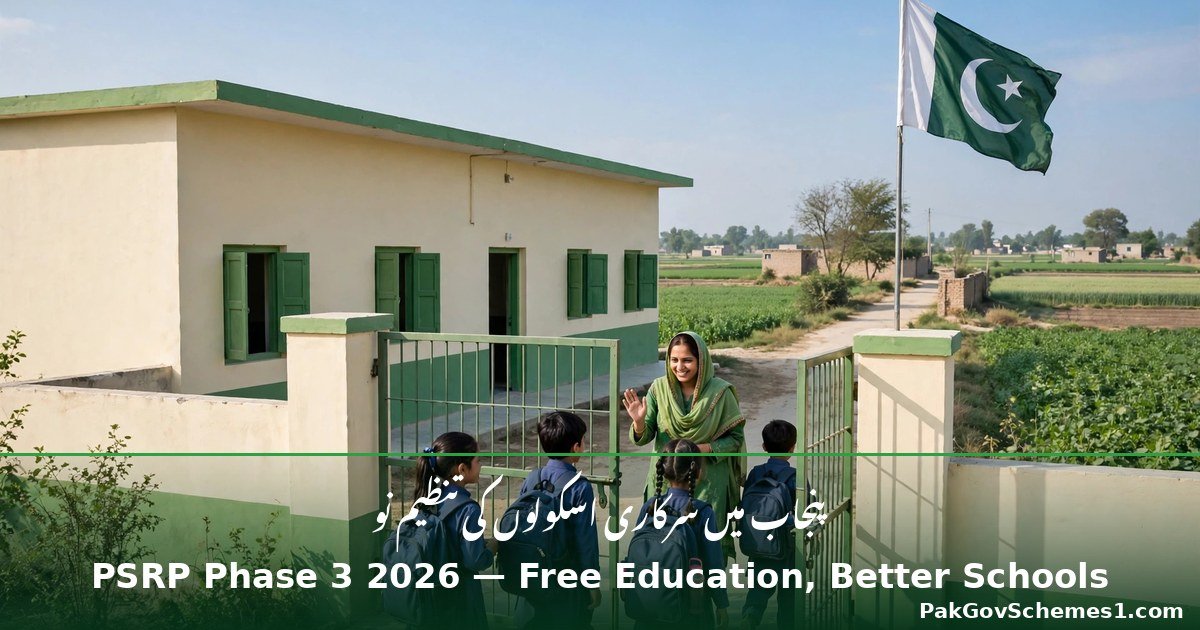
Punjab PSRP Phase 3 2026 is the third round of the Punjab government’s plan to hand over struggling government schools to private partners for better management. Under the Public Schools Reorganization Program (PSRP), the Punjab Education Foundation (PEF) selects educated individuals, NGOs, private schools and Ed-Tech firms to run selected public schools, while the government keeps ownership of the buildings and education remains completely free for students. This guide explains what PSRP is, how Phase 3 worked, who could apply, and what it means for parents, students and teachers.
Quick Overview: Punjab PSRP Phase 3 2026
| Information | Details |
|---|---|
| Program Name | Public Schools Reorganization Program (PSRP) — Phase 3 |
| Responsible Department | Punjab Education Foundation (PEF), School Education Department Punjab |
| Program Purpose | Improve low-performing government schools through public-private partnership |
| Eligible Applicants | Educated youth, education experts, private schools, NGOs, Ed-Tech firms, PEF/PEIMA partners |
| Fee for Students | Free — partners cannot charge any fee |
| Partner Payment | Monthly per-student subsidy from PEF (exact Phase 3 rate not officially announced) |
| Registration Status | Closed (online deadline 31 March 2026; extended to 7 April 2026) |
| Registration Method | Online only through the PSRP portal |
| Official Website | pef.edu.pk |
| Official Portal | psrp.pefsis.edu.pk |
| Last Updated | 10 November 2026 |
Latest Update on Punjab PSRP Phase 3 2026
Phase 3 applications are closed. The online window opened in February 2026 with an original last date of 31 March 2026, extended to 7 April 2026 because interest was low, according to The Express Tribune on 16 March 2026. One guide mentions 15 April 2026 instead, but the newspaper report supports 31 March and 7 April. After applications closed, PEF moved to scrutiny, merit scoring and provisional results, then agreement signing with successful partners. PEF’s own account, published on 10 November 2026, says applicants could appeal before 10 July 2026. That date has passed, and no new Phase 3 applications are being accepted.
Attention has now shifted to the next round. The Nation reported on 30 October 2026 that a fourth phase has been initiated, covering 6,460 more schools — 5,860 primary and middle schools and, for the first time, 600 high schools — and that 13,600 schools were outsourced in the first three phases. But independent guides updated in October 2026 state PEF has not officially announced Phase 4 registration, and no Phase 4 advertisement, school list or Terms of Reference was on its website then. Until PEF publishes an official advertisement, there is no confirmed date, school list or deadline.
What Is the Public Schools Reorganization Program (PSRP)?
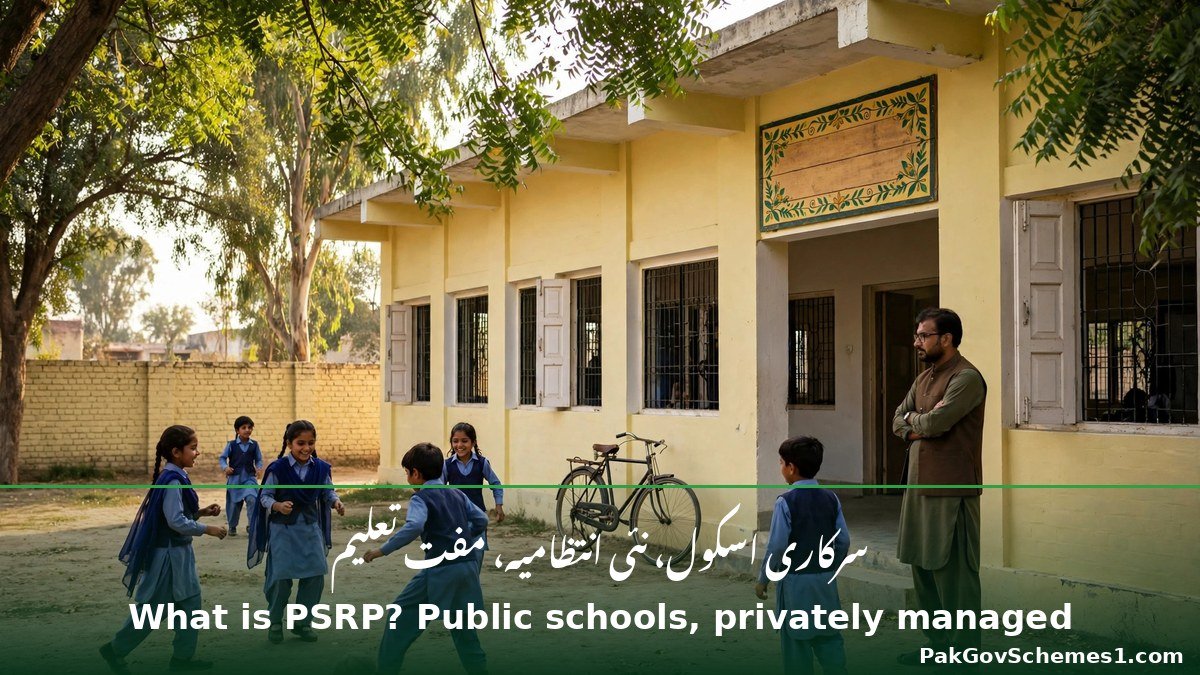
PSRP is a public-private partnership launched by the Punjab Education Foundation under Chief Minister Maryam Nawaz Sharif, approved by the Punjab Cabinet on 25 June 2024. The government identifies badly performing schools — very low enrolment, or zero, one or two teachers — and invites qualified private partners to run them. The partner manages teachers, maintains the building, runs enrolment campaigns and follows the Punjab Textbook Board curriculum, while PEF monitors the school and can take it back if performance is poor.
This is not privatisation. The school building remains public property, the government does not sell the school, education stays free, the government supplies textbooks, and students sit the same public examinations. The model is publicly financed and privately managed, and Article 25-A of the Constitution — free and compulsory education for children aged five to sixteen — remains its foundation. Punjab has over 52,000 public schools serving around 12 million children, yet an estimated 9.5 to 9.7 million children aged five to sixteen are out of school, per Geo.tv and The News in October 2026. Phase 1, completed in 2025, handed over more than 11,000 schools; Phase 3 added 2,735 more, according to ARY News. PEF says the programme now covers more than 10,000 schools and about one million students.
How the PSRP Handover Works
First, PEF advertises a district-wise list of selected schools, with each school’s EMIS code. Only listed schools are part of the phase. Second, applicants apply online through the PSRP portal, choosing preferred schools in priority order. Applications are scored on a 100-point merit system, so selection rests on qualifications, experience and the applicant’s plan, not on personal contacts. Third, shortlisted applicants submit hard copies for scrutiny and verification, and successful partners sign an agreement with PEF and take charge.
Fourth, the partner runs the school under PEF’s rules. PEF pays for physical improvements such as classrooms, toilets, furniture, water, fans, solar panels and Ed-Tech equipment, while the partner receives a monthly payment for each enrolled student — a direct reason to bring more children into school and keep them there. PEF monitors enrolment, attendance, teacher availability, infrastructure and academic standards, and underperforming partners get time to improve before a school is reassigned. PEF’s own figures include 866 new classrooms in 540 schools, 9,033 classrooms repaired, 5,067 toilets renovated, 160,450 furniture sets and 8,911 schools repainted. These figures come from PEF’s own account and have not been independently verified.
Who Could Apply for PSRP Phase 3? Eligibility Criteria
Phase 3 was open to a wide range of applicants, not only large organisations. The five streams were young entrepreneurs, education experts, private school owners and educational chains, NGOs and civil society organisations, and Ed-Tech firms. Existing PEF partners and PEIMA licensees could also apply. In the young entrepreneur category, the lead applicant needs 16 years of education and other group members must be graduates.
Full eligibility criteria and partner responsibilities are in the official PSRP Phase III Terms of Reference on pef.edu.pk. Applications were judged on a 100-point merit system, with academic qualifications, relevant experience and the proposed school improvement plan carrying the most weight. For the young entrepreneur group, which applies as a team of three, the final score was the average of all three members. For parents and students, there is no eligibility test to join a PSRP school: admission is free, follows PEF guidelines for the 2026-27 session, and focuses on enrolling out-of-school children. Families can also explore the Daanish Schools free admission programme and the CM Punjab Honhaar Scholarship.

PSRP Phase 3 Registration Procedure: Step by Step
Phase 3 registration is closed, so the steps below describe how the process ran — and how a future phase is likely to work. Always confirm the current advertisement before acting.
- Read the official advertisement. PEF published the Phase 3 advertisement (SPL-194) in March 2026, with the school list and Terms of Reference on pef.edu.pk.
- Check the school list. Download the district-wise list from pef.edu.pk or the PSRP portal and note the EMIS codes of schools you can manage.
- Register on the PSRP portal. Create an account at psrp.pefsis.edu.pk with your CNIC and a password, and keep your login details safe.
- Fill in the online form. Enter your details, choose preferred schools in priority order, and upload the required documents.
- Submit before the deadline. Online submissions closed on 31 March 2026, extended to 7 April 2026. Late applications were not accepted.
- Submit hard copies if shortlisted. Shortlisted applicants had to send printed documents by 7 April 2026.
- Wait for scrutiny and merit results. PEF checks documents, calculates merit scores and publishes provisional results on pef.edu.pk.
- File an appeal if needed. Applicants unhappy with the outcome could appeal before 10 July 2026. That date has now passed.
- Sign the agreement. Successful applicants sign a formal agreement with PEF and take charge of the school.
If you are waiting for the next round, do not pay anyone to “book” a school for you — there is no official pre-booking system, and Phase 4 has no confirmed date yet.
How to Check PSRP Phase 3 Results and Application Status
There is no public SMS code for checking PSRP results, and no result is sent through WhatsApp or Facebook. Check pef.edu.pk for the PSRP section, notices and results pages, where provisional results and lists of successful applicants are published, or log in to the PSRP portal at psrp.pefsis.edu.pk with the CNIC and password you used when applying.
If your name does not appear, first check whether the list is provisional or final, since provisional lists can change after appeals and verification. If you appealed before 10 July 2026, the outcome would come through the same official channels. If you missed the deadline, there is no officially announced way to reopen a Phase 3 decision. Parents can ask at the school, or check the district-wise list on pef.edu.pk, published school by school with EMIS codes.
PSRP Funding and Payment Details
PSRP is not a cash assistance programme for families. No money is paid to parents or students — funding flows to the school and to the partner who runs it. What follows separates confirmed facts from reported figures.
| Detail | Verified Information |
|---|---|
| Fee for students | Free. Partners cannot charge fees (confirmed by PEF). |
| Infrastructure costs | Paid by PEF — classrooms, toilets, furniture, water, fans, solar, Ed-Tech equipment (confirmed by PEF). |
| Partner payment | Monthly per-student subsidy paid by PEF against verified enrolment (model confirmed; exact Phase 3 rate not officially announced). |
| Reported subsidy rate | Rs650 to Rs750 per student per month, reported by The News (January 2026). Other reports mention Rs750 to Rs1,800 under older PEF programmes. Reported figures, not the confirmed Phase 3 rate. |
| Textbooks and curriculum | Government supplies textbooks; schools follow the Punjab Textbook Board curriculum and public examinations. |
| Payment to teachers | Teachers in PSRP schools are hired and paid by the partner, not by the government. Salary levels are not officially published. |
PEF has not published the exact Phase 3 per-student rate in any source checked here, so treat any site quoting a precise figure as fact with caution. The payment model itself — money follows the enrolled student — is confirmed, and it is why partners are expected to work hard on enrolment and attendance.

Required Documents for PSRP Partner Applications
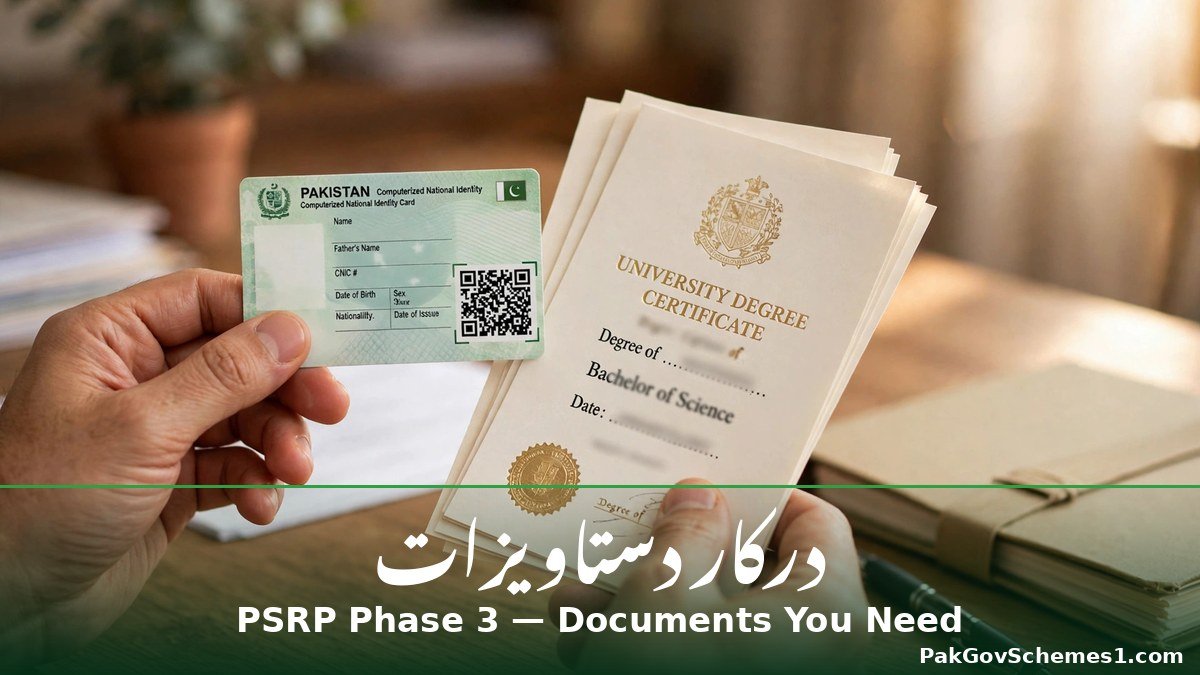
These documents are based on the Phase 3 application process in PEF’s published material and the advertisement. A future phase may ask for more, so always check the current advertisement.
- Valid CNIC of the lead applicant and of all group members
- Educational degrees and transcripts (16 years of education for the young entrepreneur lead applicant; graduation for other group members)
- Experience certificates in teaching, school management or education work, where applicable
- Registration documents for NGOs, private schools or companies applying as organisations
- A school improvement and management plan for the preferred schools
- Proof of address and a registered mobile number
- Hard copies of the complete application file, for shortlisted applicants
Parents enrolling a child need nothing beyond what a government school normally asks for, such as the child’s B-Form and proof of residence. No fee, donation or “admission charge” is payable — report anyone asking for one to PEF.
What PSRP Means for Parents, Students and Teachers
For parents, the most important fact is that nothing about your child’s right to free education changes. Your child keeps studying in the same building, with the same curriculum and the same public examinations. What should change is quality: more teachers, repaired classrooms, clean toilets, drinking water, furniture and regular attendance. If your child’s school joins PSRP, visit it, meet the new management and ask about the enrolment plan. Also see our guide to the Punjab School Meal Programme, which supports many of the same schools.
For students, PSRP should mean a functioning school day: teachers present, classrooms usable and learning material available. Twenty schools have been upgraded to matric level and 2,219 to elementary level, so many children no longer travel long distances to continue studying. If lessons are still not taking place properly after reorganisation, parents can raise it with PEF — that is what its monitoring system is for. For teachers, the picture is more difficult and deserves honesty: government teachers in handed-over schools are generally redeployed elsewhere by the School Education Department, while the partner hires its own staff, and critics warn partner-hired teachers may be paid less and have less job security. If you are affected, get transfer orders in writing, keep copies of your service record, and do not accept a private contract on a verbal promise.
Troubleshooting: Common PSRP Problems and What to Do
You applied but your name is not in the results. Check whether the list is provisional or final, and check the appeal record if you appealed before 10 July 2026. If the list is final and no appeal was filed, the decision stands.
You cannot log in to the PSRP portal. Use password recovery on psrp.pefsis.edu.pk, check you are entering the CNIC exactly as registered, and try another browser. Never share your password or OTP with anyone offering to “check your result”.
Your preferred school is not on the list. Only advertised schools are part of the phase — if yours is not listed, you cannot apply for it, no matter who promises otherwise.
A PSRP school near you is charging a fee. This is not allowed. Report it to PEF with the school name, EMIS code and any receipt you have.
A reorganised school is still not functioning. Report poor teaching, absent teachers or broken facilities to PEF, which can reassign a school that fails to improve.
You see a post saying Phase 4 registration is open. Check pef.edu.pk first. As of the research date, no official Phase 4 advertisement exists — a newspaper report that Phase 4 was “initiated” is not the same as an open registration.
Official Helpline and Complaint Procedure
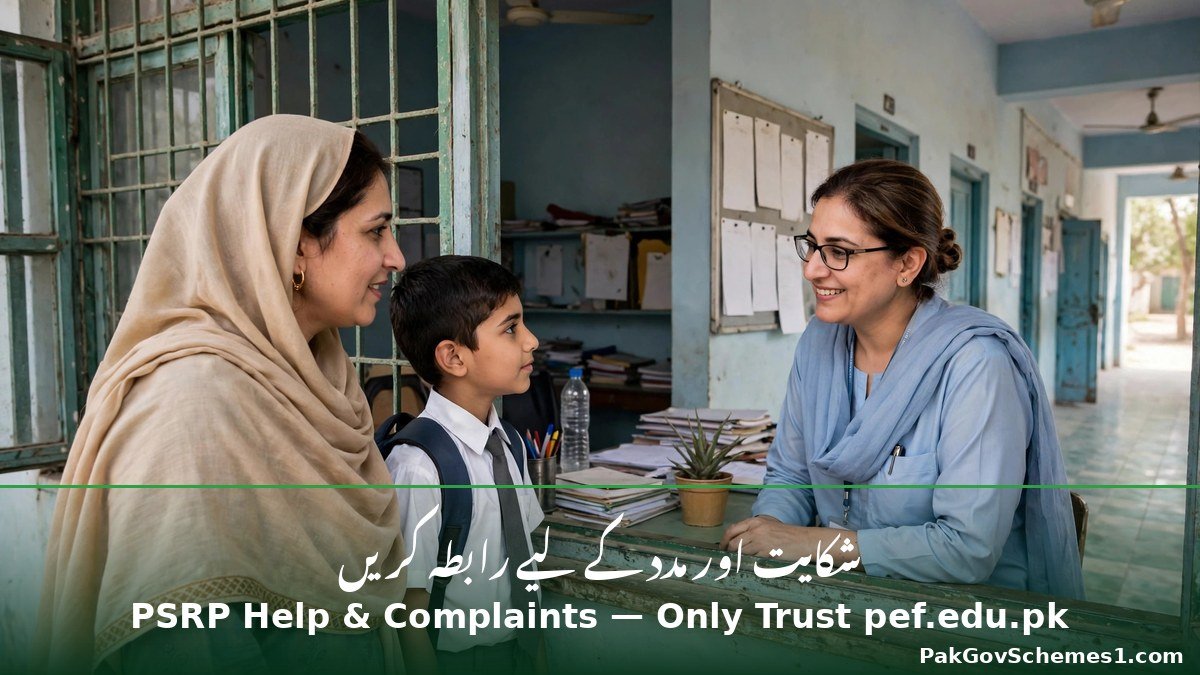
PEF publishes its notices, results and contact details on pef.edu.pk. That website is the correct first stop for any PSRP complaint, result query or appeal question. You can also use the PSRP portal at psrp.pefsis.edu.pk for application-related matters. No PEF helpline number could be verified on the official website during research for this article, so no number is printed here. Do not call numbers circulated on Facebook or WhatsApp claiming to be the “PSRP helpline” unless you have confirmed them on pef.edu.pk.
When complaining, include the school name, its EMIS code, your district, your CNIC number and a clear description of the problem, and keep a copy of what you submit. Students facing education costs can also check the PEEF Scholarship 2026 and BISP Taleemi Wazaif stipend guides on this site.

Common Mistakes to Avoid
- Believing “schools are being sold.” Ownership stays with the government — anyone saying the school was sold to a private owner is spreading misinformation.
- Paying an agent for a guaranteed school. Selection is merit-based and free — no agent can guarantee allotment, and paying one is the most common way applicants lose money.
- Applying for a school that is not on the official list. Only advertised schools are available. Check the EMIS code before applying.
- Trusting Phase 4 dates from social media. Phase 4 has no officially announced registration date yet. Wait for the PEF advertisement.
- Sharing your CNIC, password or OTP. Never give portal login details or OTPs to anyone offering to check your result or file your appeal.
- Missing the appeal window. Phase 3 appeals had to be filed before 10 July 2026. In any future phase, appeal immediately after provisional results, not at the last minute.
- Confusing old phases with the current one. Phase 1 and Phase 2 are complete — their deadlines, school lists and rates do not apply to Phase 3 or any future phase.
Frequently Asked Questions

What is Punjab PSRP Phase 3 2026?
Punjab PSRP Phase 3 2026 is the third round of the Public Schools Reorganization Program, run by the Punjab Education Foundation. It handed selected low-performing government schools to qualified private partners to manage, while the government kept ownership and education stayed free.
Is PSRP the privatisation of government schools?
No. School buildings remain public property, the government supplies textbooks, students follow the public curriculum and PEF monitors the partner. It is a management partnership, not a sale, and the school can be taken back if the partner performs badly.
Do students have to pay fees in PSRP schools?
No. All PSRP schools are completely free for students. Partners are not allowed to charge any fee under any circumstances. If a PSRP school asks for a fee, donation or admission charge, report it to PEF with the school name and EMIS code.
How many schools were included in PSRP Phase 3?
ARY News reported that 2,735 additional schools were included in Phase 3. The Nation reported that 13,600 schools had been outsourced across the first three phases combined. PEF says the programme now covers more than 10,000 schools.
Who could apply to run a school under PSRP Phase 3?
Young entrepreneurs, education experts, private school owners, educational chains, NGOs, civil society organisations, Ed-Tech firms and existing PEF or PEIMA partners could apply. In the young entrepreneur category, the lead applicant needed 16 years of education; other members needed to be graduates.
Is PSRP Phase 3 registration still open?
No. Applications opened in February 2026 and closed on 31 March 2026, extended to 7 April 2026. No new Phase 3 applications are being accepted. Anyone claiming to accept Phase 3 applications now is not acting for PEF.
When will PSRP Phase 4 registration start?
Not officially announced. The Nation reported on 30 October 2026 that a fourth phase covering 6,460 schools has been initiated, but PEF has not published a Phase 4 advertisement, school list or deadline. Check pef.edu.pk before believing any social media date.

How can I check my PSRP Phase 3 result?
Check the results and notices on pef.edu.pk, or log in to the PSRP portal at psrp.pefsis.edu.pk with the CNIC and password you used to apply. There is no official SMS code or WhatsApp service for PSRP results.
Important Safety Notice
Only use pef.edu.pk and the PSRP portal (psrp.pefsis.edu.pk) for PSRP information, applications and results. Never share your CNIC image, portal password, OTP or bank details with unknown individuals, agents or social media pages. No official PSRP process asks for payment to guarantee a school allotment, and no Phase 4 registration is open until PEF announces it. PakGovSchemes1.com is an independent informational website, not affiliated with PEF, PEIMA or the Government of Punjab.
Conclusion
Punjab PSRP Phase 3 2026 closed an important chapter in Punjab’s effort to fix its weakest government schools. More than 10,000 schools are now managed through the programme, education remains free, and PEF reports major improvements in buildings, enrolment and facilities. Honest questions remain about teacher security, subsidy rates and learning quality, and Phase 4 still has no officially announced registration date. If you applied in Phase 3, check your result only on pef.edu.pk or the PSRP portal; if you are waiting for the next round, prepare your documents and watch for the official advertisement.
Official Sources
- Punjab Education Foundation — “How Punjab Is Fixing 10,000 Failing Schools — And It’s Actually Working”, 10 November 2026: medium.com/@punjabeducationfoundation (PEF-published account; programme results and appeal deadline)
- Punjab Education Foundation — official website: pef.edu.pk (Phase III Terms of Reference, school lists and PSRP notices)
- PSRP online portal: psrp.pefsis.edu.pk (applications, school lists and status checks)
- The Nation — “Fourth phase of public schools outsourcing initiated”, 30 October 2026: nation.com.pk (Phase 4 report; 13,600 schools in first three phases)
- Geo.tv / The News — “Punjab’s educational reset”, 10 October 2026: geo.tv (programme model, school numbers, young entrepreneur requirement)
- The News — “Privatisation or public-private partnership?”, 25 January 2026: thenews.pk (reported Rs650–750 subsidy; monitoring and take-back powers)
- ARY News — “Punjab to outsource 2,735 additional government schools”, 26 February 2026: arynews.tv (Phase 3 school count; Phase 1 total; 31 March 2026 deadline)
- The Express Tribune — “Few takers for govt schools in Phase-III”, 16 March 2026: tribune.com.pk (deadline extended to 7 April 2026; low interest in Phase 3)
Disclaimer
Disclaimer: PakGovSchemes1.com is an independent informational website and is not affiliated with any government department. Information is compiled from available official announcements and other identified sources and may change. Please verify eligibility, registration status, payment details, and deadlines through the relevant official government website before taking action.

