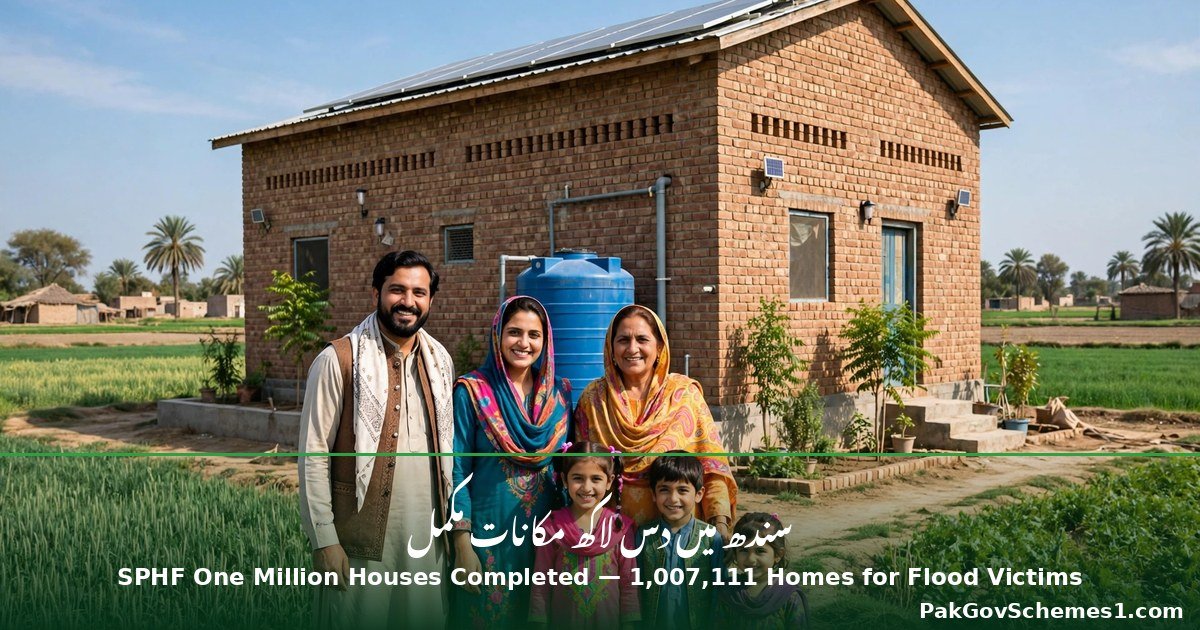
The SPHF One Million Houses Completed 2026 milestone means that 1,007,111 climate-resilient houses have now been rebuilt for families who lost their homes in the floods of 2022. Sindh Chief Minister Murad Ali Shah announced the achievement at a ceremony at the Chief Minister’s House in Karachi on 11 November 2026, calling it historic and dedicating it to the people of Sindh. This guide explains what the milestone means, which districts built the most houses, how families can check their beneficiary status, and what happens next on the road to 2.1 million homes.
Quick Overview
| Information | Details |
| Programme Name | Sindh People’s Housing for Flood Affectees (SPHF) |
| Milestone | 1,007,111 climate-resilient houses completed |
| Milestone Date | 11 November 2026 |
| Overall Target | 2.1 million climate-resilient houses |
| People Covered | More than 15 million flood-affected people across 23 districts |
| Responsible Body | Government of Sindh, through SPHF |
| World Bank Commitment | $500 million |
| Sindh Government Commitment | $179 million |
| Development Partners | World Bank, Asian Development Bank, Islamic Development Bank, European Investment Bank |
| Next Phase | Community infrastructure: clean drinking water, sanitation and drainage for about 4,800 villages |
| New Applications | Not officially announced — no open application; beneficiaries come from the 2022 flood damage survey |
| Official Website | https://sphf.gos.pk/ |
| Last Updated | 11 November 2026 |
Latest Update: One Million Houses Completed on 11 November 2026
On Tuesday, 11 November 2026, Sindh marked the completion of one million houses for flood-hit people at a ceremony at the Chief Minister’s House in Karachi. Chief Minister Murad Ali Shah called it a historic achievement and dedicated it to the people of Sindh. “This is not just a number. It represents one million families who now have a roof over their heads, security for their children and hope for a better future,” he said.
PPP Chairman Bilawal Bhutto-Zardari attended, along with Chief Secretary Asif Hyder Shah, development partners, senior officials and beneficiary families. According to a CM House press statement, SPHF has completed 1,007,111 climate-resilient houses across the province, in what is described as the world’s largest housing reconstruction initiative.
The chief minister said the journey towards 2.1 million climate-resilient homes will continue. “Today, we celebrate one million completed houses. Tomorrow, we continue our journey towards 2.1 million homes and a more resilient Sindh,” he said.

What Is the Sindh People’s Housing for Flood Affectees Programme?
The Sindh People’s Housing for Flood Affectees, known as SPHF, is the Government of Sindh’s programme to rebuild homes destroyed by the catastrophic floods of 2022. Sindh took on the challenge of reconstructing 2.1 million climate-resilient houses for more than 15 million people across 23 districts. The programme was launched under the vision of PPP Chairman Bilawal Bhutto-Zardari, who asked the provincial government to find a way to provide homes to flood-affected families.
SPHF is different because it is owner-driven. Instead of hiring contractors, the programme places families at the centre: verified families receive cash grants directly into their own bank accounts and build their own homes, following approved climate-resilient designs and guidance from partner organisations.
For the full background, read our Sindh People’s Housing Scheme guide and our report on the SPHF Phase 3 financing from the European Investment Bank.
Which Districts Built the Most Houses?
The one-million milestone was reached district by district, and the official figures announced at the ceremony show how widely the work is spread across Sindh. Khairpur recorded the highest number of completed houses, followed by the other badly flood-hit districts of northern and central Sindh.
| District | Completed Houses |
| Khairpur | 167,739 |
| Naushahro Feroze | 90,865 |
| Jacobabad | 83,037 |
| Dadu | 79,492 |
| Qambar Shahdadkot | 74,898 |
| Larkana | 72,357 |
| Shaheed Benazirabad | 66,460 |
| Shikarpur | 61,143 |
| Ghotki | 41,790 |
| Badin | 39,721 |
| Sanghar | 38,473 |
| Sukkur | 31,285 |
| Kashmore | 29,480 |
| Jamshoro | 28,364 |
| Other districts | Remaining houses to reach 1,007,111 |
These fourteen districts account for most of the completed houses. The pattern reflects where the 2022 floods caused the worst destruction: northern Sindh leads the list, and Khairpur alone accounts for more than one in every six completed houses.
How the Owner-Driven Model Works
The owner-driven model is the heart of SPHF. In a normal government housing project, a contractor builds the house and hands over the keys. Under SPHF, the family itself is the builder: the government verifies that the house was destroyed in the 2022 floods, opens a bank account in the beneficiary’s name, and releases the grant into that account in stages as construction progresses.
Each stage — plinth, walls, roof — is checked before the next payment is released, following a standard climate-resilient design. This stops middlemen from taking a share and makes sure the money becomes a finished house. Figures reported before the ceremony say around two million beneficiaries were validated and about 1.65 million bank accounts opened.

The grant is reported by independent scheme guides at Rs 300,000 per destroyed house, paid in four tranches, with a smaller reported Rs 50,000 for partially damaged houses. These figures were not confirmed in the official announcement of 11 November 2026, so treat them as reported and confirm your own case on the official SPHF portal. What is confirmed is that the grant is not a loan: nothing is repaid.

Why Women Are at the Centre of the Programme
One of the most significant achievements of SPHF, highlighted by the chief minister, is that women have been placed at the centre of the housing initiative. Land ownership documents, known as Sanads, are issued in women’s names wherever possible, or through joint household ownership — enabling millions of women in rural Sindh to become homeowners for the first time. “A house registered in a woman’s name is more than property; it is security, dignity and economic independence,” the chief minister said. A woman who holds the title deed cannot easily be pushed out of her home, and the house becomes an asset she can pass on to her children.
This focus on women’s ownership is part of the programme’s design. When the bank account and the land title are in a woman’s name, the grant money and the finished house stay with the family, and the woman’s position inside the household is strengthened — one reason development partners praise SPHF as a model for other countries.


How Every House Is Verified: Geo-Tagging and Independent Checks
A common question about a programme this large is how the government knows the houses are real. Every completed house was geo-tagged, digitally monitored and independently verified at each stage of construction, and field teams surveyed every damaged home using GIS mapping, satellite imagery and mobile-app photographs.
This digital trail serves two purposes. First, it stops fake claims: a house cannot be counted as complete unless photographs and location data prove it exists and meets the resilient design standard. Second, it protects the family, because the record cannot be lost in a paper file or changed by a local intermediary, and staged payments follow the verified construction stages rather than anyone’s favour.

How to Check Your SPHF Beneficiary Status by CNIC
If your family’s house was damaged in the 2022 floods and you were included in the damage survey, you can check your case on the official SPHF portal. The status page shows your eligibility, whether your bank account has been opened, and how far your payments have progressed. Follow these steps:
- Open the official SPHF portal at sphf.gos.pk. Use only this official address.
- Find the beneficiary status page on the portal and open it.
- Enter your 13-digit CNIC number carefully, without dashes, in the box provided.
- Press Enter or tap the search button to see your case status.
- Read the result: it shows your eligibility, your account opening status and your payment progress.
- If your case is under verification, wait for the process to finish; do not pay anyone to speed it up.
- If your damaged house was missed by the survey, raise a complaint through the official portal.
Remember: the beneficiary list comes from the 2022 flood damage survey. There is no online form to apply for SPHF, and no new registration has been announced. If a website or agent offers you an SPHF application form for a fee, it is not genuine.
What Happens Next: Water, Sanitation and Drainage for 4,800 Villages
The ceremony also announced the next phase: SPHF is moving beyond housing towards community infrastructure — clean drinking water, sanitation and drainage — in the villages where houses have been rebuilt. Through nearly $1 billion in combined investments, the government aims to reach approximately 4,800 villages.

No New SPHF Application Round Has Been Announced
The one-million milestone has created excitement, and with it, confusion. To be clear: the Government of Sindh has not announced any new SPHF application round. The programme covers families whose houses were destroyed or badly damaged in the 2022 floods and who were recorded in the official damage survey. If your house was damaged in the 2022 floods but your family was never surveyed, raise the matter through the official SPHF portal or your district administration, not through a form from a random website.
Families looking for other housing help can read about the federal PM Apna Ghar Programme, the Punjab Apni Zameen Apna Ghar scheme, and the Mera Pakistan Mera Ghar housing loan — separate programmes with their own rules. Do not pay anyone who promises to register you for any of them.
Common Problems and What to Do
Your CNIC shows no record. Your house was probably not included in the 2022 damage survey, or your CNIC details do not match it. Recheck the 13-digit CNIC, then raise the matter through the official portal or your district administration.
Your case shows “under verification” for a long time. Verification involves survey records, land documents and bank account opening, and it takes time in a programme covering two million families. Do not pay anyone who promises to move your case forward.
A payment tranche has not arrived after your stage passed. Check the payment progress on the SPHF portal. If the stage is verified but the payment is delayed, raise a complaint through the portal with your CNIC number and stage details.
Your house is in a high flood-risk zone. Programme documents say houses in floodplains and stream beds are not eligible for immediate cash support at that site, and a process to find a safer site follows. This is a safety rule, not a rejection: follow the survey team’s guidance.

Someone asks for money to add your name. This is fraud. SPHF registration is survey-based and free, and no agent can add a name to the list. Report the person to the police or through the official complaint channel.
Official Helpline and Complaint Procedure
For SPHF matters, the first and safest step is the official portal, sphf.gos.pk, where you can check your status by CNIC and find the programme’s complaint channel. A complaint helpline, 0800-90090, is reported by independent scheme guides but not verified from an official source, so confirm it on the portal before relying on it. Never share your CNIC photograph, bank details or OTP codes with anyone claiming to be from SPHF.
Common Mistakes to Avoid
- Believing a new registration round is open. No new SPHF application has been announced; the list comes from the 2022 survey.
- Paying an agent to register you. SPHF registration is free and survey-based. Anyone charging a fee is committing fraud.
- Using a fake SPHF website. Only sphf.gos.pk is the official portal. Check the address carefully before entering your CNIC.
- Sharing your CNIC photo or bank OTP with strangers. Never share these on WhatsApp, Facebook or with unknown callers.
- Building without following the resilient design. Payments are released only when each stage meets the approved climate-resilient standard.
- Confusing SPHF with other housing schemes. SPHF is only for 2022 flood victims in Sindh; other schemes have separate rules.
- Trusting social media dates for the next phase. No timetable for the water, sanitation and drainage work has been announced yet.
Frequently Asked Questions
What is the SPHF One Million Houses Completed 2026 milestone?
It is the completion of 1,007,111 climate-resilient houses under the Sindh People’s Housing for Flood Affectees programme, announced in Karachi on 11 November 2026 — the halfway point of the target of rebuilding 2.1 million houses for 2022 flood victims.
How many houses has SPHF completed so far?
SPHF has completed 1,007,111 houses across Sindh, according to the official figures of 11 November 2026. Khairpur leads with 167,739, followed by Naushahro Feroze with 90,865 and Jacobabad with 83,037. About 1.1 million more are needed to reach 2.1 million.
Who is eligible for an SPHF house?
Families whose houses were destroyed or badly damaged in the 2022 floods in Sindh and recorded in the damage survey are eligible. The house must have suffered structural damage and must not be in a high flood-risk zone. The survey decides eligibility.
Can I apply for SPHF now?
No. There is no open SPHF application and no new registration round has been announced. Beneficiaries are identified through the 2022 flood damage survey. You can check your case by CNIC on sphf.gos.pk, and you should not pay anyone who offers to register you.
How do I check my SPHF status by CNIC?
Open the official portal sphf.gos.pk, go to the beneficiary status page, enter your 13-digit CNIC number and press Enter. The result shows your eligibility, whether your bank account has been opened, and how far your payments have progressed. Use only the official portal.
How much money does SPHF give per house?
Scheme guides report a grant of Rs 300,000 per destroyed house, paid in four tranches linked to verified construction stages, with a reported Rs 50,000 for partially damaged houses. These figures were not confirmed officially, so confirm your amount on the portal.

Why are SPHF houses registered in women’s names?
Land ownership documents, known as Sanads, are issued in women’s names wherever possible because the programme places women at the centre of the recovery. As the chief minister said, a house in a woman’s name is security, dignity and economic independence.
When will SPHF reach its target of 2.1 million houses?
No completion date for the 2.1 million target has been officially announced. The chief minister said on 11 November 2026 that the journey will continue. With 1,007,111 houses complete, about 1.1 million remain, and progress will be announced through official channels.
What is the next phase of SPHF after housing?
The programme is moving beyond housing to community infrastructure: clean drinking water, sanitation and drainage for about 4,800 villages, funded through nearly $1 billion in combined investments. The chief minister announced this next phase at the ceremony, but no district-wise order or timetable has been announced.
Is SPHF a loan that families must repay?
No. SPHF is a grant, not a loan, and nothing is repaid. Verified families receive the grant into their own bank accounts in stages as construction is verified, and the finished house belongs to the family. Never pay anyone who asks for a fee.
Important Safety Notice
Use only the official SPHF portal, sphf.gos.pk, for status checks and complaints. Never share your CNIC photograph, bank account details, OTP codes or passwords with strangers, agents or social media pages. PakGovSchemes1.com is an independent informational website, not affiliated with the Government of Sindh or SPHF. Verify all details through the official portal before acting.
Conclusion
The SPHF One Million Houses Completed 2026 milestone is a real turning point for Sindh: 1,007,111 families who lost their homes in the 2022 floods now have climate-resilient houses of their own, many registered in women’s names, built through an owner-driven model that put families, not contractors, in charge. The journey to 2.1 million homes continues, and the next phase will bring clean water, sanitation and drainage to about 4,800 villages. Check your status only on the official portal, and never pay anyone who promises to register you.
Official Sources
- Dawn — “Sindh marks completion of one million houses for flood-hit people”, 11 Nov 2026 — https://www.dawn.com/news/2043680/sindh-marks-completion-of-one-million-houses-for-flood-hit-people — 1,007,111 houses completed, ceremony details, district figures, World Bank $500m and Sindh government $179m commitments, 4,800 villages infrastructure plan.
- Official SPHF portal — https://sphf.gos.pk/ — programme information and beneficiary status check.
- Government of Sindh portal — https://sindh.gov.pk/ — official provincial government portal.
- The Friday Times — “From Disaster To Dignity: Sindh’s New Model For Climate-Resilient Housing”, 8 Oct 2026 — https://www.thefridaytimes.com/08-Oct-2026/disaster-dignity-sindh-s-new-model-climate-resilient-housing — owner-driven model, GIS surveys, four staged tranches, Sanads in women’s names.
- PakGovtSchemes.pk — “Sindh Government Schemes 2026” — https://pakgovtschemes.pk/sindh-schemes/ — reported Rs 300,000 grant figure, CNIC status check, reported complaints helpline 0800-90090.
- PakEra.pk — “Check Sindh Flood House Grant Status by CNIC on SPHF” — https://pakera.pk/check-sindh-flood-house-grant-status-sphf-cnic-beneficiary-platform/ — reported beneficiary-status page and platform counters.
Disclaimer
Disclaimer: PakGovSchemes1.com is an independent informational website and is not affiliated with any government department. Information is compiled from available official announcements and other identified sources and may change. Please verify eligibility, registration status, payment details, and deadlines through the relevant official government website before taking action.

