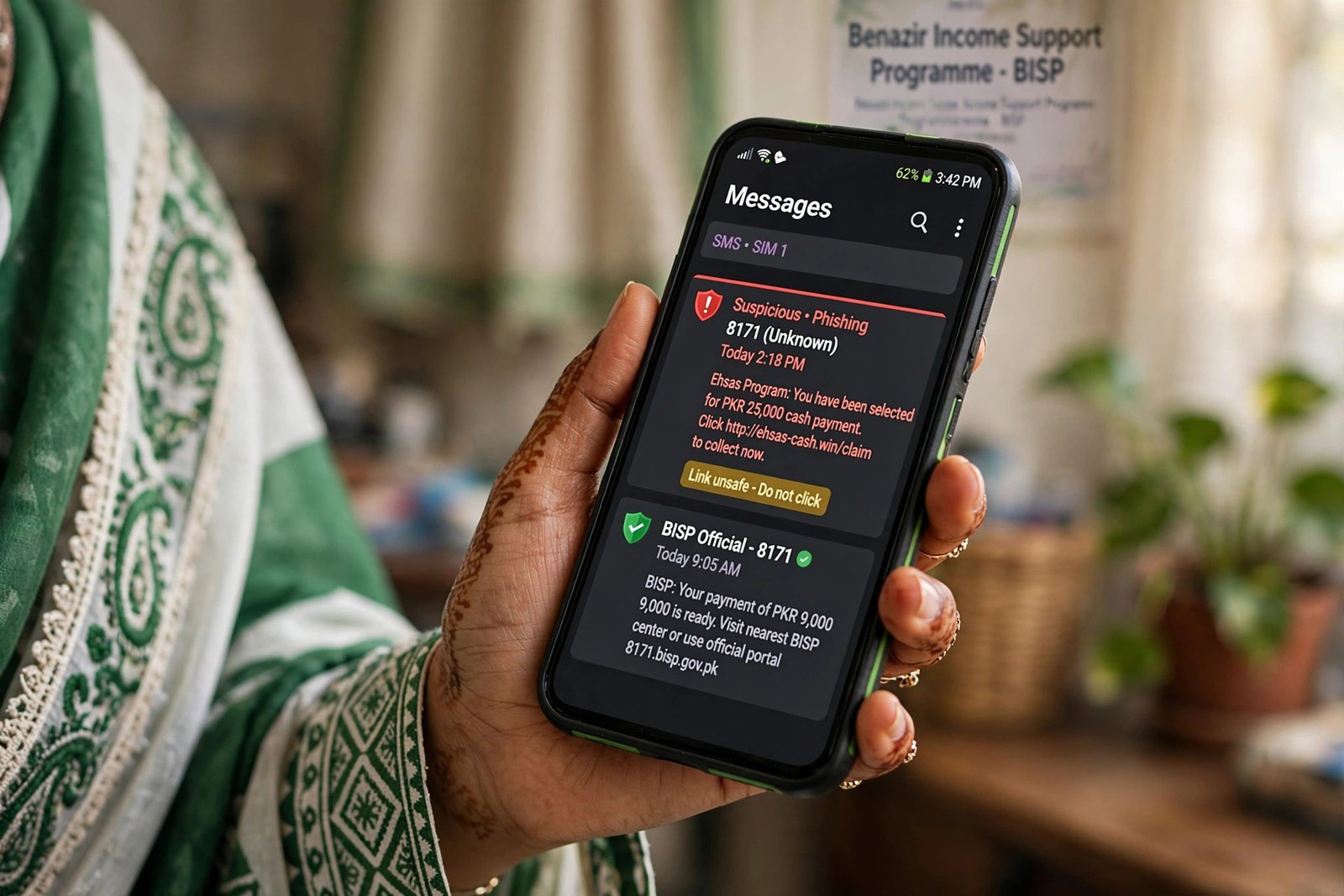
BISP 8171 Fake SMS Alert 2026 – Spot Scams and Protect Your Payment
Rs. 14,500. That is the quarterly installment millions of families wait for in 2026 — and it is exactly why the BISP 8171 fake SMS scam industry exists. Every time a payment phase begins, scammers flood phones with messages that look official, sound urgent, and are designed to steal your money or your identity within minutes.
Here is the thing most guides will not tell you plainly: the scammers are not guessing. They know the payment schedule, they know the real amount, and they know you are waiting. That is what makes their messages so convincing — and that is why you need to know the difference between a real 8171 message and a fake one before the next phase starts.
How the Scam Actually Works
The pattern barely changes, because it keeps working. First, you receive a message or a phone call saying your BISP payment has been approved or is ready for collection. The sender creates pressure immediately: your payment will be blocked, cancelled, or sent back if you do not verify right now.
Then comes the ask. They want your CNIC number, an OTP code sent to your phone, or your JazzCash or EasyPaisa account details. Sometimes they send a link to a fake “8171 web portal” that looks like the real one. The moment you enter your details or share the code, your money can be withdrawn within minutes, according to fraud awareness reporting by 8171-web-portals.pk.
The whole trick runs on urgency. A calm person checks the sender. A panicked person clicks the link. The scammer’s job is to make sure you never get calm.
Real vs Fake: The Table That Settles It
Memorize this table. It is the fastest scam detector you own.
| Check | Real BISP message | Fake message |
|---|---|---|
| Sender number | Only 8171 | Any other number, including 11-digit mobile numbers |
| Links | Never contains links | Often includes a “verify here” link |
| Personal details | Never asks for CNIC, OTP, PIN, or bank info | Asks for CNIC, OTP, or account details |
| Fees | Never demands any fee | Demands a “processing” or “verification” fee |
| Tone | Plain status update | Urgent, threatening (“blocked in 24 hours”) |
| WhatsApp/Facebook | BISP never messages on WhatsApp | Fake registration links and forms |
One rule covers nearly everything: if it did not come from 8171, treat it as fraud. BISP has stated this repeatedly — 8171 is the only official number used for beneficiary messages, and anything else should be treated as fraudulent, as documented by 8171passgov.com.pk.
The Six Scams Running Right Now
1. The “payment approved” SMS. The most common. A message from a random number says your Rs. 14,500 payment is approved and asks you to click a link or call a number to “verify.” Real 8171 messages never contain links. Ever.

2. The fake amount trick. Some messages promise Rs. 25,000 or Rs. 12,000 — amounts that do not match the current Rs. 14,500 quarterly installment. The wrong figure is deliberate: a bigger number makes you excited enough to stop thinking. If the amount does not match what BISP officially pays, the message is fake.

3. The threatening phone call. Someone calls claiming to be a BISP officer. They say your payment is blocked and demand your CNIC plus a fee via JazzCash or EasyPaisa to unblock it. BISP officers never call to collect fees. Registration, verification, and payment collection are completely free.
4. The WhatsApp registration link. A forwarded WhatsApp message offers “BISP online registration 2026” or an “Ehsaas survey” with a link. There is no online BISP registration at all — enrollment happens only through the in-person NSER survey at a BISP Tehsil Office. Any link promising otherwise is a trap.
5. The Facebook form scam. Sponsored posts and ads claim “Rs. 25,000 — fill this form” with a BISP-looking page. These harvest your CNIC and personal data for identity misuse. BISP does not run registration through Facebook forms.
6. The payment-center cut. This one happens in person, not by phone. At some collection points, agents deduct money from installments without telling the beneficiary. Count your full Rs. 14,500 before leaving, every time. Any deduction is illegal — report it on the toll-free helpline 0800-26477.
Why Smart People Still Fall for It
Now, a quick word about something uncomfortable: these scams do not only catch careless people. They catch tired, worried people waiting for money their family needs.
Scammers time their messages to payment phases. When the October–December 2026 quarter releases district by district, millions of beneficiaries are checking their phones constantly. A message that arrives in that window, quoting the right amount, from a number that looks almost official — it bypasses skepticism because it matches what you expect to see.
Let’s be honest about one more thing: the shame keeps victims quiet. People who lose money to these scams often do not report it because they feel foolish. That silence is exactly what scammers count on. Reporting is not an admission of stupidity — it is how the FIA’s cybercrime unit maps and shuts down these networks.
What to Do If You Already Shared Your Details
Act fast. Speed is the only thing that limits the damage.

First, if you shared an OTP or account PIN, call your bank or mobile wallet provider immediately and ask them to freeze the account. Then change your JazzCash or EasyPaisa PIN from a trusted device.
Second, if you entered your CNIC on a fake website, watch for identity misuse. You cannot change your CNIC, but you can stay alert for accounts or SIMs opened in your name. The PTA lets you check how many SIMs are registered on your CNIC.
Third, report it. File a complaint with the FIA Cybercrime Unit through their online reporting portal — fraud cases fall under the Prevention of Electronic Crimes Act (PECA), which carries up to three years imprisonment for offenders, according to reporting by ncf.org.pk. Also report the sender number to PTA by texting it to 420, and inform the BISP helpline at 0800-26477.

Do not pay anyone who contacts you afterward claiming they can “recover” your money for a fee. That is the same scammer wearing a different mask.
Where to Report: Every Channel in One Place
- BISP helpline: 0800-26477 (toll-free) — for payment issues and suspicious messages
- PTA: text the scam number to 420 — gets the sender’s SIM blocked
- FIA Cybercrime: online complaint portal — for formal legal action under PECA
- BISP WhatsApp complaint line: 0311-9229892 — for reporting suspicious activity
- Nearest BISP Tehsil Office: for in-person complaints
Save these numbers in your phone today, before you need them. And tell the women in your family — scammers disproportionately target female beneficiaries, who are often the registered recipients.
BISP 8171 Fake SMS: Quick Answers
How can I tell a BISP 8171 fake SMS from a real one? Check the sender first: a genuine message comes only from 8171, never contains links, and never asks for your CNIC or OTP. Any BISP 8171 fake SMS breaks at least one of these rules.
What should I do if I receive a BISP 8171 fake SMS? Do not click any link or share any code. Report the sender number to PTA by texting it to 420, and call the BISP helpline at 0800-26477. Reporting every BISP 8171 fake SMS helps the FIA track the gangs behind them.
Can a BISP 8171 fake SMS steal my installment? Yes — if you share an OTP or click a phishing link, scammers can drain a mobile wallet within minutes. Never share codes from any BISP 8171 fake SMS, no matter how urgent it sounds.
Related Guides
- 8171 Web Portal 2026 – Check BISP Payment by CNIC
- BISP 8171 Complete Guide 2026 – Payments & Eligibility
- Asaan Karobar Finance Scheme 2026 – 0% SME Loans
Disclaimer: Scam tactics change constantly. Always verify any BISP-related message through the official channels — the 8171 SMS service, the portal at 8171.bisp.gov.pk, or the toll-free helpline 0800-26477 — before acting on it. When in doubt, visit your nearest BISP Tehsil Office in person.

