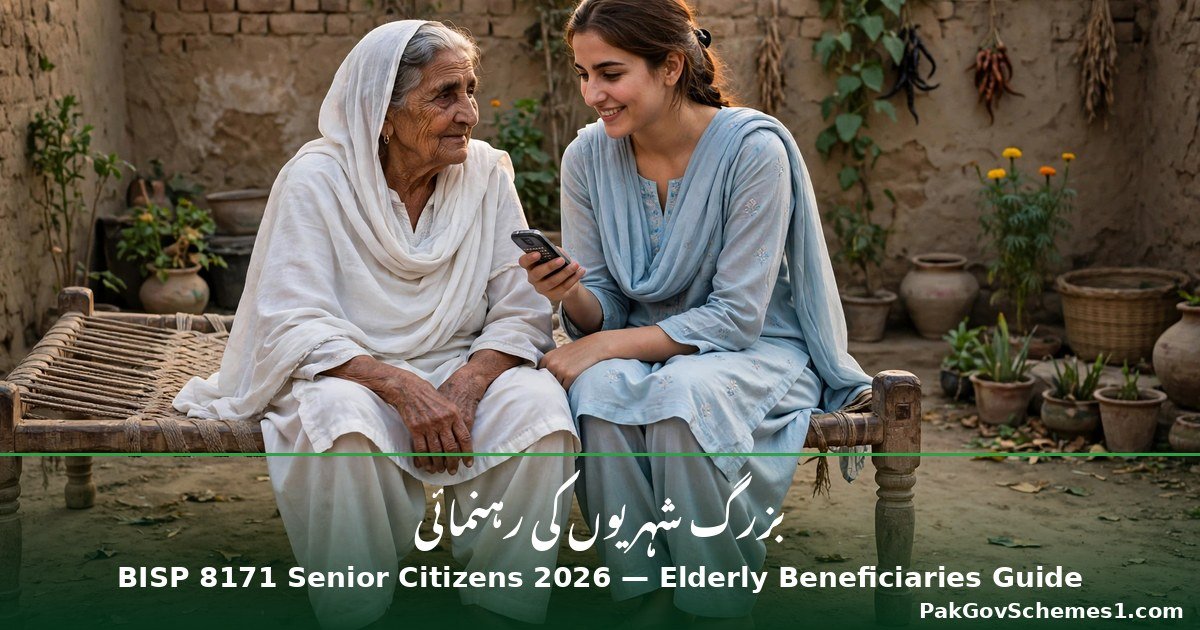
BISP 8171 Senior Citizens 2026 – Elderly Beneficiaries Guide
BISP 8171 senior citizens in 2026 do not have a separate scheme of their own — and that is the first fact to get right. Elderly women qualify for Benazir Kafaalat through the same household survey and poverty-score test as everyone else. What is different is the friction: travel, worn fingerprints, and paperwork all hit harder at 70 or 80 than at 40. This guide explains how the system actually works for elderly beneficiaries, what families can do, and which claims about a “senior citizen allowance” are fake.
Quick Overview
| Information | Details |
|---|---|
| Programme | Benazir Income Support Programme (BISP) — Benazir Kafaalat |
| Responsible department | Benazir Income Support Programme |
| Who it is for | Eligible women in poor households |
| Separate senior scheme | None — no separate BISP scheme or extra payment |
| Eligibility test | PMT score — reported cut-off 32 (37 with disability) |
| Registration | In person at a Tehsil Office — Dynamic Survey; no online form |
| Status check | SMS your CNIC to 8171, or visit 8171.bisp.gov.pk |
| Current payment | Rs 14,500 per quarter, Oct–Dec 2026 (reported) |
| Helpline | 0800-26477 (toll-free) |
| Official website | bisp.gov.pk |
| Last updated | 7 November 2026 |
Latest Update — 7 November 2026
The October–December 2026 Kafaalat installment is reported at Rs 14,500, released district by district in phases. As of 7 November 2026, BISP had announced no national date — check your own status on 8171. A rise to Rs 18,000 from January 2027 is reported only.
BISP is moving payments into Social Protection Digital Wallets linked to free Benazir SIMs. The date 31 December 2026 is reported as the target for complete digitalisation, but it is not a confirmed deadline for collecting a SIM.
On 29 October 2026, BISP officials briefing First Lady Bibi Asifa Bhutto Zardari highlighted the removal of the “ever-married” condition for the Kafaalat payee — reported by the Associated Press of Pakistan, but not yet a formal rule. BISP Chairperson Senator Rubina Khalid has also directed campsite staff to give priority to elderly women.
The Three Frictions Elderly Beneficiaries Face
The BISP system was built around a beneficiary who can travel, queue, and press her thumb on a scanner. Many of its most deserving recipients cannot:
- Getting there. Camps and offices assume travel. For an 80-year-old with arthritis, a trip across the district is an ordeal — many simply stop collecting.
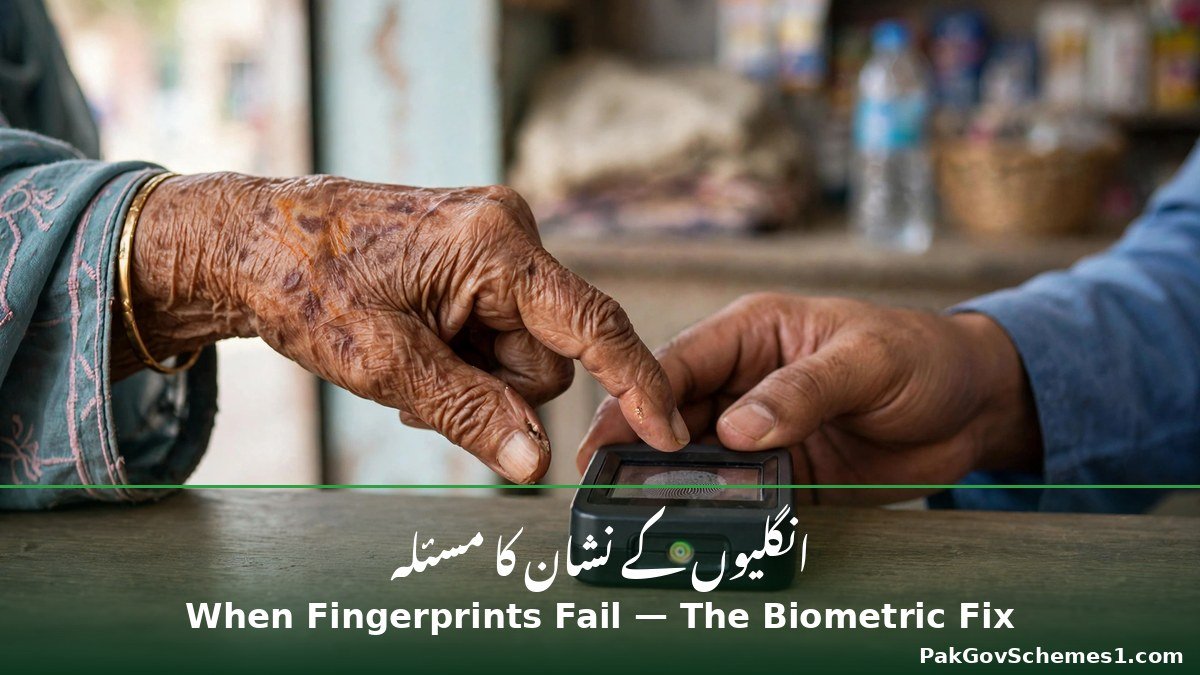
- The thumbprint. Decades of manual labour wear fingerprints smooth, and elderly skin verifies poorly — the gate that protects the payment becomes the wall that blocks it.
- The paperwork. Re-surveys and record updates assume the beneficiary can appear in person, repeatedly. An elderly woman who cannot travel falls behind on that compliance.
The family has to bridge the gap.

The Biometric Problem, Specifically
What happens when her thumb will not verify, visit after visit? Start with the simple fixes: clean, dry hands; try a different finger, since the thumb often fails while a smaller finger works; and try a different retailer. Do not retry endlessly — repeated failures can risk the account being blocked.
If the simple fixes fail, the fingerprint record at NADRA needs attention — a family member should take her to a NADRA centre to update her biometrics.

If her prints still fail after a NADRA update, ask the Tehsil Office about the Non-Biometric Verification System (Non-BVS), reported for beneficiaries whose fingerprints cannot be verified even after an update. It is reported in selected areas, including parts of South Punjab — ask whether it is available in your district. Facial verification is also reported in selected districts. Never pay for a “bypass” — that is fraud, and it can get her record flagged and her payments frozen.
Eligibility Criteria
There is no age threshold for BISP — an elderly woman qualifies on the same household test as a younger woman. The essentials are: a household surveyed through the Dynamic Survey; a PMT score within the reported cut-off (32 or below, or 37 with a disabled member); a valid CNIC for the woman named as payee; and no exclusion flag. Priority is reported for widows, divorced women, and households with a disabled or elderly member. The payment goes to the eligible woman of the household: an elderly man alone cannot be the payee. Age 65 and above matters for a different programme — Punjab’s Ba-Himmat Buzurg pension, covered below.
Registration Procedure: Step by Step
There is no online form and no fee. The route is in person: the beneficiary herself must be present for the survey and biometrics.
- Check the current status first. Send her 13-digit CNIC by SMS to 8171, or check on 8171.bisp.gov.pk.
- Visit your BISP Tehsil Office. Take her original CNIC. Any adult household member can ask for a survey, but she must attend for her own biometrics.
- Fix NADRA details first if they are wrong. If her name, marital status, address, or family record is wrong, correct it at NADRA first.
- Complete the Dynamic Survey. Answer honestly — household members, income, assets, housing, education.
- Complete biometric verification and keep the survey slip safe.
- Re-check on 8171 after a few weeks. If nothing has changed, return with the slip.
- Ask about timing rules. Reported guidance says a household cannot repeat its survey within two years; beneficiaries are recertified every three years.
Several guides report Saturday opening for elderly citizens (65+) and persons with disabilities — but another guide says offices work Monday to Friday only, so confirm the hours at your own office before travelling.

CNIC Check and Application Status
Use only the two official methods. By SMS: send the 13-digit CNIC, without dashes or spaces, to 8171. By portal: open 8171.bisp.gov.pk, enter the CNIC and the picture code, and submit. Never share a CNIC, OTPs, or PINs with callers or in website comments.
| Status you may see | What it most likely means | What to do |
|---|---|---|
| Eligible | Your household meets the criteria. | Wait for the 8171 SMS, then collect. |
| Under verification / Janch Partal | Your record is still being checked. | Wait and re-check. |
| Not eligible / ineligible | Your household does not meet the criteria. | Ask the Tehsil Office. |
| Record not found / not registered | No BISP record matches the CNIC. | Re-enter the CNIC; if it still fails, visit the office. |
| Survey required | Household data is missing or too old. | Visit a Tehsil Office for a survey. |
BISP has published no official glossary of this wording, so these labels are reported, not verbatim.
Payment Details and Schedule
| Detail | Verified Information |
|---|---|
| Assistance amount | Rs 14,500 per quarter, Oct–Dec 2026 (reported) |
| Payment schedule | Quarterly, district by district; no national date announced |
| Payment method | Digital Wallet linked to a free Benazir SIM (reported) |
| Payment status check | SMS CNIC to 8171 or the portal 8171.bisp.gov.pk |
| Payment collection | Authorised retailer after the 8171 SMS, with CNIC and biometrics |
| Withdrawal charge | Rs 280 per cash withdrawal (reported) |
| Deduction complaints | Helpline 0800-26477 or your Tehsil Office |
Payments begin only after the household is declared eligible and the 8171 SMS confirms a payment is ready. The cash goes into her hands, counted, with a receipt.

Required Documents
Carry originals — photocopies alone are not accepted. Take the original valid CNIC of the woman named as payee (renew it at NADRA first if expired); adult family members’ CNICs; children’s B-Forms; and a mobile number registered in her own name. Bring proof where it supports the claim: a death certificate for a widow, or a disability certificate, which supports the higher PMT cut-off of 37. Keep copies of her CNIC and survey slips in one folder.

Troubleshooting
- CNIC not found: re-enter the digits slowly; if it still fails, visit the Tehsil Office.
- Under verification for weeks: re-check on 8171, then visit with the slip.
- Payment ready but wallet not activated: complete the free SIM and wallet process.
- Fingerprints fail repeatedly: update them at NADRA first, then ask about Non-BVS.
- She cannot travel at all: raise the case formally with the Tehsil Office, in writing and with medical documentation.
- The beneficiary has died: update the NADRA record, and ask whether another eligible woman in the household can be surveyed.
Official Helpline and Complaint Procedure
BISP’s toll-free helpline is 0800-26477 — use it to report an incorrect status, a deduction, or anyone demanding money. You can also complain in person. If a caller claiming to be a BISP officer asks for money, an OTP, or a PIN, hang up and report the number.

Separate Punjab Programmes — Not BISP
Ba-Himmat Buzurg Programme is Punjab’s social pension for senior citizens: a reported Rs 2,000 per month (Rs 6,000 per quarter), for people aged 65 and above, with priority to elderly women. It is reported to use a poverty-score test — sources disagree on the exact range, quoting between 16.18–30 and 20 or below — and to run through PSPA channels, helpline 1221. Registration is not through 8171.
Himmat Card is different again: it is for persons with disabilities in Punjab who are certified as not fit to work — not for senior citizens generally. The reported amount is Rs 10,500 per quarter, checked on the DPMIS portal, helpline 1312. An elderly person qualifies only if they are a certified person with a disability, not because of age. Keep the three programmes — BISP Kafaalat, Ba-Himmat Buzurg, Himmat Card — separate in any application.
Fake Claims Debunked
Elderly beneficiaries are the most targeted group for BISP fraud. There is no separate BISP senior-citizen scheme and no extra elderly payment — any post promising a “senior citizen allowance” or a “BISP Elderly Package” of Rs 2,000 per quarter is inventing a programme that does not exist. There is no online BISP form for seniors. Nobody can collect her payment at home for a fee, and no agent can fix a fingerprint failure for cash — the only official routes are NADRA and the Tehsil Office. Messages naming a fixed payment date for this quarter are not official. And 8070 is a Punjab-specific code, not a BISP number — BISP’s only official number is 8171.
Common Mistakes to Avoid
- Paying an agent for approval, home delivery, or a fingerprint fix.
- Using a fake registration website that asks for CNIC photos or a fee.
- Trusting SMS or calls from any number other than 8171.
- Sharing CNIC photos, OTPs, or wallet PINs with anyone.
- Letting someone else collect “on her behalf” — the cash must reach her hands, counted.
- Confusing Ba-Himmat Buzurg or Himmat Card with BISP.
Frequently Asked Questions
Is there a separate BISP scheme for senior citizens?
No. There is no separate BISP senior-citizen scheme and no extra elderly payment. Elderly women qualify through Benazir Kafaalat, the same household survey and poverty-score test as everyone else. Punjab’s Ba-Himmat Buzurg pension is a separate provincial programme, not part of BISP.
Can an elderly man receive BISP Kafaalat himself?
No. Kafaalat is paid to the eligible woman of the household, so an elderly man cannot be the payee on his own. His household can still qualify if an eligible woman in it — his wife, daughter-in-law, or another female member — meets the criteria and is named as the payee.
What if her fingerprints never verify?
First update her fingerprints at NADRA, using the form the Tehsil Office issues. If they still fail, ask about the Non-Biometric Verification System or facial verification, both reported in selected districts, and about payment through a bank account. Never pay anyone promising a fingerprint bypass.
Can a family member collect the payment for her?
No. Biometric verification requires the beneficiary herself, so nobody can collect without her present. But a family member can handle everything around it: travel, queues, paperwork, and counting the cash with her. The money must go into her hands, counted, with a receipt.
What is Ba-Himmat Buzurg, and is it the same as BISP?
No, it is different. Ba-Himmat Buzurg is a Punjab Social Protection Authority programme paying a reported Rs 2,000 per month to senior citizens aged 65 and above, with priority to elderly women. It is Punjab-only, uses PSPA channels and helpline 1221, and is not registered through 8171.
What should we do if she cannot travel at all?
Raise the case formally with the Tehsil Office, in writing and with medical documentation, and ask what exceptional arrangements exist. Field and mobile survey options are reported in some areas and phases, but BISP has published no general home-visit rule, so no arrangement is guaranteed.
Does the 31 December 2026 wallet deadline affect her?
Not as a confirmed cut-off. The 31 December 2026 date is reported as the target for complete digitalisation of BISP beneficiary accounts, not a confirmed deadline for collecting a Benazir SIM. If BISP has told her to collect a SIM, do it promptly through the official channel — the SIM and wallet are free.
What happens to the payment if the elderly beneficiary dies?
The payment stops; it does not transfer automatically. Update the death record at NADRA, then ask the Tehsil Office whether another eligible woman in the household can be surveyed as the new payee. Do not let anyone keep collecting in her name — that is fraud.
Important Safety Notice
Use only the official portals — 8171.bisp.gov.pk and bisp.gov.pk — and never share OTPs, passwords, PINs, or CNIC photos with unknown individuals. BISP registration, surveys, SIMs, and wallets are all free; anyone charging for them is a scammer. Agree as a family that the cash is counted in her hands. PakGovSchemes1.com is an independent informational website, not an official government department.

Conclusion
BISP 8171 senior citizens are served by the same Benazir Kafaalat programme as everyone else — there is no separate elderly scheme, no extra payment, and no online form. The real work is practical: get the household surveyed, keep her CNIC and biometrics current, accompany her to the office and the payment point, and check her status every quarter. If her fingerprints fail, use the official NADRA and Tehsil Office route, never a paid bypass. Check the official sources before acting.
Related Guides
BISP Payment Schedule 2026 — payment dates and checks. BISP 8171 Status Messages Explained 2026 — what each reply means. 8171 New Registration 2026 — the Dynamic Survey in full. BISP Tehsil Office Locator 2026 — nearest office.
Official Sources
- Benazir Income Support Programme — bisp.gov.pk (official programme site; homepage read 7 November 2026)
- 8171 Web Portal — 8171.bisp.gov.pk (official status check; live, 6 November 2026)
- Punjab Social Protection Authority — pspa.punjab.gov.pk (Ba-Himmat Buzurg authority)
- DPMIS Himmat Card Verification — dpmis.punjab.gov.pk (Himmat Card status check)
Reported context (not official sources): Associated Press of Pakistan, 29 October 2026 (ever-married briefing; 9.7 million SIMs, 9.3 million wallet payments); which.pk BISP 8171 guide, updated 7 November 2026 (Rs 14,500; PMT cut-off 32/37).
Disclaimer: PakGovSchemes1.com is an independent informational website and is not affiliated with any government department. Information is compiled from available official announcements and other identified sources and may change. Please verify eligibility, registration status, payment details, and deadlines through the relevant official government website before taking action.

