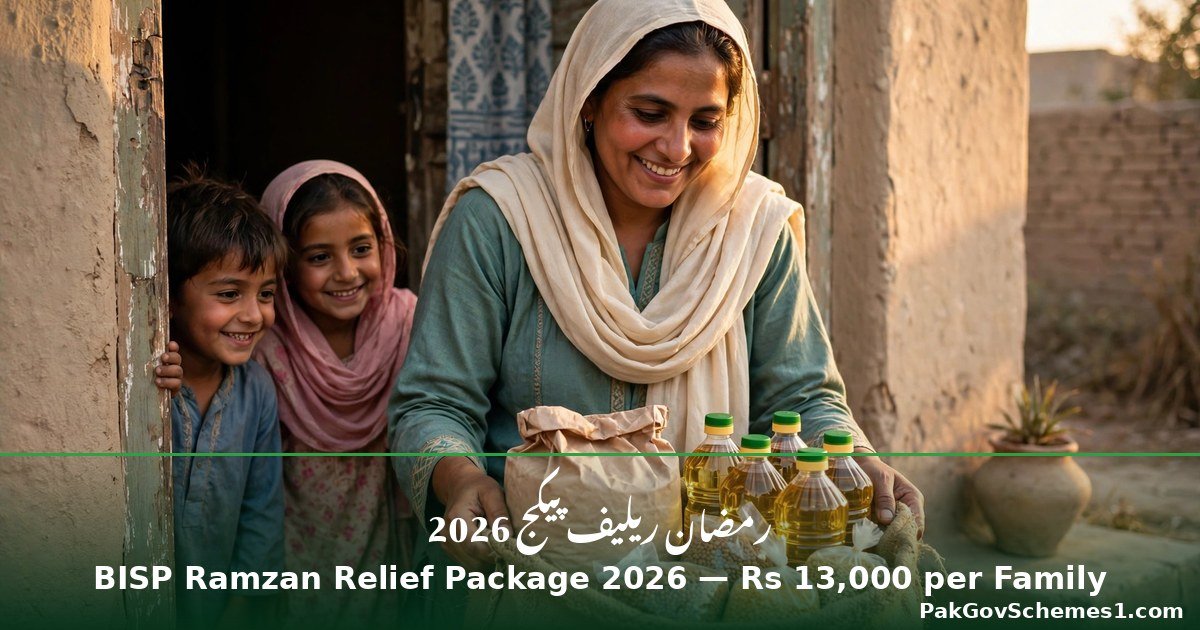
Ramadan 2026 has passed, and with it the federal government’s BISP Ramzan package 2026 relief round has closed. This is the record of what was officially announced for that cycle — the Rs 38 billion federal package, the Rs 13,000 paid to each deserving family through digital wallets, and the Rs 10 billion share reserved for families registered under the BISP Kafalat programme. There is no active application, no registration portal, and no “registration still open” process for 2026, despite claims still circulating on WhatsApp.
Quick Overview
| Item | Detail |
|---|---|
| Programme | Prime Minister Ramazan Relief Package 2026 (BISP-linked; the Kafalat-family component is the “BISP Ramzan package 2026”) |
| Amount per family | Rs 13,000 (officially announced; up from Rs 5,000 in 2025) |
| Total allocation | Rs 38 billion (federal, 2026) |
| Coverage | 12.1 million households across all four provinces, Azad Jammu and Kashmir, and Gilgit-Baltistan |
| Distribution method | Digital wallets and direct bank transfers (utility-store distribution discontinued) |
| Announced | February 14, 2026, by Prime Minister Shehbaz Sharif |
| Status now | Closed — Ramadan 2026 ended in March 2026; no 2027 package officially announced |
| Kafalat families’ share | Rs 10 billion of the Rs 38 billion earmarked for families registered under BISP’s Kafalat programme |
Latest Update — October 23, 2026
The most important fact first: the 2026 Ramzan relief round is over. Ramadan began on February 19, 2026 — the crescent was sighted on the evening of February 18 — and ended around March 19–20, 2026. The federal package announced on February 14 was a Ramadan-season disbursement, and that window has closed.
Two things to note as of October 23, 2026. First, no 2027 Ramzan package has been officially announced. Second, a Geo News fact-check confirmed during the 2026 cycle that “register for the Rs 13,000 relief” websites were fraudulent: the Ministry of Poverty Alleviation confirmed there was no application process, no web portal, and no website for the 2026 package. If you see such sites now, they are scams targeting a closed programme.
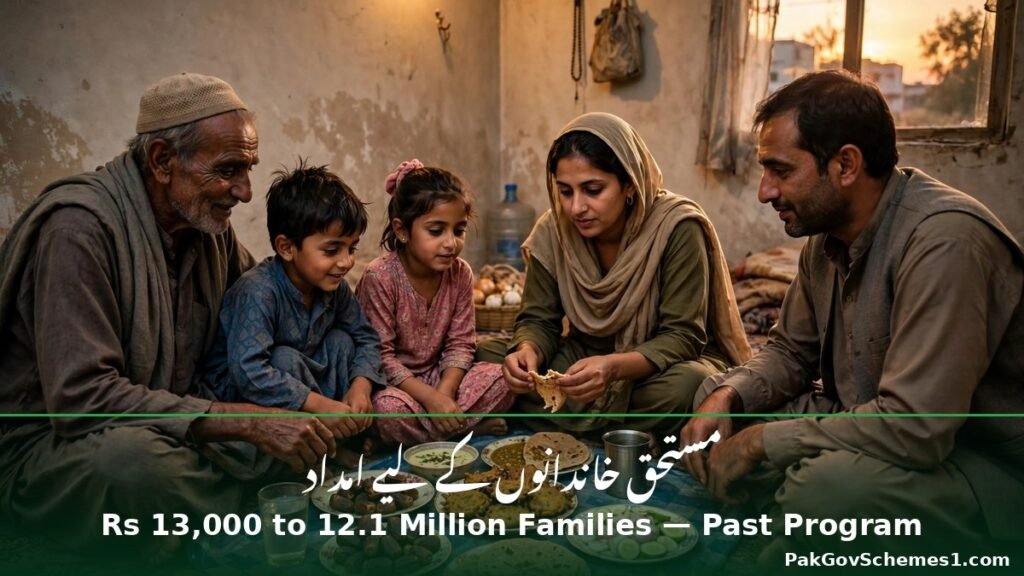
Eligibility (As It Was When the Package Was Active)
The 2026 package did not run an open application. Eligibility was determined from government records. As it stood during Ramadan 2026:
- Deserving families identified by the government — beneficiaries were already in the system; no separate Ramzan application existed.
- Families registered under the BISP Kafalat programme — a dedicated Rs 10 billion slice of the Rs 38 billion was earmarked for them.
- Families not covered by other sponsorship schemes — the remaining Rs 28 billion went to deserving families outside the existing sponsored lists.
- Nationwide coverage — all four provinces plus Azad Jammu and Kashmir and Gilgit-Baltistan.
- No SMS code, no online form, no “registration link” — a Ministry of Poverty Alleviation official told Geo Fact Check that for the 2026 package there was no application process, web portal, or website to register and receive the amount.

BISP’s verified database of deserving households anchored the process, and the Kafalat-registered slice flowed through that record. Keeping your record current via the free dynamic survey at your Tehsil Office remains the sensible move for future relief rounds.
How Beneficiaries Received the Package
The money reached families in a documented flow — all of it reported through official briefings and reputable outlets during February 2026.
Step 1: Beneficiaries were identified from existing records
No new enrollment drive was run. The government drew on its existing welfare databases, with BISP’s Kafalat-registered families forming the identified core of one segment.
Step 2: Payments were sent through digital wallets and banks
Each eligible family received Rs 13,000 directly into a digital wallet or bank account — a deliberate break from the old utility-store system. The Prime Minister said the old arrangement subjected deserving families to substandard items and long queues that compromised their dignity. A State Bank of Pakistan framework governed the disbursement, with twelve banks and fintech companies as partners.

Step 3: Beneficiaries were informed directly
The government ran a nationwide awareness campaign and placed more than 1.2 million automated calls to tell beneficiaries about the package. Real-time dashboards tracked payments as they were made.
Step 4: Progress was reviewed at the top
At the February 26, 2026 review meeting, the Prime Minister was briefed that 64 percent of eligible beneficiaries had received payments by the 8th of Ramazan, with verification and disbursement for the rest progressing. The government cited a third-party audit of the previous year’s Rs 20 billion package (Rs 5,000 per family) which found the digital distribution highly transparent and corruption-free — the basis for repeating the model in 2026.
How to Check Payment Status
During the active disbursement window, beneficiaries verified their status through the package’s own channels: the 9999 helpline, where an agent could check a CNIC and confirm eligibility, and the official status webpage pmrrp.nitb.gov.pk (both reported via Geo Fact Check).
Today, there is nothing left to check — the 2026 round is closed, and no 2027 package has been announced. Keep your regular BISP record healthy instead: send your 13-digit CNIC without dashes by free SMS to 8171 from your own registered number, check 8171.bisp.gov.pk, or call the toll-free BISP helpline 0800-26477. That is the record any future relief round will draw on.
Package Details
| Detail | Officially announced / reported |
|---|---|
| Announcement date | February 14, 2026 (formal launch ceremony, broadcast nationally) |
| Total allocation | Rs 38 billion — described by the Prime Minister as the largest federal Ramazan relief package in the country’s history |
| Amount per deserving family | Rs 13,000 (increased from Rs 5,000 in 2025) |
| Households covered | 12.1 million households (~36 million people) |
| Kafalat programme share | Rs 10 billion for families already registered under the Kafalat programme |
| Remaining share | Rs 28 billion for deserving families not covered by other sponsorship schemes |
| Distribution method | Digital wallets and direct bank transfers; old utility-store distribution discontinued |
| Delivery partners | Twelve banks and fintech companies (reported); State Bank of Pakistan framework for secure disbursement |
| Progress reported (Feb 26, 2026) | 64% of eligible beneficiaries paid by the 8th of Ramazan; 1.1 million digital transactions; 1.2 million+ automated awareness calls |
| 2025 comparison | Rs 20 billion allocation, Rs 5,000 per family; third-party audit found the digital distribution transparent and corruption-free |
| Status-check channels (during the round) | 9999 helpline; pmrrp.nitb.gov.pk status webpage; official app (all reported) |
| Current status | Closed — Ramadan 2026 ended in March 2026 |
Documents Required
Because there was no application process for the 2026 package, no fresh documents were collected for it. For the record:
- Original CNIC — the national ID that anchored eligibility, wallet verification, and any status check.
- A mobile number registered in the beneficiary’s own name — digital-wallet delivery ran on registered SIMs.
- An active digital wallet or bank account — where the Rs 13,000 was transferred.
- For complaints: the original CNIC, and — if available — the date and reference details of any disputed transaction.
No new survey forms were required and no documentation fee was charged for the Ramzan round. Anyone demanding documents plus money for “Ramzan enrollment” was running a scam.
Troubleshooting Common Problems
These were the problems beneficiaries reported during the 2026 disbursement window, and what applied at the time.
- “I never received the Rs 13,000.” Eligibility was system-determined, and disbursement to the remaining beneficiaries was still progressing in late February. The advised action was to call the 9999 helpline and have an agent verify the CNIC.
- “My wallet or bank transfer failed.” With twelve banks and fintech companies in the delivery chain, individual failures occurred. The helpline could confirm whether a transfer had been initiated.
- “An agent deducted money or asked for a cut.” Fraud. All package transfers were free to receive — no agent or officer was entitled to any fee or commission.
- “I got a message with a link to claim my package.” Fake. Geo Fact Check confirmed no website or link was part of the official process; legitimate government websites end in .gov.pk.
- “I received conflicting messages about eligibility.” Only the official channels counted: the 9999 helpline and the pmrrp.nitb.gov.pk status page (both reported). Messages from random numbers promising inclusion were scams.

Official Helpline and Complaints
The channels that belonged to the 2026 Ramzan relief process:
- 9999 helpline — the Ramzan package helpline, where an agent could verify a CNIC and confirm status (reported by Geo Fact Check via a Ministry official).
- pmrrp.nitb.gov.pk — the official status-check webpage for the package (reported by Geo Fact Check via the Press Information Department). Note that Pakistan government websites use the .gov.pk domain — any “registration” page on another domain was fake.
For BISP matters in general: the toll-free helpline 0800-26477, the 8171 SMS service and 8171.bisp.gov.pk portal, and the BISP Tehsil Office in every district for written complaints and re-verification. Genuine BISP messages come only from 8171.
Common Mistakes to Avoid
These mistakes still matter, because the scams they describe have outlived the programme they imitated:

1. Trusting a “registration” website on a non-.gov.pk domain
Geo Fact Check confirmed that the website circulating during Ramadan 2026, asking users to register for the Rs 13,000 payment, was fraudulent and had no connection with the government’s programme. Real government websites end in.gov.pk.
2. Paying anyone a fee for “enrollment”
There was no application process for the 2026 package — no form, no portal, no fee. Any “agent” charging for enrollment was selling nothing; BISP services are free.
3. Believing “Ramzan package 2026 registration still open” claims
The 2026 round closed with Ramadan in March 2026. Anyone now claiming a 2026 registration is “still open” is running a scam.
4. Sharing your CNIC, OTP, or wallet PIN with strangers
Scammers harvested CNIC numbers and OTPs through fake Ramzan links. No genuine helpline or official ever asks for your OTP, PIN, or password.
5. Confusing the Rs 13,000 relief with the regular BISP installment
The Ramzan payment was a one-time seasonal relief, separate from the quarterly BISP installment. In 2026 the confirmed quarterly amount was Rs 14,500; the increase to Rs 18,000 takes effect only from the January 2027 quarter.
6. Acting on a viral date for a 2027 package before any official announcement
No 2027 Ramzan package has been officially announced as of October 23, 2026. The rule for every cycle: do not travel, do not pay, and do not share documents based on a forwarded message — wait for an official 8171 message.
FAQs — BISP Ramzan Package 2026
Is the BISP Ramzan package 2026 still active?
No. It was a seasonal relief round tied to Ramadan 2026, which ended in March 2026. The disbursement window has fully closed — there is no active application, no registration portal, and no pending 2026 payment round for any family.
How much did each family receive under the 2026 package?
Rs 13,000 per deserving household, officially announced on February 14, 2026 — an increase from Rs 5,000 per family in the 2025 package. The Rs 13,000 was transferred via digital wallets or bank accounts, never distributed as ration goods or utility-store packages.
Did BISP families have to register separately for the Ramzan relief?
No. The Ministry of Poverty Alleviation confirmed to Geo Fact Check that there was no application process, web portal, or website for the 2026 package. Beneficiaries — including the Kafalat families covered by the Rs 10 billion slice — were already identified from existing records.

How was the money actually delivered to families?
Through digital wallets and direct bank transfers under a State Bank of Pakistan framework, with twelve partner banks and fintech companies handling delivery. The old utility-store distribution system had already been discontinued entirely for this purpose before the 2026 round.
What was the connection to BISP specifically?
Rs 10 billion of the Rs 38 billion federal package was earmarked for families already registered under the government’s Kafalat programme — BISP’s flagship scheme. The remaining Rs 28 billion covered deserving families who were not on other sponsorship lists.
Was there an official helpline or status-check method?
Yes, during the round: the 9999 helpline, where agents could verify a CNIC and confirm eligibility, and the status webpage pmrrp.nitb.gov.pk — both reported by Geo Fact Check via government officials. These channels belonged to the now-closed 2026 cycle and no longer serve beneficiaries.
Are “Ramzan package 2026 registration still open” messages real?
No. The 2026 round ended in March 2026 and no re-opening has been announced. Geo Fact Check debunked the fraudulent “register for Rs 13,000” website during the cycle itself. Treat any such message arriving today as a scam and delete it without responding.
Has a Ramzan package been announced for 2027?
Not officially announced, as of October 23, 2026. No amount, date, or distribution method for any 2027 package exists in any official announcement. Ignore every viral claim naming figures; rely only on official government announcements instead. Any new development will be reported here once confirmed.
What should I do now to be ready for any future relief round?
Keep your BISP record current: complete the free dynamic survey at your BISP Tehsil Office if asked, keep your CNIC valid, and keep your SIM registered in your own name. Check status anytime via SMS to 8171, 8171.bisp.gov.pk, or 0800-26477.
Why did the 2026 package use digital wallets instead of ration bags?
The Prime Minister said the old utility-store system forced deserving families into long queues and delivered substandard items, compromising their dignity. A third-party audit of the 2025 digital distribution found it fully transparent and corruption-free, which justified repeating the model in 2026.
Safety Notice
Ramzan relief season is prime season for fraud, and the 2026 cycle was no exception. Geo News’ fact-check confirmed that fraudulent websites asked people to “register” for the Rs 13,000 payment with no connection to the government’s programme. The rules: genuine BISP messages come only from 8171; legitimate government websites end in .gov.pk; no official ever asks for your OTP, PIN, or password; and no relief process charges a registration fee.

Conclusion
The BISP-linked Ramzan relief of 2026 — Rs 38 billion, Rs 13,000 per family, digital wallets for 12.1 million households, Rs 10 billion for Kafalat families — is a closed chapter, disbursed during Ramadan (February–March 2026). It confirmed two lasting lessons: the digital model replaced the old ration queues, and there was never any registration to pay for — a fact the fraudsters exploited and the fact-checkers corrected. No 2027 package has been announced; until one is, keep your BISP record current through the free official channels and distrust every “Ramzan package” message not from 8171 or a.gov.pk source.

Official Sources
Official (government announcements and briefings):
- Radio Pakistan (radio.gov.pk) — PM Ramazan Relief Package 2026 review briefing, Feb 26, 2026: Rs 38 billion, Rs 13,000 per family, digital wallets, 64% paid by 8th Ramazan, 12 bank/fintech partners, 1.1M transactions, 1.2M+ robo-calls (https://www.radio.gov.pk/26-02-2026/pm-announces-formal-launch-of-ramazan-relief-package-2026)
- bisp.gov.pk — re-checked October 23, 2026; no Ramzan-specific 2026 announcement found (the package was federal; BISP’s Kafalat-registered families formed part of the identified beneficiary base)
- 8171.bisp.gov.pk — official BISP status-check portal
- Ministry of Poverty Alleviation and Social Safety, via Geo Fact Check — no application process, web portal, or website for the Ramadan Relief Package 2026; beneficiaries already identified (https://www.geo.tv/latest/654206-fact-check-website-asking-users-to-register-for-rs13000-ramadan-relief-is-fraudulent)
Reported (third-party outlets, cited as such in this article):
- Dawn ePaper, Feb 15, 2026 — unveiled Feb 14, 2026: Rs 38 billion for 12.1M families; Rs 10 billion for Kafalat families; utility-store system discontinued; 2025’s Rs 20bn audit found transparent (https://epaper.dawn.com/DetailImage.php?StoryImage=15_02_2026_001_005)
- ProPakistani, Feb 14, 2026 — Rs 13,000 per family via digital wallet or bank transfer; Rs 10 billion for Kafalat families; State Bank framework (https://propakistani.pk/2026/02/14/govt-announces-rs-13000-cash-support-for-each-deserving-family/)
- Profit by Pakistan Today, Feb 14, 2026 — 12.1 million households to receive Rs 13,000 each through digital wallets (https://profit.pakistantoday.com.pk/2026/02/14/rs38bn-ramazan-package-unveiled-12-1m-households-to-receive-rs13000-each)
- The Nation, Feb 27, 2026 — 64% of eligible individuals had received payments; 9999 helpline and app reported (https://www.nation.com.pk/27-Feb-2026/64pc-eligible-individuals-received-payments-pm-s-ramazan-relief-package)
- ARY News — Ruet-e-Hilal announced the crescent on Feb 18, 2026; first fasting day Feb 19, 2026 (https://arynews.tv/ramadan-2026-cresent-pakistan-live-updates)
- Pakistan Today (updated Sep 29, 2026) — BISP warning: genuine messages only from 8171; helpline 080026477 (https://www.pakistantoday.com.pk/2024/01/14/bisp-warns-citizens-against-fraudulent-messages-about-program)
Disclaimer: PakGovSchemes1.com is an independent informational website and is not affiliated with any government department. Information is compiled from available official announcements and other identified sources and may change. Please verify eligibility, registration status, payment details, and deadlines through the relevant official government website before taking action.

