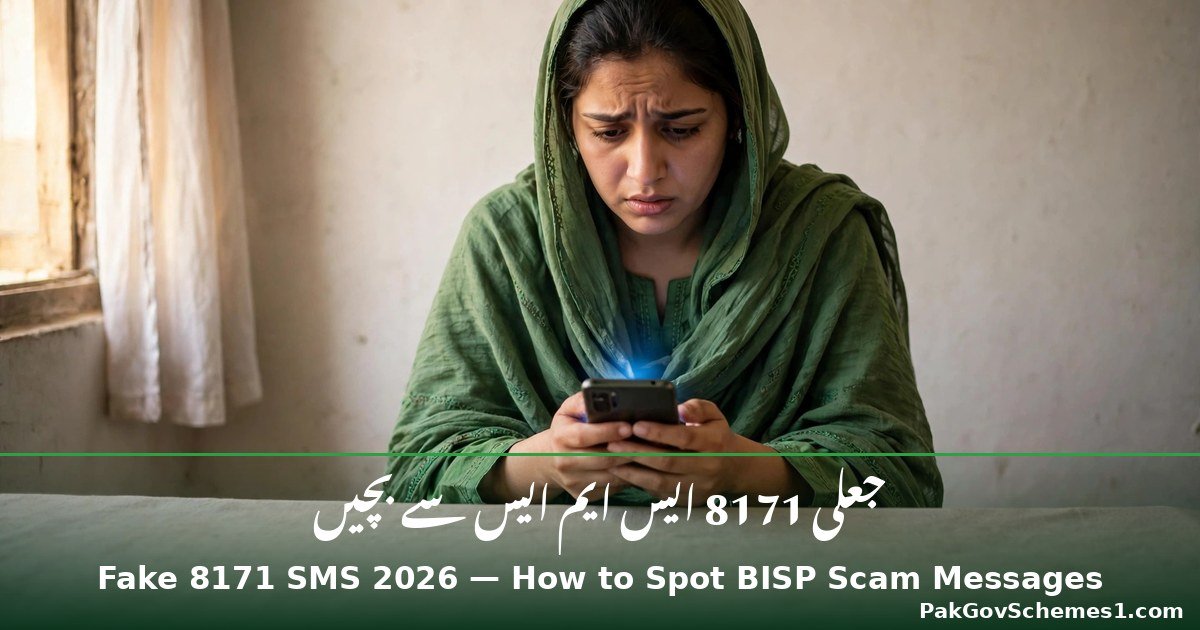
Fake 8171 SMS 2026 – How to Spot BISP Scam Messages
Fake 8171 SMS 2026 messages are the most common way scammers try to steal money and personal details from BISP beneficiaries in Pakistan. A text arrives claiming your Benazir Kafaalat payment is ready, then asks you to click a link, pay a fee, or share a code — and it is all a lie. Real BISP messages come only from the short code 8171, never contain links, and never ask for money. This guide, checked against official BISP, NCCIA and PTA sources on 11 November 2026, shows how to tell a real message from a fake one, what to do when one arrives, and where to report it.
Quick Overview
| Information | Details |
|---|---|
| Programme | Benazir Income Support Programme (BISP) — Benazir Kafaalat |
| Official SMS sender | 8171 only — any other number claiming to be BISP is fake |
| Official portal | 8171.bisp.gov.pk (type it yourself; never follow a link) |
| Official website | bisp.gov.pk |
| Real Kafaalat amount | Rs 14,500 per quarter (Oct–Dec 2026) |
| Oct–Dec 2026 payment start | Not officially announced as of 11 November 2026 |
| Registration and survey | Free, in person at a Tehsil Office — no online form or app |
| BISP helpline | 0800-26477 (toll-free) |
| Cybercrime reporting | NCCIA helpline 1799; complaint.nccia.gov.pk |
| Spam SMS reporting | Forward the message to 9000; PTA helpline 0800-55055 |
| Last updated | 11 November 2026 |
Latest Update — 11 November 2026
The newest verified warning came from the National Cyber Crime Investigation Agency (NCCIA) on 9 November 2026: messages in the Prime Minister’s name, falsely offering a cash reward of Rs 13,000, are a fraud. They may contain dangerous links designed to steal personal and banking details. Do not click, share details, or forward them. Report them to the NCCIA helpline 1799.
BISP restated the same warning in Press Releases No. 70 and 71 (24–25 August 2026): 8171 is its only official number, and it charges nothing. No newer BISP fraud alert was found on bisp.gov.pk. Two claims need care: “12 November” payment-start messages are unconfirmed, and “added today for a fee” messages misuse a policy discussion only highlighted on 29 October 2026.
Eligibility Criteria: Who Scammers Target
Scammers aim at the people most likely to believe a payment message.
- Registered BISP beneficiaries: Women receiving Benazir Kafaalat are the prime target — “your payment” sounds believable.
- People waiting for a first payment: Families awaiting approval after the NSER survey want good news — exactly what a fake “payment approved” message offers.
- Elderly beneficiaries and those who cannot read well: Older women, and anyone who struggles with SMS text, trust a message carrying BISP’s name.
- People in villages and small towns: Where the nearest BISP office is far, a message offering to “fix” registration by phone feels convenient.
- Anyone who recently searched for BISP help online: People who clicked BISP links or joined Facebook groups may be on a scammer’s list.
Being on this list means be extra careful — a real BISP message comes only from 8171.

Registration Procedure: Step by Step — What to Do When You Get a Suspicious Message
Do not act on the message itself. Follow these steps in order.

- Read the sender first. If the sender is the short code 8171, it may be genuine. An ordinary mobile number (03xx) or WhatsApp account means fake.
- Do not click any link. A real 8171 message never contains a link. Any link proves the message is fake — the page may install malware or copy what you type.
- Do not reply, call back, or send any code. Replying confirms your number is active. Never share your CNIC, OTP, wallet PIN, bank details, or a CNIC photo.
- Do not pay anything. BISP registration, surveys, status checks and payments are free. Any “fee”, “tax” or “verification charge” is fraud.
- Check your real status yourself. Send your 13-digit CNIC by SMS to 8171, or type 8171.bisp.gov.pk into your browser and enter your CNIC, mobile number and picture code.
- Take a screenshot and save the message. Keep the sender’s number and full text visible. Do not delete it yet — it is your evidence.
- Report the sender to PTA. Forward the message to 9000 — type the sender’s number, a space, then the message. Or call the PTA helpline 0800-55055 (9am–9pm, seven days a week).
- Report the fraud to BISP — and to NCCIA if money or data was taken. Call the BISP helpline 0800-26477 (toll-free). If you shared an OTP or paid money, also call NCCIA on 1799 or complain at complaint.nccia.gov.pk.
- Warn your family the same day. Tell your parents and neighbours: “8171 never sends links and never asks for money.”
CNIC Check or Application Status — The Real 8171 Portal
There are only two official ways to check your BISP status, and both are free. By SMS: type your 13-digit CNIC number (without dashes) and send it to 8171 from your own phone. The reply tells you whether you are eligible, under verification, or not eligible.
By web portal: type 8171.bisp.gov.pk into your browser yourself — do not click a link in any message to get there. Enter your CNIC, your registered mobile number, and the picture code. If it does not open, use the SMS method. Fake portals copy BISP’s logo but use a different domain.
What the replies mean: if you are eligible, wait for the payment SMS from 8171 before visiting a payment centre. If your record is under verification, visit your nearest BISP Tehsil Office with your original CNIC. If you are not eligible, no agent, link, or fee can change that. If you get no reply, check the CNIC digits and your SMS balance, then try again. See our guide to each BISP 8171 status message.
Payment Details and Schedule
Fake messages almost always quote a wrong amount. Knowing the real figures exposes them fast.
| Detail | Verified Information |
|---|---|
| Current Kafaalat amount | Rs 14,500 per quarter (BISP Press Release No. 20, 10 Mar 2026) |
| Current quarter | October–December 2026; released in phases, district by district |
| Payment start date (Oct–Dec 2026) | Not officially announced as of 11 November 2026 |
| Next announced amount | Rs 18,000 from January 2027 — reported (presidency briefing, 22 Jun 2026) |
| Payment method | Partner bank / Benazir wallet and authorised payment points; SMS only from 8171 |
| Cash withdrawal charge | Rs 280 fixed charge (BISP Press Release No. 70, 24 Aug 2026) |
| Payment status check | SMS your CNIC to 8171, or 8171.bisp.gov.pk |
| Deduction complaints | Report at once on 0800-26477 or at your BISP Tehsil Office |
Any message promising Rs 25,000, Rs 12,000 or Rs 27,000 matches no real BISP amount and is fake. The Rs 13,000 “PM cash prize” is also fake — NCCIA warned about it on 9 November 2026. Even a correct-looking Rs 14,500 message is fake if it comes from another number or asks for a fee.
Required Documents
No documents are needed to spot a fake message:
- Your original CNIC — for the portal or a Tehsil Office visit.
- Your registered mobile number — the SMS check must be sent from your own phone.
- A screenshot of the fake message — sender’s number and full text, as evidence.
- The sender’s number, written down — for forwarding to 9000 and reporting.
- Transaction proof, only if money was lost — your wallet or bank receipt, for NCCIA.
Never send a photo of your CNIC to anyone, or give your CNIC or phone to an “agent” who offers to check your record for a fee.
How to Check Registration Problems
Problems usually have a safe, official fix.
Clicked a link or shared an OTP: close the page at once. Call your bank or wallet first to freeze the account and change your PIN, then call 0800-26477 and NCCIA on 1799. Paid a “fee”: the money is unlikely to come back, but report it to NCCIA (1799) and your wallet/bank with the transaction proof. Downloaded a “BISP app”: there is no official BISP app. Uninstall it at once. See our guide BISP 8171 App 2026 — Real or Fake? No reply to your SMS to 8171: check the CNIC digits and your SMS balance. Try the portal instead — the service is slow during payment season. Status “under verification” for months: visit your nearest BISP Tehsil Office with your original CNIC. See our BISP Tehsil Office locator. Money deducted at a payment point: BISP’s fixed charge is Rs 280. Report any extra deduction on 0800-26477 with your payment SMS and receipt.
Official Helpline and Complaint Procedure
Report every fake message, even if you spotted it in time.
Call the BISP helpline 0800-26477 (toll-free) to report a fake message, fee demand, or deduction — nobody from BISP will call you from it asking for money. Visit your nearest BISP Tehsil Office with your original CNIC for status, survey, and deduction problems; registration and the survey are free.

When money or data was taken, call the NCCIA helpline 1799 — NCCIA replaced the FIA Cyber Crime Wing — or file formally at complaint.nccia.gov.pk or helpdesk@nccia.gov.pk, with your name, CNIC, what happened, and your screenshots. Forward the fake SMS to 9000 (sender’s number, a space, then the message) or call the PTA helpline 0800-55055 (9am–9pm, seven days a week) to have the SIM blocked. If money moved, call your bank, Easypaisa or JazzCash first. Report fake Facebook pages inside the app; see our guide on fake BISP Facebook pages.

Fake 8171 SMS 2026: Fake Claims Debunked
These claims circulate widely. Each one is false, and each one has a simple check.
| Circulating claim | Verdict | Why |
|---|---|---|
| “Your BISP payment of Rs 25,000 is ready — click this link” | FAKE | No BISP payment is Rs 25,000. |
| “PM Shehbaz Sharif is giving Rs 13,000 cash prize — click to claim” | FAKE | NCCIA warned about this message on 9 November 2026. |
| “BISP payments start 12 November 2026” | UNCONFIRMED | No BISP announcement confirms this date. |
| “Rs 18,000 payment from October 2026” | FAKE as dated | Rs 18,000 is the reported figure for January 2027. |
| “Download the official BISP 8171 app to receive payment” | FAKE | There is no official BISP app. |
Common Mistakes to Avoid
Clicking a link “just to check”: the link is the trap. Believing a message because the amount looks right: scammers now quote the real Rs 14,500. Paying a small “verification fee”: BISP charges nothing. Sharing your CNIC photo or OTP on WhatsApp: they can unlock your mobile wallet. Trusting a Facebook page that uses BISP’s name: logos are copied in minutes. Letting a shopkeeper or “agent” handle your messages: they may copy your details. Travelling on a forwarded message: wait for the official SMS from 8171.

Frequently Asked Questions
How do I identify a fake 8171 SMS?
Check the sender first. A real message comes only from the short code 8171. A fake one comes from an ordinary mobile number and usually contains a link, a prize or inflated amount, a fee demand, or a request for your CNIC or OTP.
Does BISP ever send links by SMS?
No. BISP never sends clickable links, never announces prize winnings, and never asks for fees, OTPs, or PINs by SMS. The only official web address is 8171.bisp.gov.pk, which you must type yourself — any link inside a message claiming to be from BISP is fake.
What should I do if I already clicked a fake 8171 SMS link?
Close the page at once and do not type anything into it. If you entered details, call the BISP helpline 0800-26477. If you shared an OTP or wallet details, contact your bank or wallet provider immediately to freeze the account.
Where do I report a fake 8171 SMS?
Forward the message to 9000 (sender’s number, a space, then the message) so PTA can act on the number. Call the BISP helpline 0800-26477 so the fraud pattern is recorded. If money or data was taken, also complain to NCCIA on 1799.
Can scammers fake the 8171 sender name?
Scammers normally use ordinary mobile numbers because the 8171 short code belongs to BISP, so checking the sender works. Even so, never rely on the sender alone — a message with a link or a fee demand is fake whatever the sender shows.
Is there an official BISP 8171 app I should download?
No, there is no official BISP app. Any message, Facebook post, or WhatsApp forward offering a “BISP app” or APK file is a scam. App links harvest your data or install malware. Check your status only by SMS to 8171 or on 8171.bisp.gov.pk.
What is the real BISP payment amount in 2026?
The real Benazir Kafaalat payment is Rs 14,500 per quarter, confirmed by BISP Press Release No. 20 (10 March 2026). Rs 18,000 is the reported figure for January 2027, not this quarter. Messages promising other amounts match no real BISP payment.
Someone called me claiming to be from BISP. Is that real?
No. BISP does not call beneficiaries to ask for CNIC numbers, OTPs, fees, or SIM details. A call asking for these is fraud, even if the caller sounds polite and uses your name. End the call and report the number to PTA on 0800-55055.
How do I check my real BISP payment status safely?
Send your 13-digit CNIC number by SMS to 8171 yourself, or type 8171.bisp.gov.pk into your browser and enter your CNIC, mobile number, and the picture code. Both methods are free. Never check your status through a link sent to you in a message.
What if money was deducted from my BISP payment?
BISP’s fixed cash-withdrawal charge is Rs 280. Any deduction above that is unauthorised. Report it immediately on the BISP helpline 0800-26477 and at your nearest BISP Tehsil Office, with your payment SMS from 8171 and the receipt from the payment centre.
Important Safety Notice
Use only verified official channels — SMS to 8171, the portal 8171.bisp.gov.pk, bisp.gov.pk, and the helpline 0800-26477. Never share your OTP, PIN, password, or CNIC photo, and never pay anyone for BISP services. If a message creates urgency, that urgency is itself a warning sign: stop, check the sender, and verify first.
Conclusion
Fake 8171 SMS 2026 messages succeed only when they are believed for a few seconds. The defence is one simple rule: a real BISP message comes only from 8171, has no link, and never asks for money or codes. Check your status yourself by SMS to 8171 or on 8171.bisp.gov.pk, report every fake message to 0800-26477, 9000, and NCCIA 1799 when money or data is involved, and warn your family the same day. When in doubt, trust the official channel — never the message.
Official Sources
- BISP Press Releases No. 70 and 71 (24–25 Aug 2026): 8171 is the only official BISP number; BISP charges nothing; Rs 280 cash-withdrawal charge.
- BISP Press Releases No. 57, 66, 06 and 20 (2026): helpline 0800-26477; no agent may charge; all authentic messages come only through 8171; Kafaalat is Rs 14,500 per quarter.
- NCCIA warning, 9 November 2026 (ProPakistani, UrduPoint, Dunya News): fake Rs 13,000 PM cash-prize messages; report on helpline 1799.
- PTA consumer guidance (re-verified 9 Nov 2026): helpline 0800-55055; forward spam SMS to 9000; REG to 3627.
- Press Information Department release, 29 Oct 2026: ever-married removal highlighted at a briefing to the First Lady (reported, not yet a rule).
Disclaimer: PakGovSchemes1.com is an independent informational website and is not affiliated with any government department. Information is compiled from available official announcements and other identified sources and may change. Please verify eligibility, registration status, payment details, and deadlines through the relevant official government website before taking action.

