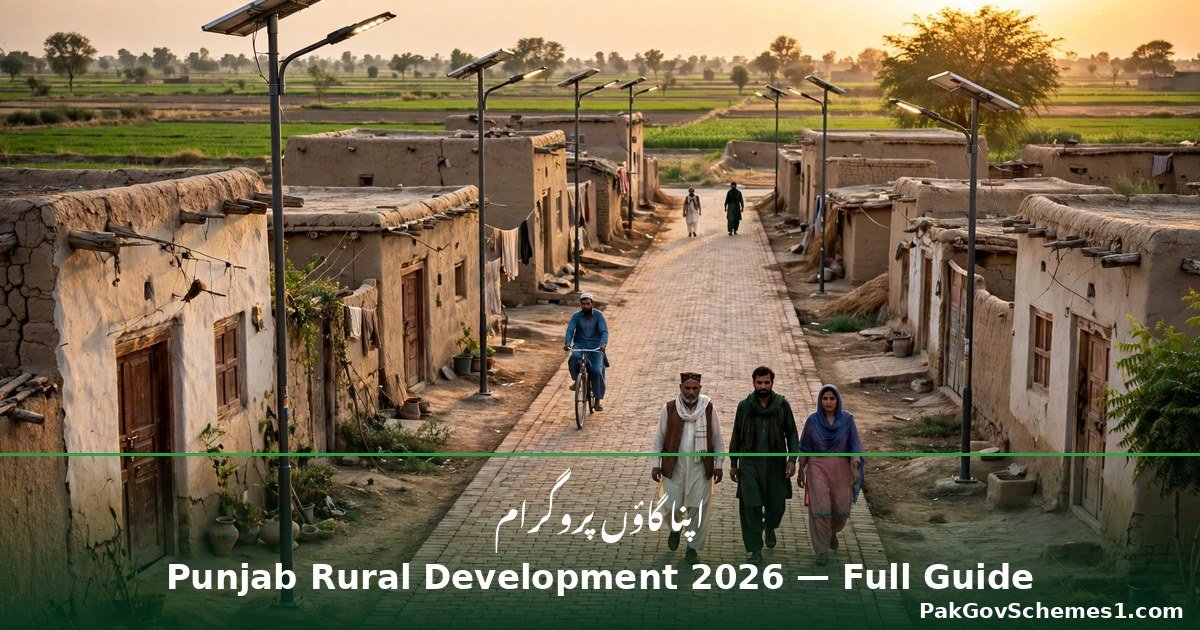
Punjab Apna Gaon Programme 2026 is the Punjab government’s new rural development programme, approved by Chief Minister Maryam Nawaz Sharif on 17 November 2026. Under it, villages will get paved streets, modern drainage, wastewater disposal ponds and solar streetlights — and the residents of each village will decide the priorities themselves through a cooperative society. In the first phase, cooperative societies will be set up in 485 villages, and 1,500 more villages will follow in the second phase. This guide explains what has actually been announced, how the cooperative model will work, and what villagers should — and should not — expect.
Quick Overview
| Information | Details |
|---|---|
| Programme name | CM Punjab Apna Gaon Programme (also reported as “Apna Gaon Programme”; Dunya News calls it the “Khushhal Dehat Programme”) |
| Announced / approved | 17 November 2026, by Chief Minister Maryam Nawaz Sharif at a special meeting in Lahore |
| Responsible authority | Government of Punjab; the department running the programme has not been officially named. The Assistant Director of Local Government sits on the tehsil monitoring committee |
| Programme purpose | Develop villages: paved streets, modern drainage, wastewater disposal ponds, solar streetlights |
| How it works | Cooperative society model — village residents decide development, construction and repair priorities |
| Phase 1 | Cooperative societies in 485 villages |
| Phase 2 | 1,500 more villages (1,985 villages in total across both phases) |
| Launch deadline | Within 44 days of the 17 November 2026 approval — that is, by 31 December 2026 |
| Budget / funding | Not officially announced |
| List of villages | Not officially announced |
| Citizen application | None announced — this is a government-implemented programme, not an individual application scheme |
| Helpline | Not officially announced |
| Last updated | 18 November 2026 |

Latest Update — Approved on 17 November 2026
On Monday 17 November 2026, Punjab Chief Minister Maryam Nawaz Sharif chaired a special meeting in Lahore and approved the launch of the CM Punjab Apna Gaon Programme through designated cooperative societies. The Government of Punjab announced it the same day, and it was reported by UrduPoint (carrying the Associated Press of Pakistan report), Pakistan Today, Business Recorder, Express Tribune, ARY News and Dunya News.
The chief minister set a 44-day deadline for the launch. Counting 44 days from the 17 November approval, the launch is due by 31 December 2026. That date is our calculation from the announced deadline — the government has not named a specific launch date, and no launch ceremony has been announced yet.
The same meeting agreed to partially lift the ban on cooperative societies in Punjab after nearly 29 years, so the societies needed for the programme can be formed. An administrative structure has also been put in place to run it transparently.
What the Programme Will Build in Villages
The programme covers four infrastructure works in each selected village — the only works named in the official announcement.
1. Paved streets. Village streets will be paved, replacing the mud and broken-brick lanes that turn to mud in the rain and dust in the dry season.
2. Modern drainage systems. Proper drains will be built so that rainwater and household wastewater do not collect in the streets.
3. Wastewater disposal ponds. Suitable ponds (joharr) will be developed to dispose of wastewater safely, instead of letting it pool beside homes and streets.
4. Solar streetlights. Solar-powered streetlights will be installed so village streets are lit at night without adding to electricity bills. The chief minister gave a separate direction for the installation of solar streetlights in villages.
The government says the aim is to improve the quality of life in rural areas and reduce migration to the cities. No other facilities — such as water supply, gas, schools or health units — have been announced as part of this programme, and readers should not assume they are included.

How the Cooperative Society Model Works
The most important feature of the Punjab Apna Gaon Programme 2026 is that it is not run from Lahore alone. Each village’s cooperative society will decide what its own village needs first — which street to pave, which drain to repair, where the pond should go — and the work will be completed through that society.

The chief minister said she wanted to put the people of each village in charge of its development, and that the model would make rural development long-term and sustainable while encouraging grassroots democracy and self-reliance.
Two committees will run the model, according to the announcement:
A five-member tehsil monitoring committee will oversee the working of the cooperative societies. It will be headed by the Assistant Commissioner of the tehsil, and the Assistant Director of Local Government will also be a member.
A five-member management committee for each village society, made up of a president, vice president, general secretary, treasurer and executive member, will manage the society’s work and make sure funds are used properly.
How the members of each village society will be chosen — by election, by nomination or by some other method — has not been announced. That detail is expected when the programme launches. Readers should not pay anyone who claims to be collecting names or fees for society membership before any official process is announced.
Phases and Timeline
| Phase | Villages | What happens | Status |
|---|---|---|---|
| Phase 1 | 485 | Cooperative societies established; development projects begin | Approved 17 Nov 2026; launch due within 44 days |
| Phase 2 | 1,500 | Programme extended to 1,500 more villages | Announced; no start date given |
| Total | 1,985 | Both phases combined | Planned coverage |
The 44-day deadline is the only date the government has given. It runs from the approval on 17 November 2026, which points to a launch by 31 December 2026. No date has been announced for the second phase, and no district-wise or village-wise list has been published for either phase. If a list appears on social media claiming to name the 485 first-phase villages, treat it as unconfirmed until the Punjab government publishes it officially.
For comparison, the province’s cleanliness drive is covered in our Suthra Punjab Programme guide, and its connectivity work in our Punjab free Wi-Fi hotspots guide.

Who Benefits — and Is There Any Eligibility Test?
There is no individual eligibility test for the Punjab Apna Gaon Programme 2026, because it is not a cash or subsidy scheme for individuals. The beneficiaries are whole villages: every resident of a selected village benefits when its streets are paved, its drains are built and its streetlights are installed.
No income limit, CNIC condition, PMT score or age requirement has been announced. The only question that matters for a villager is whether their village is among the 485 in the first phase or the 1,500 in the second — and that list has not been published yet.
It is also worth being clear about what this programme is not. It is a development programme for Punjab province in Pakistan. It has nothing to do with any scheme of the same or a similar name in Indian Punjab. It is also not a housing scheme, not a loan scheme and not a cash-transfer programme — no money will be paid to individual villagers under this programme as announced.
Registration — There Is No Public Application
There is no application form, online portal, SMS code or registration office for the Punjab Apna Gaon Programme 2026, because villagers do not apply to join it. The government selects the villages and sets up the cooperative societies, and the work is then carried out through them.

That means the steps a villager can take are limited and simple:
Step 1: Wait for the official village list. Until the government publishes which 485 villages are in the first phase, nobody can confirm whether a particular village is included.
Step 2: Watch for the society formation in your village. When the programme reaches a village, a cooperative society will be formed there; how its five office-bearers will be chosen has not been announced yet.
Step 3: Take part in the society’s decisions. Once a society exists, residents will be able to raise their village’s priorities — which street, which drain — through it. That is the participation the programme promises.
Step 4: Check with your tehsil office if needed. The tehsil monitoring committee is headed by the Assistant Commissioner, so the Assistant Commissioner’s office is the natural place to ask about the programme in your tehsil. Do not pay any agent who offers to “register” your village or your name — no such paid registration exists.
How to Check Whether Your Village Is Included
There is no online portal, SMS service or CNIC check for this programme, and no status-check system has been announced. As of 18 November 2026, the only way to know whether a village is in the first phase is to wait for the official list, which this article will reflect once published.
Until then, be careful with lists circulating on WhatsApp and Facebook. A genuine list will come from the Government of Punjab or the relevant department, not from a random page. If someone asks for your CNIC number, a fee, or an OTP to “check” your village’s status, it is a scam — the programme has no such check.
Documents Required
No documents are required from villagers, because there is no citizen application. No CNIC copy, no form and no fee have been asked for.
Documents may be needed later for people who become office-bearers of a village cooperative society — for example, a CNIC to record membership — but no such requirement has been announced. If anyone asks you for documents or money in the name of this programme before any official process is announced, do not hand them over.

What to Do If Your Village Is Not in Phase 1
Most Punjab villages will not be in the first phase — only 485 are, out of thousands of villages in the province. If your village is not among them, that does not mean it has been left out permanently: the second phase covers 1,500 more villages, but no date or selection method for it has been announced.
There is no appeal process and no way to apply for inclusion, because villages are selected by the government, not by application. The practical step is to follow the official announcements and check whether your village appears when the second-phase list is published. Meanwhile, other Punjab development work continues — for example, the district-level package covered in our Attock development package guide.
Official Helpline and Complaint Procedure
No helpline number, complaint portal or dedicated office has been officially announced for the Punjab Apna Gaon Programme 2026. This article does not invent one.
Until a contact channel is announced, the route for questions is the local administration: the Assistant Commissioner heads the tehsil monitoring committee, and the Assistant Director of Local Government is also a member. Villagers with a question about the programme in their tehsil can approach the Assistant Commissioner’s office. If a helpline is announced at the launch, we will add it here.

Common Mistakes to Avoid
Paying someone to “register” your village or your name. There is no registration and no fee. Anyone charging for it is running a scam.
Trusting a village list from WhatsApp or Facebook. No official list of the 485 villages has been published. Only a list from the Government of Punjab counts.
Treating 31 December 2026 as a confirmed launch date. The government set a 44-day deadline; 31 December is our calculation from that deadline, not an announced launch date.
Expecting cash payments. This is an infrastructure programme — streets, drains, ponds and lights — not a cash-transfer or subsidy scheme. No money will be paid to villagers.
Confusing it with Indian Punjab schemes. This is the Government of Punjab, Pakistan. Announcements from Indian Punjab are a different government and a different programme.
Mixing up the programme’s name. Most reports call it the “Apna Gaon Programme” or “CM Punjab Apna Gaon Programme”, while Dunya News calls it the “Khushhal Dehat Programme”. They appear to describe the same 17 November decision, but the Government of Punjab’s own announcement uses Apna Gaon Programme.
Sharing your CNIC or OTP for a “status check”. There is no CNIC or status check for this programme. Never share CNIC images, bank details or OTPs with strangers.

Frequently Asked Questions
What is the Punjab Apna Gaon Programme 2026?
It is a Punjab government rural development programme approved on 17 November 2026 by Chief Minister Maryam Nawaz Sharif. Villages will get paved streets, modern drainage, wastewater disposal ponds and solar streetlights, with residents deciding priorities through cooperative societies in each village.
How many villages will the Apna Gaon Programme cover?
A total of 1,985 villages are planned. In the first phase, cooperative societies will be established in 485 villages, and in the second phase the programme will extend to 1,500 more villages. No list of the villages has been published yet.
When will the Punjab Apna Gaon Programme 2026 launch?
The chief minister set a 44-day deadline from the approval on 17 November 2026, which points to a launch by 31 December 2026 — a date calculated from the announced deadline; the government has not named a specific launch date yet.
How can I apply for the Apna Gaon Programme?
You cannot apply, because there is no public application. This is a government-implemented programme: the government selects the villages and sets up cooperative societies there. Villagers take part through their village society once it is formed, not by applying online or by SMS.

What is a cooperative society in the Apna Gaon Programme?
It is a village-level body that will decide and manage development work in its village, such as which streets to pave and which drains to build. Each society will have a five-member management committee with a president, vice president, general secretary, treasurer and executive member.
Who will monitor the cooperative societies?
A five-member tehsil monitoring committee headed by the Assistant Commissioner will oversee the societies, with the Assistant Director of Local Government also serving as a member. This structure is meant to keep the work transparent and the funds properly used.
Is there a budget for the Apna Gaon Programme?
Not officially announced. No budget or funding figure for the programme was given in the 17 November 2026 announcement or in any news report checked for this article. If the government announces a budget at the launch, we will update this guide with the figure.
Will villagers get money under this programme?
No. This is not a cash-transfer, loan or subsidy scheme. The programme builds village infrastructure — paved streets, drainage, wastewater ponds and solar streetlights. No payment to individual villagers has been announced, so anyone promising cash in its name is not genuine.
Is this the same as the Khushhal Dehat Programme?
It appears to be the same decision. Dunya News reported the 17 November 2026 announcement under the name “Khushhal Dehat Programme”, with the same 485 and 1,500 village figures and the same 44-day deadline. The Government of Punjab’s own announcement calls it the Apna Gaon Programme.
How do I know if my village is in the first phase?
You cannot check yet, because no village list or online portal has been published. Wait for the official list from the Government of Punjab. Do not trust lists on social media, and never pay anyone or share your CNIC to “check” your village’s status.
Important Safety Notice
Check programme details only on verified official government sources and reputable news reports, and never share your CNIC image, bank details, OTPs or passwords with strangers who promise to register your village. No official charges a fee for this programme. PakGovSchemes1.com is an independent informational website, not a government department.
Conclusion
Punjab Apna Gaon Programme 2026 is a new idea for rural Punjab: instead of decisions being made far away, each village’s own cooperative society will set its development priorities, while the government provides paved streets, drainage, wastewater ponds and solar streetlights. The first phase covers 485 villages, the second 1,500 more, and the launch is due within 44 days of the 17 November approval. But the details that matter most — the village list, the budget and how society members will be chosen — have not been announced yet. Follow official announcements and check back here for verified updates.
Official Sources
- UrduPoint (Pakistan Point News / APP), “Punjab Announces Apna Gaon Programme for Rural Development, Prosperity and Basic Facilities”, 17 November 2026 — urdupoint.com — full announcement: 485 and 1,500 villages, 44-day deadline, 29-year ban partially lifted, five-member committees, solar streetlights.
- Pakistan Today, “Maryam Nawaz approves Apna Gaon Programme for 485 villages in first phase”, 17 November 2026 — pakistantoday.com.pk — approval at special meeting, Government of Punjab announcement quoted, tehsil monitoring committee details.
- Business Recorder, “CM gives nod to ‘Apna Gaon Programme’ through cooperative societies”, 18 November 2026 — brecorder.com — 485 first-phase villages, 1,500 in second phase, 44-day deadline, 29-year ban.
- Express Tribune, “CM approves rural co-op societies plan”, 18 November 2026 — tribune.com.pk — paved streets, drainage systems and wastewater disposal ponds through the cooperative society model.
- ARY News, “CM Punjab approves ‘Apna Gaon Programme’ through cooperative societies”, 17 November 2026 — arynews.tv — approval, phases, 44-day deadline, 29-year ban partially lifted.
- Dunya News, “CM Punjab announces Khushhal Dehat Programme for rural development”, 17 November 2026 — dunyanews.tv — same figures under the “Khushhal Dehat Programme” name; confirms the naming difference.
- NewsGuru, “Punjab Government Sets Deadline To Launch Village Programme”, 17 November 2026 — newsguru.pk — 1,985 total villages, infrastructure scope, further details expected.
Disclaimer: PakGovSchemes1.com is an independent informational website and is not affiliated with any government department. Information is compiled from available official announcements and other identified sources and may change. Please verify eligibility, registration status, payment details, and deadlines through the relevant official government website before taking action.

