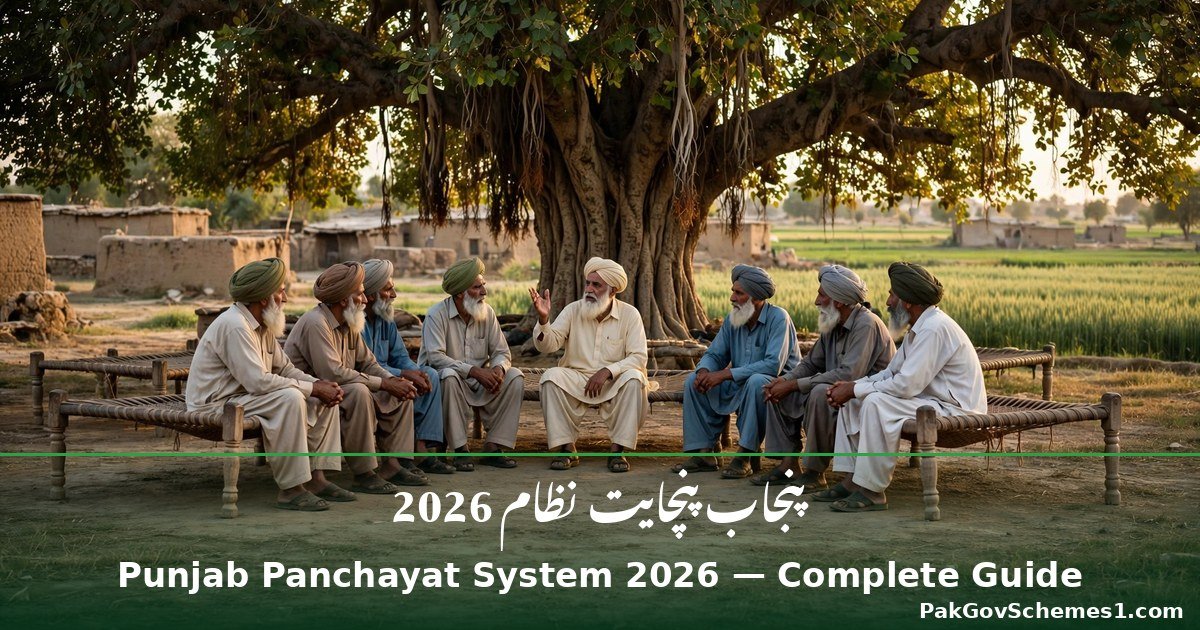
The Punjab Panchayat system 2026 is a proposed community justice plan for Punjab that would let local disputes be settled in the village itself, through mediation and mutual consent, instead of going to court. Punjab Chief Minister Maryam Nawaz Sharif gave in-principle approval to the plan on Wednesday, 18 November 2026. This guide explains what the proposed Punjab Panchayat Act would do, who would sit on the committees, what disputes it could settle, and — just as importantly — what has not been decided yet. The system is not operating yet, and no one can apply to it at this stage.
Quick Overview
| Information | Details |
|---|---|
| Programme Name | Punjab Panchayat System 2026 (proposed) |
| Proposed Law | Punjab Panchayat Act (proposed — not yet passed) |
| Approved By | Punjab Chief Minister Maryam Nawaz Sharif — in-principle approval, 18 November 2026 |
| Responsible Government | Government of Punjab |
| Programme Purpose | Accessible, speedy and low-cost resolution of local disputes through mediation and mutual consent |
| Who It Would Serve | Residents of Punjab, especially people in villages and small towns, including women, minorities, poor and disadvantaged citizens |
| Committee Levels | Union council, village, locality and mouza |
| Who Appoints Members | The Deputy Commissioner of the district (as proposed) |
| Payment or Fee | Not officially announced — no fee, payment or allowance has been mentioned |
| Registration / Application | Not officially announced — there is no application process yet |
| Current Status | In-principle approval only; rules, policy guidelines and regulations are yet to be prepared |
| Start Date | Not officially announced |
| Last Updated | 20 November 2026 |
Latest Update: In-Principle Approval on 18 November 2026
On Wednesday, 18 November 2026, Punjab Chief Minister Maryam Nawaz Sharif chaired a meeting in Lahore on a proposed panchayat system for the province. Officials briefed her on the proposed structure, procedures and jurisdiction. At the end of the meeting, she gave in-principle approval to establish a Panchayat system across Punjab.
The Chief Minister said the Punjab government is introducing the Punjab Panchayat Act to revive the centuries-old tradition of community mediation within a proper legal framework, and to make people partners in the justice system. She said courts should not necessarily be the first forum for every mutual dispute, and that minor conflicts could be settled through dialogue and the wisdom of respected community members.
She directed the relevant authorities to prepare a comprehensive plan covering rules, policy guidelines and regulations for the proposed programme. She also asked for clear criteria to define the powers and jurisdiction of the panchayat committees.
It is important to understand what “in-principle approval” means. It is a green signal to develop the plan — not the passing of a law and not the launch of the system. The Punjab Panchayat Act has not been passed, no rules have been published, no committees have been formed, and no start date has been announced.
What Is the Punjab Panchayat System?
A panchayat is a council of respected local people who help settle disputes in their own community. The idea is very old in Punjab: for centuries, village elders have gathered — often under a tree or in a village courtyard — to listen to both sides and help them reach a fair settlement that everyone can accept.
The Punjab Panchayat system 2026 would bring that tradition inside a legal framework. Instead of informal gatherings with no legal standing, the proposed system would create official panchayat committees under the Punjab Panchayat Act, working within clearly defined legal boundaries. Their job would be mediation, reconciliation and amicable settlement — helping people agree, not punishing them.
The key word in the whole plan is consent. The committees would resolve disputes with the mutual consent of the parties concerned, so a settlement would only happen if both sides agree to it. Nobody would be forced to accept a panchayat decision, and nobody would lose the right to go to court.

The Chief Minister described the aim clearly: an accessible, speedy and low-cost way to resolve local disputes. Accessible means close to home, in your own village. Speedy means settled in weeks, not after years of court hearings. Low-cost means without the lawyer and court fees that stop many poor families from seeking justice at all.
Access to Justice for Women, Minorities and the Poor
One of the clearest points in the briefing was who the system is meant to help most: women, minorities, poor and disadvantaged segments of society. The Chief Minister said it would work within clearly defined legal boundaries, with fairness and impartiality, while improving access to justice for women, minorities and poor communities.

This matters because these groups face the biggest barriers in the formal justice system. A woman in a village may not be able to travel to a district court, pay a lawyer, or wait years for a hearing. A local committee in her own village could remove many of those barriers — if the system is designed and run fairly.

That “if” is why the safeguards matter. The meeting was informed that a negative list — matters outside the panchayat’s jurisdiction — would be introduced to prevent misuse of the system against women and vulnerable segments. The government itself has said the panchayat must not become a tool for pressuring women or weaker parties into unfair settlements.
The exact contents of that negative list have not been announced yet. Until the rules are published, no one can say which cases a panchayat will be allowed to hear. What is confirmed is that the list is part of the plan, and that clear criteria for the committees’ powers will be set.
How a Dispute Would Be Resolved: Step by Step
No official procedure has been published yet, so the steps below describe how the proposed system is intended to work, based on the briefing reported on 19 November 2026. They are not confirmed, and they may change when the rules are announced.
- A local dispute arises. The system is meant for minor, mutual disputes between people in the same community — the kind of disagreements that neighbours and families currently take to court or leave unresolved.
- The parties agree to try mediation. Because the system works on mutual consent, both sides would need to be willing to sit with the committee. A panchayat cannot force a settlement on someone who does not agree.
- The panchayat committee listens to both sides. Committee members — respected local people chosen for their reputation, impartiality and wisdom — would hear each side’s version of events, in their own village and in their own language.
- The committee helps the parties reach a settlement. Through dialogue and the members’ understanding of local conditions, the committee would work towards an agreement both sides can accept, rather than declaring a winner and a loser.
- The dispute is settled by agreement. If both parties agree, the matter is resolved quickly, locally and without court costs. If they do not agree, the matter is not settled — and the parties keep their full right to approach a court.

There is no registration form, online portal, SMS code or fee mentioned in any report so far. Do not trust any website, agent or social media post that claims to register your case with a panchayat or charges you money for it.
Who Can Become a Panchayat Member?
According to the briefing, Deputy Commissioners would appoint permanent local residents enjoying public confidence as panchayat members. The selection would be based on three qualities: good reputation, impartiality and wisdom. Members would be people who already live in the area permanently and are trusted by the public — not outsiders, and not officials posted from elsewhere.
| Proposed Member Category | Why They Were Named |
|---|---|
| Lambardars (village headmen) | Know the village, its families and its land records |
| Teachers | Respected, educated and known to the whole community |
| Retired judges | Understand the law and fair procedure |
| Retired army officers | Known for discipline and impartiality |
| Retired civil servants | Understand government procedure and record-keeping |
| Other respected community figures | People of good reputation in the locality |
These are proposed categories, not a final list. The number of members per committee, how long they would serve, whether women would be included, and how the Deputy Commissioner would choose between candidates have not been announced. These details will only be known when the rules are published.
Committees at Four Levels
Panchayat committees would be established at four levels, so that a committee exists close to wherever a dispute happens. The levels announced in the briefing are:
- Union council level — the committee for a whole union council area, covering several villages.
- Village level — a committee for a single village, the closest forum for most rural disputes.
- Locality level — a committee for a neighbourhood or mohalla, mainly for towns and urban areas.
- Mouza level — a committee for a mouza, the smallest revenue and settlement unit in rural Punjab.


How these four levels would relate to each other has not been announced. It is not yet known whether a dispute would start at the lowest level and move up, or whether each level would handle different kinds of cases.
For comparison, readers interested in how the Punjab government already works at village level can read our Punjab Apna Gaon Programme guide and the Suthra Punjab Programme guide, which cover other village-level initiatives in the province.
What the Panchayat Will NOT Handle: The Negative List and Safeguards
The strongest protection in the proposed plan is that the panchayat’s powers will be limited. Three safeguards were confirmed:
- A negative list. Certain matters will be placed outside the panchayat’s jurisdiction, so that committees cannot hear them at all. This is specifically meant to prevent misuse of the system against women and vulnerable segments of society.
- Clearly defined legal boundaries. The system will operate within limits set by law, and the Chief Minister has directed that clear criteria be prepared for the powers and jurisdiction of the committees.
- Courts remain fully open. The proposed framework will not undermine citizens’ right to seek judicial protection, and the jurisdiction of the courts will remain intact. Going to a panchayat will not close the door to a court.
What exactly will be on the negative list has not been announced. Serious criminal cases, for example, are the kind of matter a community mediation body would normally never handle — but until the list is published, that is general reasoning, not a confirmed fact. Readers should wait for the official rules.
Informal village gatherings that settle disputes without any law behind them already exist in many places, and some have a bad record of unfair decisions, especially against women. The point of the Punjab Panchayat Act, as described by the Chief Minister, is to replace unregulated practice with a system that has legal boundaries and defined powers. Whether it succeeds will depend on the rules still to be written.
Why the Government Says Punjab Needs This
The Chief Minister gave two reasons for the initiative. The first is access: justice should reach people’s doorsteps, especially for those who cannot easily reach a court. The second is the burden on the courts. She said the panchayat system would help reduce that burden and make speedy, affordable justice possible through community mediation.
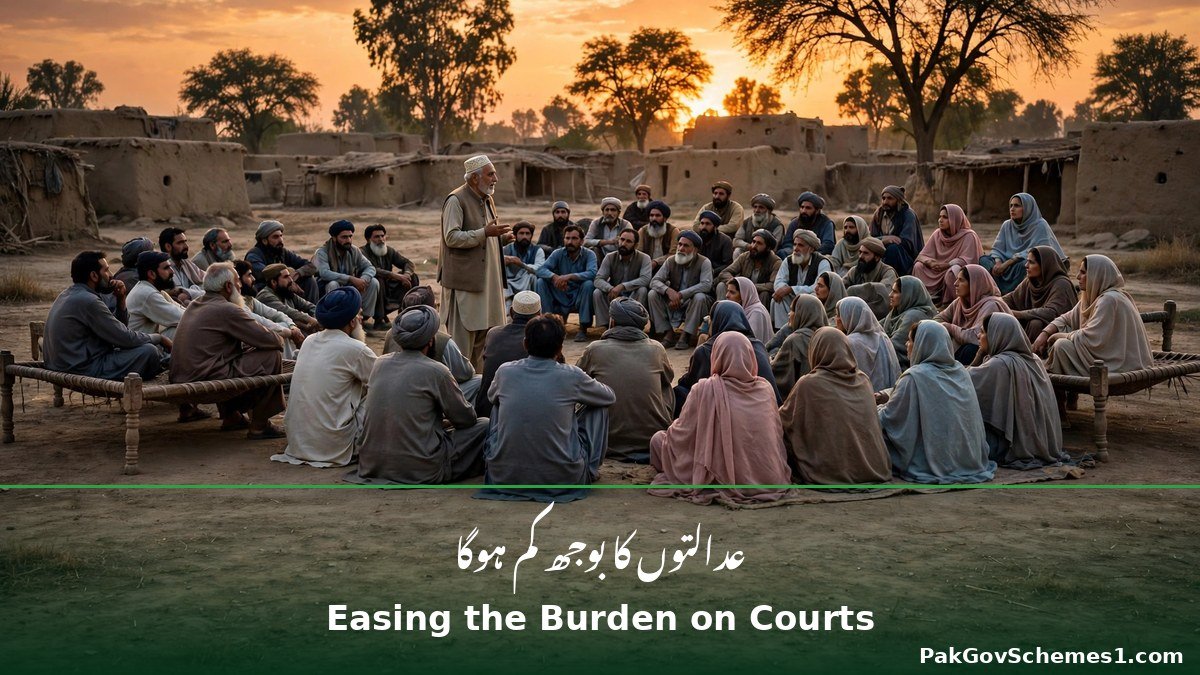
The logic is simple. Courts in Pakistan handle very large numbers of cases, and many are small, local disputes that could be settled by agreement if both sides had a trusted forum. If panchayats settle even a share of them locally, courts would have more time for serious cases.
The Chief Minister also framed the plan as empowerment: the initiative aims to empower people at the grassroots level by giving them a role in resolving their own disputes, and to make people partners in the justice system. She said the government was committed to bringing justice to people’s doorsteps through meaningful social reforms.
These are the government’s stated aims, not results yet. There is no evidence so far about how many disputes panchayats would handle or how fair their decisions would be in practice — because the system does not exist yet.
How to Follow the System’s Progress
Because the system is still at the proposal stage, there is no status check, no helpline, no portal and no office to visit about it. Interested readers should watch for the next official steps, in this order:
- The comprehensive plan. The Chief Minister has directed officials to prepare rules, policy guidelines and regulations. When this plan is announced, it will show the real shape of the system.
- The Punjab Panchayat Act. The draft law will need to be presented to and passed by the Punjab Assembly before the system has legal force. Watch for news of the bill being tabled.
- Committee formation. Only after the law and rules exist can Deputy Commissioners begin appointing members. Any claim that members have already been appointed is not verified.
- The negative list and jurisdiction criteria. These will tell citizens exactly which disputes a panchayat can hear and which it cannot.
Until then, the most reliable sources are the Punjab government website and reputable news reports. If you need an official document for any Punjab scheme, our Punjab domicile certificate guide explains how official documents are normally obtained in the province.
What Citizens Should Keep Ready
There is no application to prepare, because there is no application process yet. But if a dispute arises in your family or neighbourhood, keeping a few basic things ready is good practice:
- Your valid CNIC. Any official process in Pakistan starts with identity, so keep your CNIC valid and safe. Never share its photo or number with strangers or on social media.
- A written record of the dispute. Note the dates, the people involved and what happened, in your own words. If there are documents — a property paper, a written agreement, a receipt — keep the originals safe and keep copies separately.
- Names of witnesses. If neighbours or family members saw what happened, note their names. A panchayat, like a court, will want to hear from people who know the facts.
- Any earlier written decisions. If the matter has already been to a court, a police station or an arbitration, keep those papers. A panchayat will need to know what has already been decided.
Do not pay anyone who offers to “register” you with a panchayat, to “reserve” a committee seat, or to guarantee a decision in your favour. No such service exists, and anyone selling it is running a fraud.

Troubleshooting: Common Questions and Problems
What if the other party refuses mediation? Then the panchayat cannot settle the matter, because the system works on mutual consent. Your right to go to court remains fully intact.
What if a panchayat tries to decide a case it has no power over? The negative list and defined legal boundaries are meant to prevent this. If a committee claims powers it does not have, do not accept its decision — seek legal advice and approach the courts.
What if a decision feels unfair or forced? A settlement that is not genuinely agreed by both sides is not a valid panchayat settlement. Women and vulnerable citizens in particular should know the system is meant to protect them, not pressure them, and the courts remain open to them.
What if someone demands money for a panchayat hearing? No fee has been announced. Anyone demanding payment for a panchayat case should be treated with suspicion, and reported to the district administration or the police.
Where can I check official news about the system? Watch the Punjab government website (punjab.gov.pk) and reputable news outlets. We will also update this article when the rules, the draft Act or a start date are announced. For guidance on checking official messages, see our BISP 8171 status messages explained guide.
Official Helpline and Complaint Procedure
No helpline, complaint number, email address or office has been announced for the Punjab Panchayat system 2026. This is expected: the system is only at the in-principle approval stage, and there is no office to contact yet.
Once the rules are published, the responsible department and its contact details should be announced with them. Until then, general matters can be raised through the Punjab government website (punjab.gov.pk) and your district administration. Do not trust any phone number or WhatsApp number on social media claiming to be the “Panchayat helpline” — no such number has been announced.

Common Mistakes to Avoid
- Believing the system is already running. It is not. Only in-principle approval has been given. There are no committees, no hearings and no registrations yet.
- Paying agents or middlemen. No one can register your case, reserve a seat or guarantee a decision, because the system does not exist yet. Anyone charging for it is a fraud.
- Accepting a forced “panchayat decision”. A real panchayat settlement under the proposed system requires your genuine consent. A decision imposed on you is not a settlement, and you can still go to court.
- Trusting social media announcements. Fake posts about new government schemes spread fast. Verify every claim against the Punjab government website or a reputable newspaper before acting on it.
- Sharing CNIC copies or personal documents with strangers. Never send your CNIC photo, family details or signed papers to unknown people who claim to represent a panchayat.
- Confusing informal gatherings with the official system. Village elders already mediate disputes informally. That is not the same as the proposed legal panchayat system, and their decisions do not carry the same standing.
- Assuming every dispute can go to a panchayat. The negative list will exclude some matters entirely. Wait for the official rules before assuming your case qualifies.
Frequently Asked Questions
What is the Punjab Panchayat system 2026?
It is a proposed system of community committees in Punjab that would settle local disputes through mediation and mutual consent, under a proposed law called the Punjab Panchayat Act. Punjab Chief Minister Maryam Nawaz Sharif gave in-principle approval to the plan on 18 November 2026.
Has the Punjab Panchayat Act been passed?
No. Only in-principle approval has been given. The Act has not been passed by the Punjab Assembly, and no rules, policy guidelines or regulations have been published yet. The law will need to be drafted and passed before the system can start working.
When will the panchayat system start in Punjab?
Not officially announced. No start date, launch date or pilot date has been given. The Chief Minister has directed officials to prepare a comprehensive plan first, covering rules, policy guidelines and regulations. A date can only be expected after that plan is ready.
Who will be members of a panchayat committee?
Deputy Commissioners would appoint permanent local residents of the area who enjoy public confidence, chosen for their good reputation, impartiality and wisdom. Proposed members include lambardars, teachers, retired judges, retired army officers, retired civil servants and other respected community figures.
At which levels will panchayat committees be formed?
Committees would be established at four levels: union council, village, locality and mouza. This is meant to put a committee close to every community in Punjab, so that people do not have to travel far to settle a local dispute.
What kinds of disputes will a panchayat settle?
Local, minor disputes between people in the same community, settled by mutual consent through mediation and reconciliation. The exact list of cases a panchayat can hear has not been announced yet, and a negative list will exclude some matters entirely.
Can a panchayat force me to accept its decision?
No. The proposed system works on mutual consent, so a settlement is only valid if both parties agree to it. Your right to approach the courts is fully preserved, and the jurisdiction of the courts remains intact even after the system starts.
Is there any fee to take a dispute to a panchayat?
Not officially announced. No fee, payment or allowance has been mentioned in any official briefing or report so far. The system is described as a low-cost forum, but until the rules are published, no one should pay anyone for a panchayat hearing.
How can women and minorities be protected from misuse of the system?
The plan includes a negative list of matters outside the panchayat’s jurisdiction, specifically to prevent misuse against women and vulnerable segments, plus clearly defined legal boundaries for the committees’ powers. The courts also remain open to anyone who feels a decision was unfair or forced.
How can I apply to a panchayat or register a case?
You cannot — not yet. There is no application form, portal, SMS code or registration process, because the system has not started. Watch for the official announcement of the rules and the Punjab Panchayat Act, and do not pay anyone who offers to register you.
Important Safety Notice
Use only verified official government sources for information about the Punjab Panchayat system 2026. Never share your CNIC number, CNIC photo, OTPs or personal documents with unknown individuals, agents or social media pages claiming to represent a panchayat. Never pay anyone for panchayat registration, membership or a guaranteed decision. PakGovSchemes1.com is an independent informational website, not affiliated with any government department, and information here may change.
Conclusion
The Punjab Panchayat system 2026 is a promising idea at a very early stage: the Chief Minister has given in-principle approval to community mediation under a proposed Punjab Panchayat Act, with committees at union council, village, locality and mouza levels chosen for reputation, impartiality and wisdom. But the Act has not been passed, no rules have been published, and no start date has been announced. Citizens should note the safeguards — mutual consent, a negative list and courts that stay open — and wait for the official rules. Check the Punjab government website and this page for verified updates.
Official Sources
- Radio Pakistan (official), “Maryam Nawaz approves Panchayat system across Punjab”, 18 November 2026 — radio.gov.pk
- Dawn, “Punjab CM approves panchayat system to resolve disputes”, 19 November 2026 — dawn.com
- The Nation, “Punjab CM Maryam approves Panchayat system across Punjab”, 19 November 2026 — nation.com.pk
- The Express Tribune, “Panchayat system to be revived for dispute resolution”, 19 November 2026 — tribune.com.pk
- Business Recorder, “Punjab to introduce panchayat system”, 19 November 2026 — brecorder.com
- Dunya News, “Punjab CM Maryam Nawaz approves establishment of panchayat system in principle”, 18 November 2026 — dunyanews.tv
- ARY News, “Punjab to introduce panchayat system for grassroots dispute resolution”, 18 November 2026 — arynews.tv
- Government of Punjab, official website — punjab.gov.pk (no dedicated Panchayat page or press release found there as of 20 November 2026)
Disclaimer: PakGovSchemes1.com is an independent informational website and is not affiliated with any government department. Information is compiled from available official announcements and other identified sources and may change. Please verify eligibility, registration status, payment details, and deadlines through the relevant official government website before taking action.

