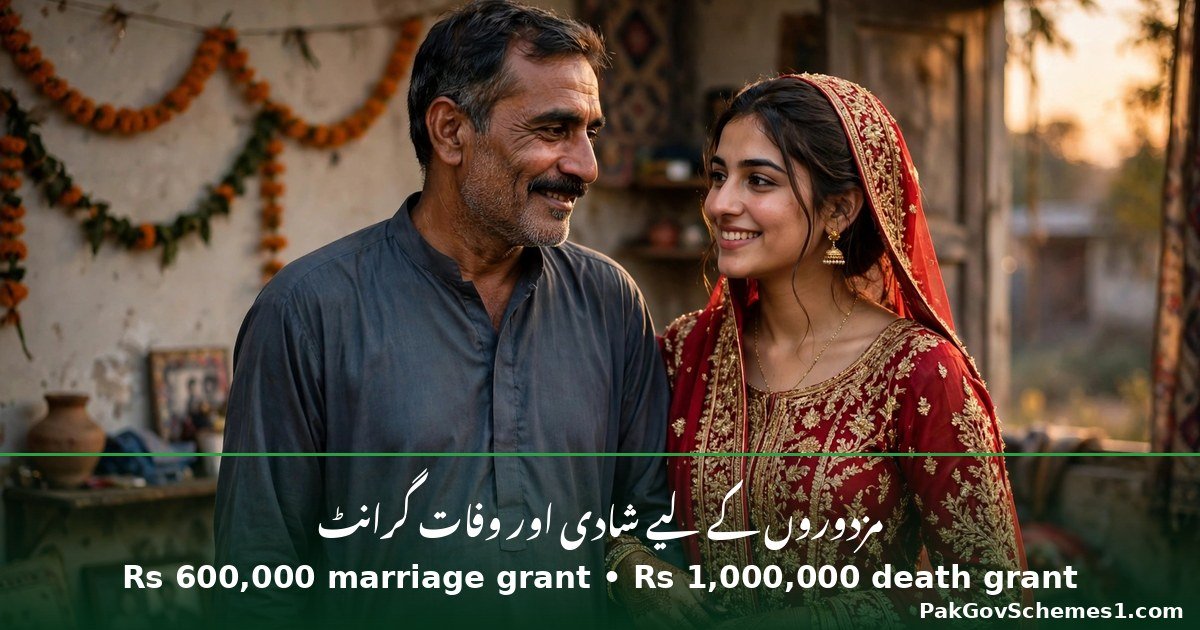
The Punjab Workers Welfare Fund marriage and death grants 2026 give real financial help to the families of registered industrial and mine workers in Punjab. The marriage grant is now Rs 600,000 for the daughter of an eligible worker, and the death grant is Rs 1,000,000 for the family of a worker who dies in service. Both amounts were raised by an official notification dated 20 November 2025, and the new rates apply to marriages and deaths on or after 25 August 2025. This guide explains who qualifies, which documents you need, how to apply online, and what to do if your case gets stuck.
Quick Overview: Punjab Workers Welfare Fund Marriage and Death Grants 2026
| Information | Details |
|---|---|
| Programme name | Punjab Workers Welfare Fund (PWWF) Marriage Grant and Death Grant |
| Responsible department | Punjab Workers Welfare Fund, Labour and Human Resource Department, Government of Punjab |
| Purpose | One-time cash help for a worker’s daughter’s marriage, and for the family of a worker who dies in service |
| Eligible beneficiaries | Registered industrial and mine workers in Punjab (EOBI or PESSI registered) and their families |
| Marriage grant | Rs 600,000 (marriages on or after 25 August 2025; Rs 400,000 for earlier marriages) |
| Death grant | Rs 1,000,000 (deaths on or after 25 August 2025; Rs 800,000 for earlier deaths) |
| Application status | Open — claims accepted online throughout the year; apply within 2 years of the marriage or death |
| How to apply | Online on the PWWF portal: mis.pwwf.punjab.gov.pk (district labour welfare office as fallback) |
| Key documents | CNICs, NADRA family registration certificate, PESSI or EOBI card, employment certificate, computerised marriage or death certificate, bank IBAN, e-stamp affidavit |
| Official website | pwwf.punjab.gov.pk (portal: mis.pwwf.punjab.gov.pk) |
| Last updated | 9 November 2026 |

Latest Update on the PWWF Marriage and Death Grants
The higher grant rates are already in force. The Punjab Workers Welfare Fund raised the marriage grant from Rs 400,000 to Rs 600,000 and the death grant from Rs 800,000 to Rs 1,000,000 through notification No. PWWF(MG)MISC/2023-(Rates), dated 20 November 2025. The increase followed the decision of the 163rd meeting of the federal Workers Welfare Fund governing body on 25 August 2025, adopted by the Punjab fund at its 21st governing body meeting on 13 November 2025. The new rates apply to marriages and deaths on or after 25 August 2025; earlier events get the old rates of Rs 400,000 and Rs 800,000. The detailed welfare grant rules that now govern these claims were notified on 3 February 2026 and took effect on 1 February 2026.
Payments under the new rates are already being made. On 27 August 2026, the Labour and Human Resource Department distributed marriage and death grant cheques worth Rs 30 million at a ceremony at the Municipal Corporation Hall in Faisalabad, attended by Deputy Commissioner Muhammad Nauman Siddiq as chief guest. Chief Minister Maryam Nawaz had confirmed the increases in her Labour Day message on 1 May 2026. There is no newer rate announcement for 2026, so treat any social media post claiming a further increase as unconfirmed unless it appears on pwwf.punjab.gov.pk.
Who Is Eligible for the PWWF Marriage and Death Grants?
Both grants are only for registered industrial and mine workers in Punjab — not for government servants, shop staff in unregistered businesses, or domestic workers. The worker must meet the definition of a “workman” under the Punjab Industrial Relations Act 2010; managers and senior administrative staff are usually not covered.
Marriage Grant Eligibility
For the marriage grant of Rs 600,000, every point below must be true on the date of the Nikah. The father or mother must be a worker in a registered factory or mine in Punjab — the factory must be working and registered in the Directorate General of Labour Welfare database, or the mine must be registered and pay its contribution to the PWWF. The worker must be registered with the Employees’ Old-Age Benefits Institution (EOBI) or the Punjab Employees Social Security Institution (PESSI), with at least nine months of contributions in the last twelve months and at least three years of total service. The bride must have been at least 18 at the Nikah.
A female worker who meets the same test can claim the grant for her own marriage. Daughters of a retired worker are also covered, but the claim must be made in the worker’s lifetime, with a fresh life certificate attested by a gazetted officer. Daughters of a worker laid off after a disability certified by a PESSI hospital or a DHQ or THQ medical board are covered too. If a worker died in service, the family must claim the death grant first. Note: the February 2026 rules say the grant is “allowed only one time for all daughters”, while the federal fund’s page says all daughters aged 18 or over are covered — confirm with your district office before applying for a second daughter.
Death Grant Eligibility
For the death grant of Rs 1,000,000, the worker must have died while still in service and before turning 60 — a worker who died after retirement cannot be claimed for. There is no minimum length of service. The worker must have been registered with EOBI or PESSI, with at least three months of contributions in the year before the death, and employed in a working factory registered in the Directorate General of Labour Welfare database, or in a mine that pays its contribution to PWWF. A worker compulsorily retired during service is also covered if he or she dies before 60. If the worker died within 90 days of joining, before a card was made, the claim needs proof of employment attested by the District Labour Officer or the Inspector of Mines.


Who Receives the Death Grant?
The death grant is paid in a fixed order: the widow or widower applies first; if there is no living spouse, the children apply; parents apply when the worker was unmarried or left no spouse and no children. A guardian applies for minor children and needs a guardian certificate from the family court. Where there is more than one widow, one widow or her children apply, naming all heirs. Except for a single surviving spouse, a succession certificate is compulsory — a NADRA succession certificate is usually faster than a court one. A married adult son, a brother, or an uncle cannot claim it. The money goes into the entitled heir’s bank account, so the application must include that person’s IBAN, account title, and branch.
How to Apply for the PWWF Marriage and Death Grants: Step by Step
Both grants are applied for online on the same PWWF portal. The process is the same for each, except for the form you choose and the documents you upload.
- Prepare your documents first. Get the computerised marriage or death certificate before anything else — the handwritten Nikah Nama is not enough. Also arrange the NADRA family registration certificate, the worker’s PESSI or EOBI card, and the employment certificate on the PWWF specimen form.
- Open the PWWF portal. Go to mis.pwwf.punjab.gov.pk and click Sign Up.
- Enter the worker’s CNIC. The system checks the CNIC against PESSI records and shows the worker’s basic details. Enter the number exactly as printed.
- Verify your mobile number and email. Confirm the codes sent to the mobile number and the email. Your login details arrive by email after the codes are confirmed.
- Fill in the grant form. Choose the marriage grant or the death grant, fill in the worker’s and the family’s details, and enter the bank account IBAN of the person who will receive the money.
- Upload clear scans of every document. Blurry or cropped scans are a common reason for delay, so check each file before you submit.
- Submit and keep your record. Note down the application or tracking number, and keep a copy of everything you uploaded.
- Wait for scrutiny. A district scrutiny committee, headed by the Assistant Director Labour Welfare, checks the case before payment.
If the portal does not find the worker’s CNIC, or the worker was only registered with EOBI, take the full file to your district labour welfare office and ask them to start the case. Mine workers’ families should go to the Assistant Mines Labour Welfare Commissioner for their region. If your mobile number has changed, use the portal’s Forgot Password option, which verifies the CNIC again and lets you update the number and email.
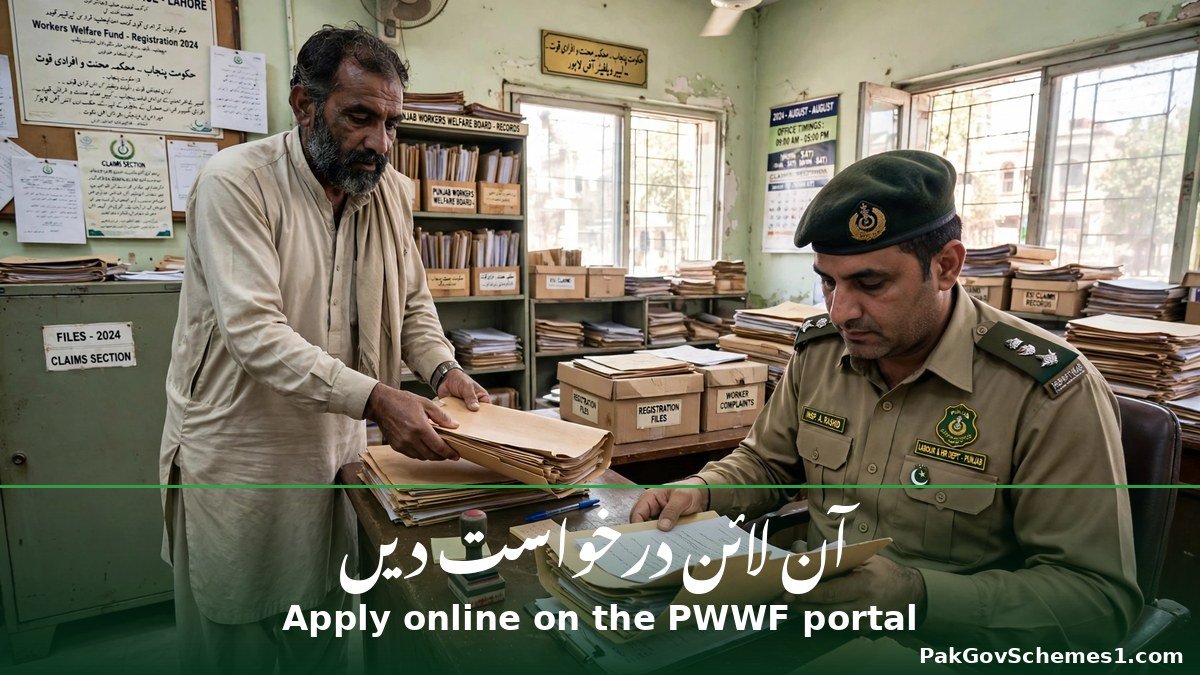
CNIC Check and Application Status
There is no separate public SMS code or status portal for the PWWF grants like the 8171 service used for BISP. The CNIC check happens inside the application itself: when you sign up on mis.pwwf.punjab.gov.pk, the portal checks the worker’s CNIC against PESSI records and shows the worker’s basic details. If the CNIC is not found, the worker is usually not on the PESSI record yet, the record has an error, or the worker is registered only with EOBI. Ask the employer to check the PESSI registration, or visit the PESSI office to correct it — a PESSI card also opens free treatment for the family at PESSI hospitals. If the check still fails, take the CNIC, the EOBI or PESSI card, and the employment certificate to the district labour welfare office, which can check the record and start the case manually. After you submit, there is no online tracking page for individual claims, so follow up with the district labour welfare office or the PWWF helpline, quoting the worker’s CNIC and the submission date. Keep the employer’s certificate original safe, because a missing attestation is a common reason for a file to be sent back.
Payment Details and Schedule
| Detail | Verified Information |
|---|---|
| Marriage grant (new rate) | Rs 600,000 — marriages on or after 25 August 2025 (Notification No. PWWF(MG)MISC/2023-(Rates), 20 November 2025) |
| Marriage grant (old rate) | Rs 400,000 — marriages before 25 August 2025 |
| Death grant (new rate) | Rs 1,000,000 — deaths on or after 25 August 2025 (same notification) |
| Death grant (old rate) | Rs 800,000 — deaths before 25 August 2025 |
| Payment schedule | Not officially announced — claims accepted throughout the year, paid after the district scrutiny committee approves the case; no fixed monthly payment date |
| Payment method | Directly into the bank account given on the application (IBAN) |
| Payment status check | Not officially announced — no public online tracker; follow up with the district labour welfare office or the PWWF helpline |
| Other payments | The PWWF grants are paid on top of PESSI and EOBI benefits — a family can claim all three |
The PWWF does not publish a processing time for Punjab. The federal Workers Welfare Fund lists a 15-day target for its own cases, from receiving the claim through scrutiny, committee, verification, pre-audit and approval, to payment — but do not treat that as a promise for Punjab; allow several weeks and follow up if the case goes quiet. The PWWF death grant is separate from the PESSI death grant, which pays the worker’s last drawn wages, and from any EOBI survivor’s pension. A family can claim all three, and claiming the PWWF death grant first also opens the way for the children to claim education support and the marriage grant later.


Required Documents for the PWWF Grants
Upload scanned copies of the documents below. The February 2026 rules give the checklist, and the portal asks for the same papers. Get the computerised certificates first, because the rest of the file depends on them.
Documents for the Marriage Grant
- Valid CNIC of the worker, the bride, and the groom.
- Family registration certificate (FRC) of the worker, issued by NADRA.
- Valid PESSI or EOBI card of the worker.
- Employment certificate from the employer, on the PWWF specimen form.
- Computerised marriage certificate of the bride, issued by NADRA or the local government. The handwritten Nikah Nama alone is not enough.
- A cheque leaf showing a valid IBAN, or an account maintenance certificate from the bank.
- An affidavit on a Rs 100 e-stamp paper, on the PWWF specimen form. It warns that a false detail means refunding double the grant.
- For the daughter of a deceased worker: the death certificate and proof that the death grant was paid. For the daughter of a disabled worker: the disability certificate from a PESSI hospital or a DHQ or THQ medical board.
Documents for the Death Grant
- Valid CNIC of the applicant heir or heirs, and of the spouse or widow.
- NADRA family registration certificate of the deceased worker.
- Valid PESSI or EOBI card of the worker.
- Employment certificate from the employer, on the PWWF specimen form.
- Computerised death certificate, issued or attested by the government office.
- A cheque leaf with a valid IBAN, or an account maintenance certificate, for each beneficiary.
- Succession certificate from NADRA or the family court, when there is more than one legal heir. For minor children, a guardian certificate from the family court is needed.
- An affidavit on e-stamp paper, on the PWWF specimen form. The exact stamp value could not be confirmed from the published rules, so confirm it at the labour welfare office.
The federal fund’s printed forms also ask for the last pay slip, the service certificate, and the appointment letter for a death grant — keep them ready if your district office asks. The official advertisement or your district office may specify additional documents.
Common Problems and How to Fix Them
The portal does not find the worker’s CNIC. The worker is usually not on the PESSI record, or the record has a mistake. Ask the employer to check the PESSI registration, or visit the PESSI office to correct it. If the worker is registered only with EOBI, take the file to the district labour welfare office instead.
The application is under verification for a long time. The district scrutiny committee checks each case with NADRA, EOBI or PESSI, and the employer. If the employer’s certificate is not attested, or a document is unclear, the file is sent back. Visit the district labour welfare office with the worker’s CNIC and the submission date and ask which document is holding the case.
You only have a handwritten Nikah Nama, or no family registration certificate. Get the marriage registered with the Union Council and obtain the computerised marriage certificate from NADRA or the local government first — an application with only the handwritten Nikah Nama will not pass scrutiny. Apply for the NADRA family registration certificate before you start, because the case cannot move forward without it.
The deadline has passed. The normal limit is two years from the Nikah or the death. For the marriage grant, the PWWF Secretary can accept a claim up to one more year late with a written reason; for the death grant, up to two years late. Do not give up without asking in writing, but note that the federal fund’s printed form says claims after two years will not be processed, while its policy page allows condonation, so the decision is not guaranteed.
The portal shows an error or does not send the verification code. Check that the mobile number and email are entered correctly, and try again after some time. If the problem continues, contact the portal support email below, or take the file to the district labour welfare office and apply through the office.
Official Helpline and Complaint Procedure
For questions, contact the Punjab Workers Welfare Fund on 042-99260242, between 9am and 5pm, or email contact@pwwf.punjab.gov.pk. For portal problems, email support@pwwf.punjab.gov.pk. The head office is at F-A/1, Khyber Block, Allama Iqbal Town, Lahore, and you can also visit your district labour welfare office, or the Regional Mines Labour Welfare Office for mine workers’ families. To complain about a delayed claim, write to the PWWF with the worker’s CNIC, the submission date, and copies of your documents. The federal fund in Islamabad (051-9106325, info@wwf.gov.pk) does not handle Punjab claims, so contact the Punjab office first. Never pay anyone who promises to speed up or guarantee your grant — the application is free.


Common Mistakes to Avoid
- Trusting social media announcements about a new increase. Only the 20 November 2025 notification is official; any higher figure on Facebook or WhatsApp is unconfirmed unless it appears on pwwf.punjab.gov.pk.
- Confusing these grants with other schemes. The Punjab Benevolent Fund pays much smaller marriage and funeral grants to government servants, and the Sindh Workers Welfare Board pays a different marriage grant of Rs 150,000. Neither figure applies in Punjab, and PWWF covers Punjab only — workers elsewhere apply to their own provincial board or the federal fund.
- Applying with a handwritten Nikah Nama only. Get the computerised marriage certificate first, or the case will be sent back.
- Paying an agent, or sharing CNIC images and OTPs with strangers. No agent can approve a grant, and the portal sends verification codes only to your own mobile and email. Applications go through the PWWF portal or the labour welfare office, and the service is free.
- Missing the two-year deadline. Apply within two years of the Nikah or the death; a late claim needs a written reason and the Secretary’s approval, which is not guaranteed.
- Skipping the death grant after a worker’s death. The children can only claim the marriage grant and education support after the death grant has been paid, so file the death grant claim first.
Frequently Asked Questions
How much is the Punjab workers marriage grant in 2026?
Rs 600,000 for a marriage on or after 25 August 2025, under the PWWF notification dated 20 November 2025. Marriages before that date fall under the old rate of Rs 400,000. The grant is for the daughter of a registered industrial or mine worker in Punjab.
How much is the Punjab workers death grant in 2026?
Rs 1,000,000 for a death in service on or after 25 August 2025, under the same notification. Deaths before that date fall under the old rate of Rs 800,000. The worker must have died in service before the age of 60.
How do I apply for the PWWF marriage or death grant online?
Go to mis.pwwf.punjab.gov.pk and click Sign Up. Enter the worker’s CNIC, which the system checks against PESSI records, verify the codes sent to your mobile and email, then fill in the grant form and upload the documents. A district scrutiny committee checks the case before payment.
How many years of service does a worker need for the marriage grant?
At least three years of total service on the date of the Nikah, plus at least nine months of EOBI or PESSI contributions in the last twelve months. The death grant has no minimum service, but needs three months of contributions in the year before the death.
Can a female factory worker claim the marriage grant for her own wedding?
Yes. A female worker who meets the service and contribution test can claim the grant for her own marriage, and the same three-year service and nine-month contribution rules apply to her. The bride must be at least 18 years old at the time of the Nikah.
How long do I have to apply for the marriage or death grant?
Two years from the date of the Nikah for the marriage grant, and two years from the date of death for the death grant. A late marriage claim of up to one more year, or a late death claim of up to two more years, can be accepted by the PWWF Secretary with a written reason.
Who receives the death grant if the worker’s widow has also died?
The children apply. If there are no children, the worker’s living parents apply. A guardian appointed by the family court applies for minor children. A succession certificate is compulsory whenever someone other than the surviving spouse applies, or there is more than one legal heir.
Is the PWWF grant the same as the PESSI death grant or the EOBI pension?
No. PESSI pays its own death grant of the worker’s last drawn wages, and EOBI pays a survivor’s pension. The PWWF grant is a separate payment from a separate fund, and a family can claim all three. Claiming the PWWF death grant first also opens the children’s later marriage and education claims.

Can I apply if the worker is registered only with EOBI and not PESSI?
The rules accept EOBI or PESSI registration, but the online portal checks the CNIC against PESSI records. If the portal does not find the worker, take the full file to your district labour welfare office and ask them to start the case there.
What is the PWWF helpline number?
The Punjab Workers Welfare Fund can be reached on 042-99260242 from 9am to 5pm, or by email at contact@pwwf.punjab.gov.pk. For portal problems, email support@pwwf.punjab.gov.pk. You can also visit your district labour welfare office for help. The head office is in Allama Iqbal Town, Lahore.
Important Safety Notice
Apply only through the official PWWF portal at mis.pwwf.punjab.gov.pk or at a district labour welfare office. Never share your CNIC images, OTPs, passwords, or bank details with unknown people, and never pay anyone who promises to get your grant approved faster. PakGovSchemes1.com is an independent informational website and is not affiliated with any government department. Always verify eligibility, documents, and deadlines through the official PWWF website or the Labour and Human Resource Department before you apply.
Conclusion
The Punjab Workers Welfare Fund marriage and death grants 2026 offer meaningful help to the families of registered industrial and mine workers: Rs 600,000 for a daughter’s marriage and Rs 1,000,000 for the family of a worker who dies in service, at the rates in the 20 November 2025 notification. Check the worker meets the service and contribution test, gather the computerised certificates and the employment certificate first, apply online within two years, and follow up if the case is delayed. File the death grant first when a worker has died, because the children’s later claims depend on it.
Sources
- Punjab Workers Welfare Fund rate notification No. PWWF(MG)MISC/2023-(Rates), dated 20 November 2025, Labour and Human Resource Department, Government of Punjab — quoted in full on schoolspunjab.pk.
- PWWF welfare grant rules notified 3 February 2026, effective 1 February 2026 — as read and reported by pakera.pk on 2 October 2026.
- PWWF portal sign-up guide, mis.pwwf.punjab.gov.pk — as read and reported by pakera.pk on 2 October 2026.
- Workers Welfare Fund (federal), eligibility and policy pages, FAQs, forms and service timeline, wwf.gov.pk — as read and reported by pakera.pk on 31 October 2026.
- Associated Press of Pakistan, “Rs30m Marriage, Death Grants Distributed in Faisalabad”, 27 August 2026, via UrduPoint.
- Pakistan Today, “CM Maryam reaffirms commitment to workers’ rights, welfare”, 1 May 2026.
- Bloom Pakistan, “Punjab Raises Marriage Grant to Rs 6 Lakh and Death Grant to Rs 10 Lakh for Workers”, 21 November 2025.
Disclaimer: PakGovSchemes1.com is an independent informational website and is not affiliated with any government department. Information is compiled from available official announcements and other identified sources and may change. Please verify eligibility, registration status, payment details, and deadlines through the relevant official government website before taking action.

