
The Sindh drought relief package 2026 is a Rs 5.3 billion support plan for families in 25 drought-affected dehs of Tharparkar and Umerkot. Sindh Chief Minister Syed Murad Ali Shah announced the package on 20 November 2026, at the launch of the Sindh Wheat Growers Support Programme 2026-27. Each eligible family will receive Rs 8,000 in three instalments, paid through the Benazir Income Support Programme (BISP) payment system. This guide explains who can get the money, the payment dates, what families should do now, and how to avoid fake news about the package.
Quick Overview: Sindh Drought Relief Package 2026
| Information | Details |
|---|---|
| Programme name | Sindh Drought Relief Package 2026 |
| Announced by | Sindh Chief Minister Syed Murad Ali Shah, 20 November 2026 |
| Total package | Rs 5.3 billion |
| Districts covered | Tharparkar and Umerkot — 25 dehs declared drought-affected |
| Families expected to benefit | About 220,000 low-income households in Tharparkar, as reported; see the note below on the figures |
| Assistance per family | Rs 8,000 in three instalments (Dawn, 21 November 2026); some reports describe it as Rs 8,000 a month — see the note below |
| Payment dates | First instalment by 1 December 2026, second by 1 January 2027, third by 1 February 2027 |
| Payment method | Through the BISP payment mechanism |
| Eligibility basis | BISP records; poverty (PMT) score threshold raised from 32 to 40 |
| Registration | No separate registration announced — a survey is under way to identify affected households |
| Helpline for this package | Not officially announced; BISP helpline 0800-26477 applies to BISP matters generally |
| Last updated | 22 November 2026 |
Latest Update: Rs 5.3 Billion Announced on 20 November 2026
On Friday, 20 November 2026, Chief Minister Syed Murad Ali Shah announced the relief package at the launch ceremony of the Sindh Wheat Growers Support Programme 2026-27. Dawn reported it on 21 November 2026; Business Recorder and ARY News carried the same report.
The Chief Minister said 25 dehs in Tharparkar and Umerkot had recently been declared drought-affected, and the government would help affected families through BISP. The money is meant for essentials, including flour and fodder for livestock. A survey is under way to identify the affected households, and the Mirpurkhas commissioner has said relief work will be monitored daily. Readers should understand one point clearly: this was an announcement of a package, not the start of payments. No money has been paid yet, and no registration form or portal has been announced.

How Much Will Each Family Get? The Rs 8,000 Question
Dawn reported on 21 November 2026 that “each eligible family would receive Rs 8,000 in three instalments”. Business Recorder and ARY News used the same wording. This guide follows Dawn and states the amount as Rs 8,000 per family, paid in three instalments.
But some reports describe it differently. Abb Takk and 24NewsHD reported “Rs 8,000 a month, paid in three instalments” — Rs 8,000 per instalment, or Rs 24,000 in total. The total also points that way: 220,000 families at Rs 8,000 each would cost about Rs 1.76 billion, well below Rs 5.3 billion, while Rs 8,000 three times would cost about Rs 5.28 billion. The 220,000 figure is also reported, not official — Abb Takk says 220,000 households in Tharparkar; Business Recorder says 273,666 beneficiaries across both districts.
The Chief Minister announced Rs 8,000 and three instalments, but whether that means Rs 8,000 in total or per instalment is not yet settled. Do not plan your budget on either figure until the official notification is published.
Why Tharparkar and Umerkot Need Relief
Tharparkar is one of Pakistan’s most drought-prone districts. Most families depend on rain-fed farming and livestock. Earlier in November 2026, Tharparkar was declared a calamity-hit district after drought damaged 85–90 per cent of crops across all seven talukas, according to reports in The News and Daily Byte. A “deh” is roughly a village and its surrounding land, so the package targets specific villages, not every household in the two districts.

Who Is Eligible for the Sindh Drought Relief Package?
No full eligibility list has been published yet.
Live in one of the 25 declared drought-affected dehs. The package covers Tharparkar and Umerkot only, and only the dehs declared drought-affected. The full list of the 25 dehs has not been published.
Be a low-income household on BISP records. Eligibility is based on those records, and the money is paid through the BISP payment mechanism.

Fall within the new poverty score limit. The eligibility threshold has been raised from a PMT poverty score of 32 to 40, and families with scores from 0 to 40 can qualify. The PMT score is the number BISP gives a household after its survey — a lower score means a poorer household. Raising the limit brings in more families previously just above the cut-off.
Be identified by the ongoing survey. A survey is under way to identify affected households, according to the Mirpurkhas commissioner, and until the lists are finalised no family can be confirmed as eligible. Whether it is paid on top of regular BISP support has not been confirmed.
What Families Should Do Now: Step by Step
There is no registration form or portal for this package. The government is identifying beneficiaries from BISP records and the survey now under way.
- Check that your BISP record is up to date. If your household has been surveyed, your PMT score is on record. If not, or if your circumstances have changed, visit your nearest BISP tehsil office or dynamic registry centre. The survey is free.
- Cooperate with the survey teams. Survey teams are visiting the affected areas. Give correct information about family members, income and livestock.
- Keep your CNIC valid and your mobile number active. Payments are linked to the woman head of the household’s CNIC and the mobile number registered with BISP. Renew an expired CNIC from NADRA.
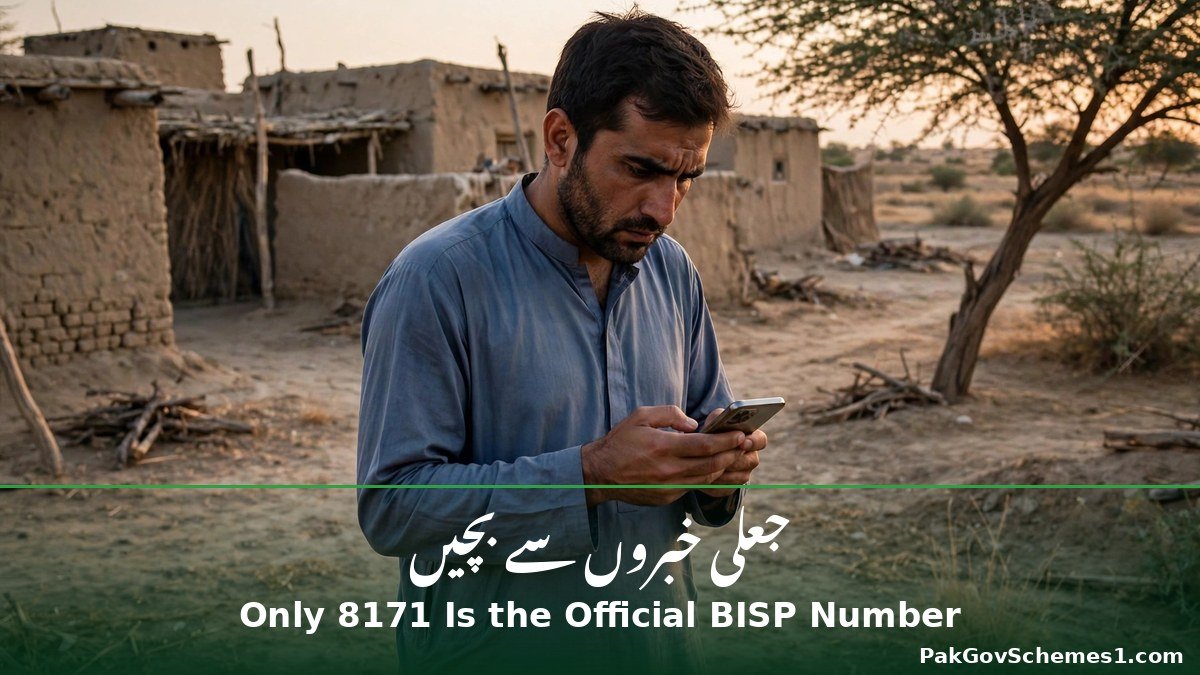
- Wait for an SMS from 8171 only. BISP has confirmed that 8171 is its only official number, so if you are selected, you should receive a message from 8171. Do not trust messages from any other number.
- Collect the payment only from an authorised channel. The payment comes through the BISP payment mechanism. Do not hand your CNIC or cash to an agent who offers to collect it for you. Count the cash and take the receipt.
Families outside the 25 dehs, or with a PMT score above 40, will not receive this package. Your regular BISP eligibility is unaffected.
CNIC Check and Payment Status
There is no separate status check for this package. Use the normal BISP routes below.
8171 web portal. Go to the official 8171 portal at 8171.bisp.gov.pk, enter your 13-digit CNIC number without dashes, and submit it to check your BISP eligibility and payment status. Use only this official address — look-alike websites can steal your CNIC.
SMS to 8171. Send your 13-digit CNIC number by SMS to 8171 from the mobile number registered with BISP. Any message about BISP from another number is fake.

What the status means. If the portal shows you as eligible, your BISP record is in order — but that does not confirm you are on the relief list, which is still being finalised. If it shows you as ineligible, your PMT score is above the limit. If it shows under verification, visit the BISP office to complete it. If the portal does not work, try again later or visit your nearest BISP tehsil office with your original CNIC. Never pay an agent to check your status; the check is free.

Payment Details and Schedule
| Detail | Verified Information |
|---|---|
| Total package | Rs 5.3 billion (announced 20 November 2026) |
| Amount per family | Rs 8,000 in three instalments, as reported by Dawn; some reports say Rs 8,000 a month — not yet settled, see the note above |
| First instalment | By 1 December 2026 |
| Second instalment | By 1 January 2027 |
| Third instalment | By 1 February 2027 |
| Payment method | Through the BISP payment mechanism |
| Payment status check | 8171 web portal (8171.bisp.gov.pk) or SMS to 8171; BISP helpline 0800-26477 |
| Payment collection | Authorised BISP payment channels only — exact channel for this package not yet announced |
| Deduction complaints | BISP helpline 0800-26477 or the nearest BISP tehsil office |
The dates are deadlines — the first instalment should reach beneficiaries by 1 December 2026, not necessarily on that day. The BISP six-bank payment system covers six banks for regular BISP payments, but it has not been confirmed whether this relief will use those banks, a camp site, or another channel.
The Wheat Growers Programme Announced at the Same Event
The relief was announced at the launch of a separate scheme, the Sindh Wheat Growers Support Programme 2026-27. Under it, eligible growers with up to 25 acres receive Rs 4,000 per acre for verified wheat cultivation, to buy DAP fertiliser. Farmers delivering wheat to the food department get an extra Rs 2,000 per maund, and the procurement price is Rs 4,500 per maund this season. Last year it paid about Rs 41.84 billion to 333,125 verified farmers through the Benazir Hari Card. A family must qualify for each scheme separately; full details are in our Sindh Wheat Growers Support Programme guide.
Required Documents
No official document list has been published, because there is no application. The list below is what BISP normally needs for a household record and survey.
- Valid original CNIC of the woman head of the household, plus other adults’ CNICs if asked.
- Children’s B-Forms from NADRA, if the survey team needs them.
- Registered mobile number — the SIM should be in your name or a close family member’s, and active.
- Household and livestock details — family size, income source, land and animals.
Do not give your original CNIC to any private person. Show it to the survey team or BISP staff, and take it back.

Troubleshooting: Problems Families May Face
No SMS by 1 December. The list is still being finalised. Check the 8171 portal; if it shows you as eligible, wait a few days, then call 0800-26477 or visit your BISP tehsil office.
PMT score above 40. The reported threshold for this package is 40. If your score is above 40, you fall outside it. If you believe it is wrong, visit a BISP dynamic registry centre and ask for a re-survey — though a re-survey does not guarantee a lower score.
Household never surveyed by BISP. Visit your nearest BISP tehsil office or dynamic registry centre and complete the survey. It is free.
Message from a number other than 8171. It is fake — BISP sends messages only from 8171. Do not reply or click any link, and do not share your CNIC or any code. Report it to 0800-26477.
Money deducted at a payment point. Count your cash before leaving and take the receipt. If any amount is deducted, report it immediately to 0800-26477. Deductions are illegal.
Official Helpline and Complaint Procedure
No helpline has been announced for this package, so use BISP’s own verified complaint channels.
BISP helpline 0800-26477 (toll-free). This number is confirmed on bisp.gov.pk and in BISP press releases. Call it to report a missing payment, an illegal deduction, a fake message, or a demand for money during the survey. If it is not accessible, visit your nearest BISP tehsil office with your original CNIC. Complaints about the package itself can also be raised with the district administration or the Mirpurkhas commissioner’s office, which is monitoring the relief work. No dedicated complaint number for the package has been published.
Common Mistakes to Avoid
- Paying an agent to get your name on the list. There is no application; beneficiaries are selected from BISP records and the survey.
- Trusting a “registration form” on social media. No form or portal exists for this package; forms on Facebook and WhatsApp are fake and designed to steal CNIC and mobile numbers.
- Believing the Rs 8,000 figure without checking. Reports differ on whether it is the total or the monthly amount.
- Confusing this relief with the wheat subsidy. The Rs 4,000-per-acre subsidy is a separate scheme for growers; a wheat grower does not automatically receive drought relief.
- Sharing your CNIC photo or OTP with strangers. No official process asks for these over WhatsApp or phone calls, and they can be used to steal your payment.
- Travelling to a payment centre without an SMS. BISP only pays after an 8171 message; going early wastes a day’s work and travel money.
- Trusting payment dates from social media. The confirmed dates are 1 December 2026, 1 January 2027 and 1 February 2027.
Frequently Asked Questions
1. What is the Sindh drought relief package 2026?
It is a Rs 5.3 billion package announced by Sindh Chief Minister Murad Ali Shah on 20 November 2026 for families in 25 drought-affected dehs of Tharparkar and Umerkot. Eligible families receive Rs 8,000 in three instalments through BISP, due by 1 December 2026, 1 January and 1 February 2027.
2. Who will get the drought relief money?
Low-income families in the 25 declared drought-affected dehs of Tharparkar and Umerkot, selected from BISP records. The poverty score limit has been raised from 32 to 40, so families scoring 0 to 40 can qualify. A survey is under way to finalise it.
3. How much money will each family receive?
Dawn reported Rs 8,000 per family in three instalments, while Abb Takk and 24NewsHD reported Rs 8,000 a month for three months. The exact amount is not yet settled, so wait for the official notification before planning around either figure.
4. When will the first instalment be paid?
By 1 December 2026, with the second by 1 January 2027 and the third by 1 February 2027. These are deadlines, and payments may be released in phases by district, so some families may receive theirs a few days before others.
5. How do I apply for the Sindh drought relief package?
You cannot apply, because no form or portal has been announced. Beneficiaries are identified from BISP records and an ongoing survey. Keep your BISP record up to date, cooperate with the survey team, and wait for an SMS from 8171.
6. Is there a separate helpline for this relief package?
No separate helpline has been announced specifically for this package. Because payments go through BISP, use the toll-free BISP helpline 0800-26477, confirmed on bisp.gov.pk, or visit your nearest BISP tehsil office today for help with your record, payment or complaint.

7. How can I check if I am on the beneficiary list?
There is no separate list or portal for this package yet. Check your BISP status on the 8171 portal at 8171.bisp.gov.pk or by sending your CNIC by SMS to 8171. If selected, you should also receive a message from 8171.
8. I live in Tharparkar but not in a declared deh. Will I get the money?
No. The package covers only the 25 dehs declared drought-affected in Tharparkar and Umerkot. Families outside those dehs are not covered, even if they are poor, and they cannot apply to join it. Your regular BISP eligibility is unaffected today.
9. Is the wheat subsidy part of the drought relief package?
No, it is a separate scheme announced at the same event. The Sindh Wheat Growers Support Programme 2026-27 pays eligible growers Rs 4,000 per acre, plus Rs 2,000 per maund delivered to the food department. Each scheme has its own rules.
10. How do I report a fake message or a deduction from my payment?
Call the BISP helpline 0800-26477 or visit your nearest BISP tehsil office with your original CNIC. BISP sends messages only from 8171, so any message from another number is fake. Report illegal deductions immediately, count your cash and take the receipt.
Important Safety Notice
For news about this package, use only verified official sources — bisp.gov.pk, the 8171 portal, and reputable newspapers. Never share your CNIC photo, bank details or OTP with unknown individuals, and never pay anyone who promises to add your name to the relief list. PakGovSchemes1.com is an independent informational website, not affiliated with any government department. For families elsewhere, the Punjab flood relief compensation guide explains a different provincial relief payment.
Conclusion
The Sindh drought relief package 2026 promises real help — Rs 5.3 billion for families in 25 drought-hit dehs of Tharparkar and Umerkot, with the first instalment due by 1 December 2026. But the exact per-instalment amount is not yet settled, the beneficiary list is still being finalised by survey, and no separate registration exists. Families in the affected dehs should keep their BISP records current, cooperate with the survey, and wait for a message from 8171.
Sources
- Dawn, “CM Murad announces Rs5.3bn relief package for drought-hit villages”, 21 November 2026 — dawn.com — Rs 5.3 billion package, 25 dehs in Tharparkar and Umerkot, Rs 8,000 in three instalments, payment dates 1 December 2026, 1 January 2027 and 1 February 2027, BISP payment mechanism, wheat programme details.
- Business Recorder, “Murad announces Rs5.3bn ‘drought relief’ for Thar, Umerkot”, 21 November 2026 — brecorder.com — same announcement and figures as Dawn; also reports the Sindh Cabinet approved relief for 273,666 BISP beneficiaries in both districts.
- ARY News, “Rs5.3bn drought relief for Thar, Umerkot; Rs4,000 per acre announced for wheat growers”, 20 November 2026 — arynews.tv — Rs 8,000 per family in three instalments, first payment by 1 December, wheat subsidy details.
- Abb Takk News, “Sindh unveils Rs5.3bn aid plan for 220,000 Tharparkar households”, 20 November 2026 — abbtakk.tv — 220,000 low-income households, PMT threshold raised from 32 to 40, families may spend the aid as they wish; describes the amount as Rs 8,000 a month.
- Sixty.pk, “Sindh announces BISP aid for drought-hit Tharparkar, Umerkot families”, 20 November 2026 — sixty.pk — survey under way to identify affected households (Mirpurkhas commissioner), relief work monitored daily, Rs 8,000 a month in three instalments.
- Daily Byte, “Sindh Unveils Rs5.3bn Aid for Tharparkar Families”, 20 November 2026 — dailybyte.pk — 85–90 per cent crop damage across seven talukas, earlier calamity-hit declaration, RO plant repairs and Naukot–Mithi pipeline feasibility, BISP reach in Tharparkar.
- BISP (bisp.gov.pk), press releases — bisp.gov.pk — helpline 0800-26477 for complaints, 8171 as the only official BISP number, no fee for the BISP survey, nearest BISP office if the helpline is not accessible.
Disclaimer: PakGovSchemes1.com is an independent informational website and is not affiliated with any government department. Information is compiled from available official announcements and other identified sources and may change. Please verify eligibility, registration status, payment details, and deadlines through the relevant official government website before taking action.

