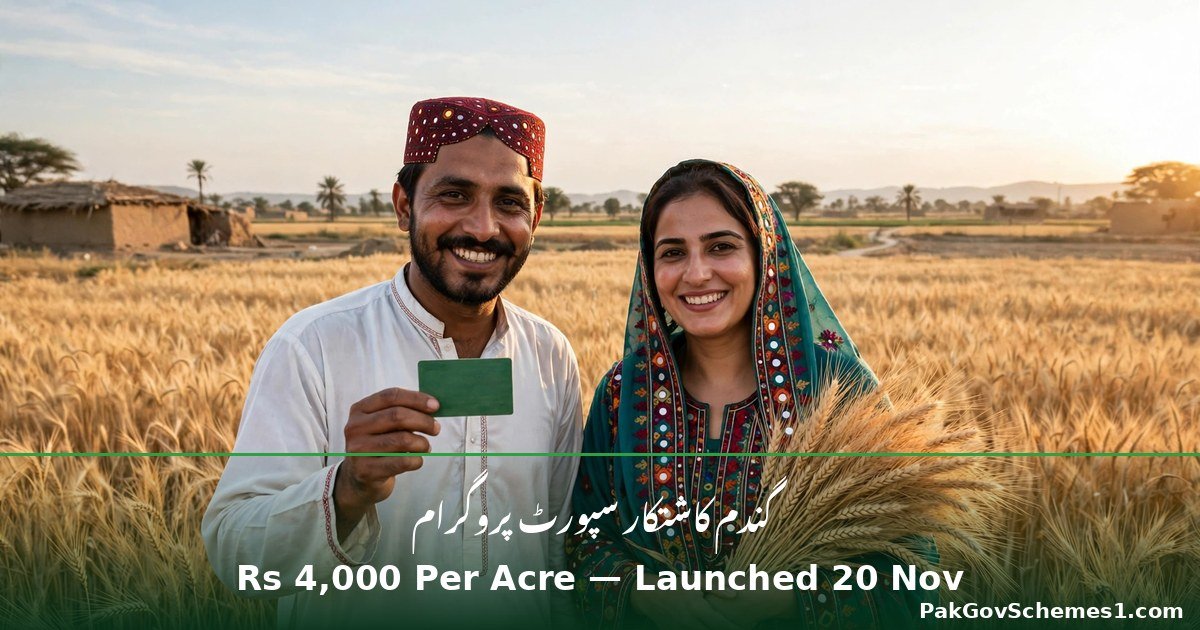
The Sindh wheat growers support programme launched on Friday, 20 November 2026, when PPP Chairman Bilawal Bhutto Zardari inaugurated the distribution at the Chief Minister’s House in Karachi. The government announced the figures farmers had waited for: Rs 4,000 per acre for growers holding up to 25 acres, an extra Rs 2,000 per maund for wheat delivered to the Food Department, and a procurement price of Rs 4,500 per maund. The same ceremony also brought Rs 5.3 billion in drought relief for Tharparkar and Umerkot. This guide reports what happened, who gets paid, and how to register.
Quick Overview: Sindh Wheat Growers Support Programme Launched 2026
| Information | Details |
|---|---|
| Programme name | Sindh Wheat Growers Support Programme 2026-27 (DAP subsidy) |
| Responsible department | Agriculture Department, Government of Sindh |
| Launch date | Friday, 20 November 2026 |
| Launch ceremony | Chief Minister’s House, Karachi; inaugurated by PPP Chairman Bilawal Bhutto Zardari |
| Total subsidy | Rs 17 billion for the Rabi season |
| Support per acre | Rs 4,000 per acre, for growers holding up to 25 acres of verified wheat area |
| Delivery bonus | Rs 2,000 per maund for wheat delivered to the Food Department |
| Procurement price | Rs 4,500 per maund (approved for the current season) |
| Farmers registered | 557,708 farmers covering about 4.55 million acres (as of 10 November 2026) |
| Stated reach | 600,000 farmers and sharecroppers, as stated by the programme leadership |
| Payment method | Through the Benazir Hari Card |
| Registration route | Benazir Hari Card registration — online portal at benazirharicard.gos.pk and district agriculture offices |
| Official helpline | 0311-1646111 (Benazir Hari Card helpline) |
| Official website | https://benazirharicard.gos.pk/ |
| Last updated | 21 November 2026 |
Latest Update: Launch Day — 20 November 2026
The launch went ahead as planned on Friday, 20 November 2026: PPP Chairman Bilawal Bhutto Zardari inaugurated the programme at the Chief Minister’s House in Karachi, and Chief Minister Syed Murad Ali Shah announced the payment details. The Agriculture Minister presented progress, growers shared experiences, and a live fund transfer was demonstrated.
This article follows our launch-day guide, which said the launch was scheduled for 20 November with no per-farmer amount announced — correct that morning, before the ceremony. See our Sindh wheat growers support programme launch-day guide and our Sindh wheat growers support programme announcement guide for the background.
The headline numbers are confirmed by several reputable outlets. Dawn reported on 21 November that growers holding up to 25 acres would receive Rs 4,000 per acre and Rs 2,000 per maund on delivery to the Food Department, with a procurement price of Rs 4,500 per maund approved. ARY News, UrduPoint and The Express Tribune reported the same figures.

What the Programme Pays: Rs 4,000 Per Acre, Plus Rs 2,000 Per Maund
The programme pays in two parts. First, eligible growers holding up to 25 acres receive Rs 4,000 per acre against their verified wheat area, to be used specifically to buy DAP fertiliser. The programme is formally a DAP subsidy, covering fertiliser cost at sowing time.
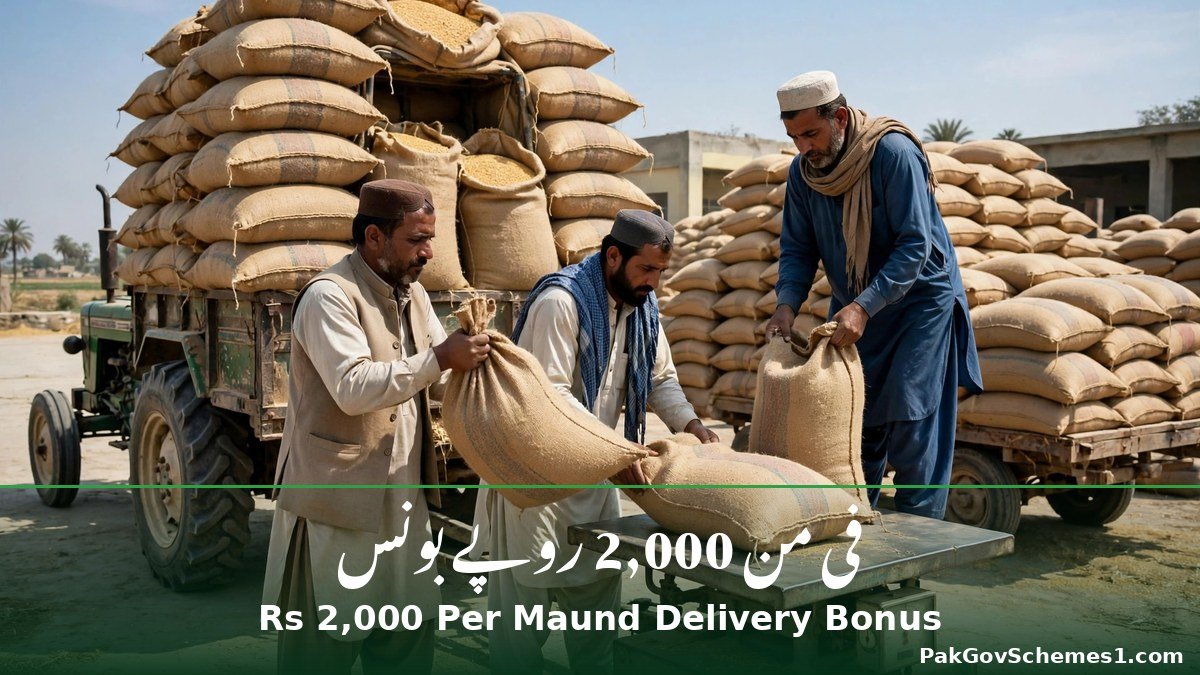
Second, farmers delivering wheat to the Food Department receive an extra Rs 2,000 per maund on the quantity actually delivered — a bonus on top of the procurement price, not instead of it. With the procurement price approved at Rs 4,500 per maund, a grower selling to the Food Department receives both.
One claim needs care: a single online outlet, pakistaninews.net, reports Rs 1.42 billion already paid to 62,588 beneficiaries. That is unconfirmed by Dawn, ARY News, UrduPoint and The Express Tribune, so treat it as reported only — rely on the confirmed figures above.
Who Gets the Subsidy: Registered Wheat Growers
The subsidy is aimed at small growers, not large landlords: Bilawal said it supports small landowners and sharecroppers, and farmers cultivating up to 25 acres form the backbone of agriculture. That limit is the key eligibility line.
Registration is the other key fact: as of 10 November 2026, 557,708 farmers had registered, covering about 4.55 million acres, according to the Agriculture Minister’s update reported by UrduPoint. Separately, the leadership states the Hari Card programme will reach 600,000 farmers and sharecroppers — a different number from the 557,708 registered, so do not treat them as the same figure.
For scale: last year’s programme paid about Rs 41.84 billion to 333,125 verified farmers, helping produce a record 4.9-million-tonne harvest.

How Farmers Get Paid Through the Benazir Hari Card
All payments go through the Benazir Hari Card, which the official portal says gives farmers a bank account and ATM facility with biometric verification. The launch ceremony included a live demonstration of a fund transfer.

In practice, a registered farmer should not expect cash at a ceremony or a payment to a random mobile wallet — the money goes to the farmer’s Hari Card bank account, so correct details (CNIC, mobile number, land record) matter. A wrong number or unverified record can delay or block payment. Farmers who registered when the card launched in October 2024 need not register again, but should check their details.
This is separate from BISP Kafalat and 8171 — 8171 will not show a wheat payment. See our Benazir Hari Card 2026 guide.
Drought Relief Announced at the Same Ceremony: Rs 5.3 Billion
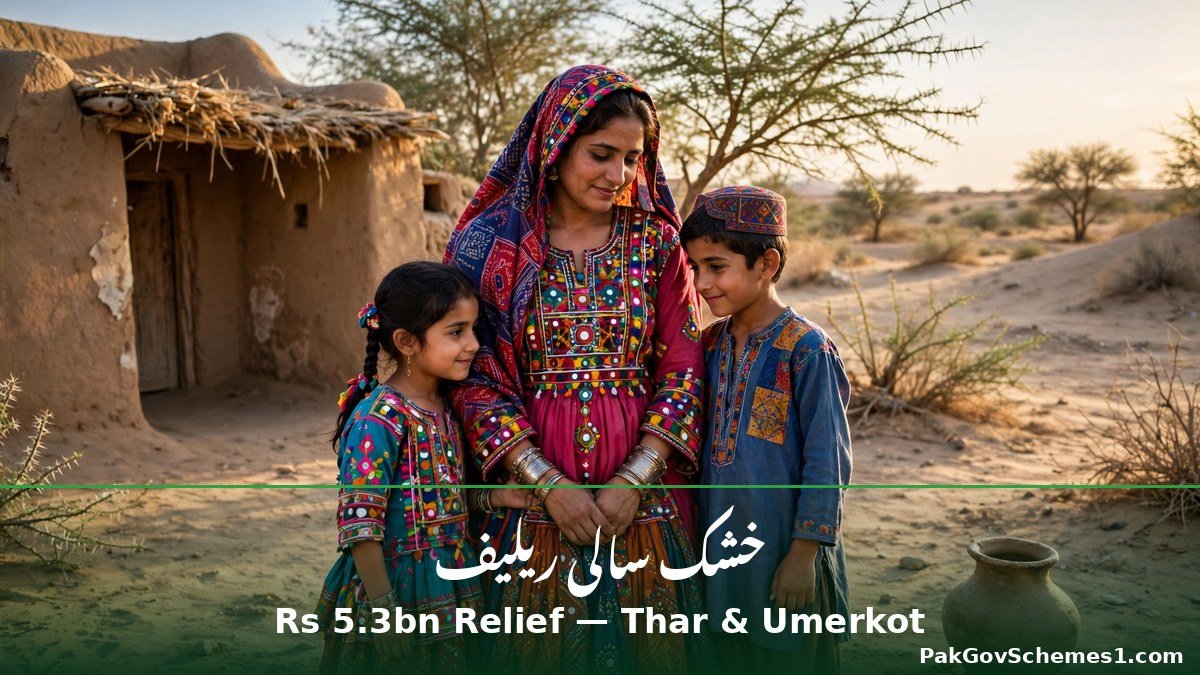
The same ceremony brought a second announcement: Rs 5.3 billion in relief for drought-affected communities in 25 dehs of Tharparkar and Umerkot. Each eligible family receives Rs 8,000 in three instalments for essentials such as flour and livestock fodder.
The dates are clear: the first instalment by 1 December, the second by 1 January and the third by 1 February, delivered through the BISP payment mechanism, according to Dawn.
This relief is separate from the wheat subsidy: a family can qualify without growing wheat, and a wheat grower outside the 25 dehs gets none. If you live in one of the 25 dehs, the money comes through the BISP payment mechanism — our BISP Oct–Dec 2026 qist collection guide explains how those payments are collected.
Registration: How to Get on the Benazir Hari Card
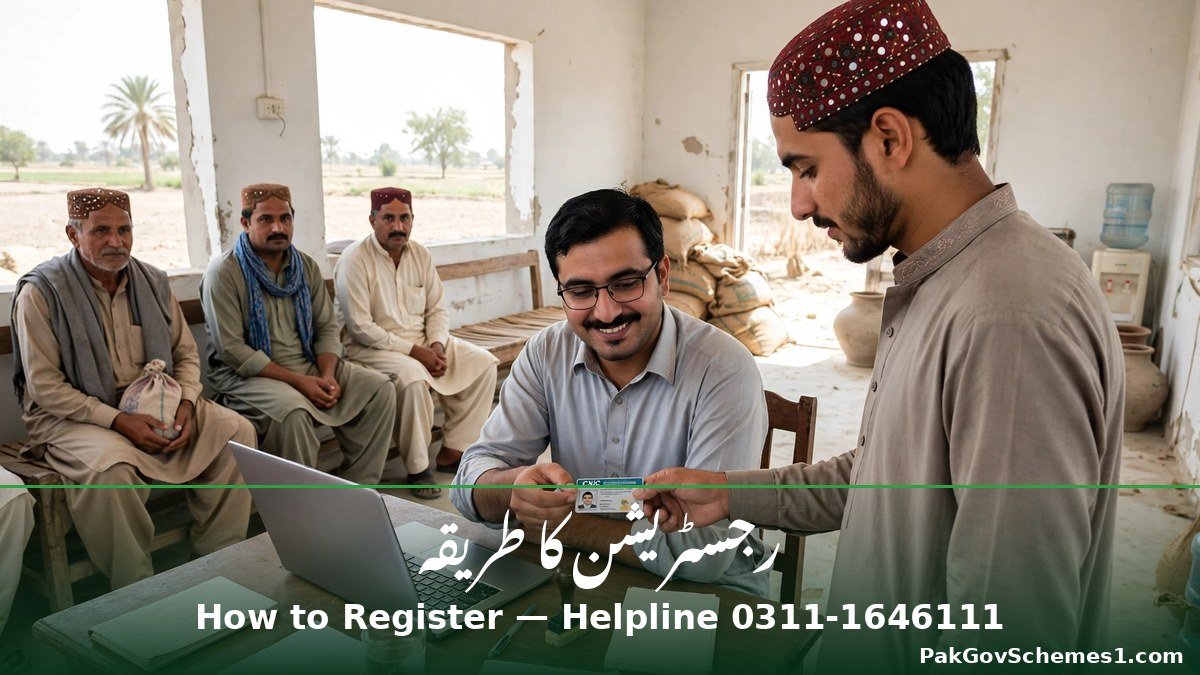
Registration for the Benazir Hari Card is already open — it is the route into the wheat subsidy:

- Check your documents first: valid CNIC, registered mobile number and land details — whether you own the land or cultivate it as a tenant or sharecropper.
- Register online at benazirharicard.gos.pk, in the farmers’ registration section — fill in your details exactly as they appear on your CNIC.
- Visit your district agriculture office if you cannot register online — the officer there can guide you and confirm your record is complete.
- Confirm your wheat area is verified — the Rs 4,000-per-acre payment is made against verified wheat area, so check the land record and crop area are correct.
- Keep your card and PIN safe — do not share the card number, PIN or any OTP with anyone.
- Wait for an official message — no SMS code has been announced. Verify any message claiming your payment is ready through the helpline or district office first.
Punjab runs its own wheat support through the Punjab wheat support programme and Punjab Kisan Card — Sindh farmers are covered by this programme, not the Punjab schemes.
CNIC and Payment Status Check
No separate online status-check portal has been announced for the wheat subsidy — unlike BISP, where 8171 shows Kafalat payments. This programme runs through the Agriculture Department and the Hari Card, not 8171.
Check in this order: log in to the Hari Card portal at benazirharicard.gos.pk and confirm your registration shows as complete; call the helpline on 0311-1646111 and ask whether payments have started for your district; or visit your district agriculture office, which holds the local record. Never enter your CNIC on any other website, or send your CNIC photo, card photo or OTP to a WhatsApp number claiming to check your wheat payment.
Payment Details and Schedule
| Detail | Verified Information |
|---|---|
| Total assistance | Rs 17 billion allocated for the Rabi season |
| Per-acre support | Rs 4,000 per acre, for growers holding up to 25 acres of verified wheat area |
| Delivery bonus | Rs 2,000 per maund for wheat delivered to the Food Department |
| Procurement price | Rs 4,500 per maund, approved for the current season |
| Farmers registered | 557,708 farmers covering about 4.55 million acres (as of 10 November 2026) |
| Stated reach | 600,000 farmers and sharecroppers, as stated by the programme leadership |
| Payment schedule | Distribution launched on 20 November 2026; district-wise payment calendar not officially announced |
| Payment method | Through the Benazir Hari Card (bank account / ATM channel with biometric verification) |
| Payment status check | No separate online check announced; use the Hari Card portal, helpline 0311-1646111, or the district agriculture office |
| Payment collection | Through the Hari Card banking channel; no cash distribution point has been officially announced |
| Drought relief | Rs 5.3 billion; Rs 8,000 per eligible family in 25 dehs of Tharparkar and Umerkot, in three instalments (by 1 December, 1 January, 1 February), via the BISP payment mechanism |
| Deduction complaints | Report to the Benazir Hari Card helpline 0311-1646111 or the district agriculture office |
“Launched on 20 November” means distribution has begun — not that all 557,708 registered farmers will be paid the same day. Payments are normally released in phases, district by district, but no district calendar has been published. If a local office gives you a date, check it against the helpline first.
Required Documents
- Valid CNIC — the original card, not a photocopy — biometric verification may be needed.
- Registered mobile number — the number linked to your CNIC and Hari Card record.
- Land record or tenancy proof — proof that you own or cultivate land in Sindh, with your wheat area correctly recorded. Accepted documents vary by district.
- Benazir Hari Card — if you hold one, bring it when you visit the office.
- Wheat delivery record — for the Rs 2,000-per-maund bonus, keep the Food Department receipt showing the quantity delivered.
No document list for the wheat subsidy has been published — the list above follows the Hari Card process.
Troubleshooting: Common Problems Farmers Face
Your name is not on the payment list. First confirm your Hari Card registration is complete on the portal — a missing land record or unverified wheat area is the usual reason a name is missing. Visit the district agriculture office with your CNIC and land papers.
You registered but have received no payment. Distribution launched on 20 November with no published completion date, so payment may simply not have reached your district yet. Ask the helpline or district office whether payments have started in your area.
You hold more than 25 acres. The Rs 4,000-per-acre payment covers growers holding up to 25 acres. The government has not said how growers above 25 acres are treated — ask your district office rather than assuming you qualify.

Your mobile number has changed. Update it through the Hari Card portal or the district office.
Someone asks for a fee to release your payment. This is a scam — subsidies are never released against a fee. Report the person to the helpline and do not send money.
The portal does not open. Try again later, or visit the district agriculture office. Do not use a lookalike website — the official portal is benazirharicard.gos.pk.
You are waiting for drought relief, not the wheat subsidy. Drought relief goes through the BISP payment mechanism, not the Hari Card, and covers only eligible families in the 25 declared dehs. The first instalment is due by 1 December; if it does not arrive, check through BISP channels.
Official Helpline and Complaint Procedure
The verified contact for the Benazir Hari Card, through which the subsidy is paid, is helpline 0311-1646111. Use it to ask about registration, check whether payments have started in your district, and report anyone demanding a fee or card details.
For local help, contact your district agriculture officer — the portal has a “Contact District Officer” section. When you complain, note the date and any reference number. If a payment does not arrive after your district’s payments have started, report it to the helpline first, then the district office, keeping your card statement or bank message as evidence.
Common Mistakes to Avoid
- Mixing up the two farmer numbers — 557,708 registered by 10 November, 600,000 stated reach. They are not the same figure.
- Treating the reported Rs 1.42 billion payment claim as confirmed — only one online outlet has reported it.
- Paying an agent to register you. Registration is free through the official portal and district agriculture offices — agents who charge a fee are not part of the programme.
- Sharing your CNIC photo, card photo or OTP. No official process for this subsidy asks for these over WhatsApp or by phone.
- Confusing this programme with BISP or 8171. The wheat subsidy is paid through the Hari Card — 8171 will not show it, though the drought relief does use the BISP payment mechanism.
- Using a fake registration website. Only benazirharicard.gos.pk is the official portal. Lookalike sites can steal your details.
- Assuming every registered farmer is paid on launch day — payments take time to reach all districts, so check your district’s position before travelling.
Frequently Asked Questions
1. When was the Sindh wheat growers support programme launched?
The Sindh wheat growers support programme was launched on Friday, 20 November 2026. PPP Chairman Bilawal Bhutto Zardari formally inaugurated the distribution at the Chief Minister’s House in Karachi, with Chief Minister Murad Ali Shah announcing the payment details at the ceremony.
2. How much money will each farmer get per acre?
Eligible wheat growers holding up to 25 acres receive Rs 4,000 per acre against their verified wheat cultivation area. The Chief Minister said growers should use the money specifically to buy DAP fertiliser for their wheat fields to improve yields.
3. What is the Rs 2,000 per maund bonus?
Farmers who deliver their wheat to the Food Department receive an extra Rs 2,000 per maund on top of the procurement price, calculated on the quantity actually delivered. The wheat procurement price for the current season has been approved at Rs 4,500 per maund.
4. How many farmers are covered by the programme?
As of 10 November 2026, 557,708 farmers had registered, covering about 4.55 million acres. The programme leadership states the Hari Card programme will reach 600,000 farmers and sharecroppers — that is the stated reach, not the registered figure, so do not confuse the two numbers.
5. How will the wheat subsidy be paid?
The subsidy will be paid through the Benazir Hari Card, using the card’s bank account and ATM channel with biometric verification. A live fund transfer was demonstrated at the launch ceremony. There is no officially announced cash distribution point for this programme.
6. How do I register for the Benazir Hari Card?
Register online at benazirharicard.gos.pk or visit your district agriculture office with your CNIC, registered mobile number and land or tenancy proof. Registration through the portal is already live, and it is free. Farmers registered earlier do not need to register again.
7. Can I check my wheat subsidy status on 8171?
No. The wheat subsidy is a Sindh Agriculture Department programme, not a BISP payment, so the 8171 portal will not show it. Check your Hari Card registration on the official portal, call helpline 0311-1646111, or visit your district agriculture office instead.

8. What is the Rs 5.3 billion drought relief package?
Announced at the same ceremony, it gives Rs 8,000 per eligible family in 25 drought-affected dehs of Tharparkar and Umerkot, in three instalments due by 1 December, 1 January and 1 February. The money is delivered through the BISP payment mechanism.
9. Is there a last date to register for the wheat subsidy?
Not officially announced. No registration deadline for this programme has been published. Because payments are linked to Hari Card registration and verified wheat area, farmers who have not registered should do so as soon as possible rather than waiting for a deadline.
10. What should I do if someone asks for money to release my payment?
Do not pay. Government subsidies are never released against a fee. Keep the person’s number and message, report it immediately to the Benazir Hari Card helpline on 0311-1646111, and never share your card PIN, OTP or CNIC photo with them.
Important Safety Notice
Use only the official portal, benazirharicard.gos.pk, and helpline 0311-1646111. Never share your OTP, card PIN, password or CNIC photo with unknown individuals, and never pay anyone promising to register you or release your payment. PakGovSchemes1.com is an independent informational website, not affiliated with the Government of Sindh or the Agriculture Department.
Conclusion
The Sindh wheat growers support programme launched on 20 November 2026 with the figures farmers waited for: Rs 4,000 per acre for growers holding up to 25 acres, an extra Rs 2,000 per maund for wheat delivered to the Food Department, and a procurement price of Rs 4,500 per maund — paid through the Hari Card to 557,708 registered farmers. The same ceremony added Rs 5.3 billion in drought relief for Tharparkar and Umerkot. Check your registration, keep your records correct, and confirm payment news through the official portal or helpline.
Sources
- Dawn, “CM Murad announces Rs5.3bn relief package for drought-hit villages”, 21 November 2026 — dawn.com — launch ceremony, Rs 4,000 per acre up to 25 acres, Rs 2,000 per maund delivery bonus, Rs 4,500 per maund procurement price, previous year Rs 41.84 billion to 333,125 farmers and 4.9 million-tonne harvest, Rs 5.3 billion drought relief, Rs 8,000 per family in three instalments by 1 December, 1 January and 1 February, via the BISP payment mechanism.
- ARY News, “Rs5.3bn drought relief for Thar, Umerkot; Rs4,000 per acre announced for wheat growers”, 20 November 2026 — arynews.tv — Rs 4,000 per acre, Rs 8,000 per family in three instalments with the first payment due by 1 December, launch ceremony inaugurated by Bilawal Bhutto Zardari.
- UrduPoint, “Sindh announces Rs5.3 billion drought relief as wheat support programme launches”, 20 November 2026 — urdupoint.com — Bilawal formally inaugurated the programme at the Chief Minister’s House, Rs 4,000 per acre, Rs 2,000 per maund for delivery to the Food Department, 557,708 farmers registered covering about 4.55 million acres as of 10 November 2026.
- The Express Tribune, “Bilawal urges parties to set aside differences, focus on economic crisis”, 20 November 2026 — tribune.com.pk — Hari Card programme to provide assistance to 600,000 farmers and sharecroppers, Rs 4,000 per acre, additional Rs 2,000 on procurement, support for small landowners and sharecroppers up to 25 acres, Rs 8,000 drought relief through BISP.
- Benazir Hari Card — official portal, Agriculture Department, Government of Sindh — benazirharicard.gos.pk — online registration live, 1.4 million farmer registration target, subsidies on seeds and fertilisers, interest-free loans, bank account / ATM / biometric verification, helpline 0311-1646111. Checked 20 November 2026.
- pakistaninews.net, “If the Farmer is Prosperous, Sindh is Prosperous”, 20 November 2026 — pakistaninews.net — cited only for the single-outlet, unverified report that Rs 1.42 billion has been paid to 62,588 beneficiaries; treated in this article as reported only, not verified.
Disclaimer: PakGovSchemes1.com is an independent informational website and is not affiliated with any government department. Information is compiled from available official announcements and other identified sources and may change. Please verify eligibility, registration status, payment details, and deadlines through the relevant official government website before taking action.

