The Benazir Mazdoor Card 2026 is the worker card of the Sindh Employees’ Social Security Institution (SESSI), which runs Sindh’s social security scheme for factory, shop and office workers. A registered worker shows the card for treatment at SESSI facilities and cash benefits when sick, injured at work, or on maternity leave. This guide explains who qualifies, how employer-led registration works, what each benefit pays, the claim deadlines, and how to check your status. Facts are labelled official, reported, or unconfirmed.
Quick Overview Table
| Information | Details |
|---|---|
| Program Name | Benazir Mazdoor Card (reported name for SESSI’s worker card) |
| Responsible Department | Sindh Employees’ Social Security Institution (SESSI) |
| Program Purpose | Medical care and cash benefits for secured workers and dependants |
| Eligible Beneficiaries | Workers whose employer registered them with SESSI and pays contributions |
| Assistance Amount | Reported: sickness 75% (100% TB/cancer), injury 100%, maternity 100% for 12 weeks, death grant Rs 15,000+ |
| Registration Status | Employer-led; no worker self-registration portal confirmed |
| Registration Method | Employer registers business, then worker, via field offices and the portal (reported) |
| Required Documents | Valid CNIC, employment/family details, NADRA biometrics |
| Official Website | sessi.gov.pk |
| Last Updated | 28 October 2026 |
Latest Update — October 2026
No new SESSI announcement about the Benazir Mazdoor Card could be verified in October 2026; older announcements are not news. Re-verification on 28 October 2026 confirmed SESSI’s own contacts: its homepage at sessi.gov.pk lists toll-free 0800-33772, UAN 021-111-173-774, and info@sessi.gov.pk. The same check did not show the words “Benazir Mazdoor Card”, so the name remains reported, not confirmed on SESSI’s current pages — though it is real history, announced for 1 January 2021 when SESSI and NADRA signed their card agreement in September 2020. Rates below come from SESSI’s pages as reported by pakera.pk in October 2026.
Not the Sindh Worker Welfare Card — Read This First
Do not confuse this card with the Sindh Worker Welfare Card: a different card from a different institution, the Workers Welfare Board Sindh (WWBS), offering Rs 700,000 health insurance via wwbs.gos.pk, while the SESSI card pays cash benefits like sickness, injury, maternity and survivors’ payments. Anyone promising one card’s benefits under the other’s name is mixing up two schemes.
Eligibility Criteria
SESSI calls a worker whose employer is registered and pays contributions a “secured worker”. That condition decides almost everything: if your employer never registered you, none of these benefits apply yet. The scheme covers factory, shop and office workers in Sindh; dependants — spouse, children, sometimes parents — are covered for medical care and survivors’ benefits.
You need a valid CNIC: biometrics and family details are recorded through NADRA at a field office before issue. Older workers may hold the earlier Social Security Registration Card, form R-5; SESSI’s forms accept either card. No income test appears in the sources checked, and no online self-application can make an unregistered worker eligible alone. If your employer is unregistered, ask them to register, or ask a directorate what applies to you.
Registration Procedure: Step by Step
Registration runs through the employer, not a form the worker fills in alone:

- Your employer registers the business. New businesses sign up through the Sindh Business Registration Portal at business.sindh.gov.pk, covering SESSI among other departments. No fee is reported; registration completes the same day once paperwork is complete, and the employer then pays contributions online.
- Your employer registers you. The employer submits your details to SESSI, and you appear as a secured worker.
- You visit a SESSI field office for biometrics. Since January 2022, SESSI records biometrics and family details through NADRA at field offices. Take your original CNIC.
- You receive the Benazir Mazdoor Card. After biometrics, you receive the card, shown for treatment and cash claims. R-5 holders keep that card; forms accept either.
- Your employer keeps paying contributions. The employer pays a reported 6% of your wage monthly. If contributions stop, benefits are at risk — check if you change jobs.
One caution: business.sindh.gov.pk is the reported route, confirmed by the Sindh Investment Department, but our direct connection did not load on 28 October 2026. If it does not open, avoid lookalike sites; go to a directorate or call the helpline below.
CNIC Check and Application Status
No verified online portal lets a worker check card status by CNIC, and this guide will not invent one. A site asking you to type your CNIC into a “Mazdoor Card status check” form is not a confirmed official channel; do not enter your CNIC or share a photo of it there.
First, ask your employer whether you are registered and contributions are being paid, and ask to see the record. Second, visit your directorate with CNIC and card and ask staff to confirm it. Third, if a dispensary or pay office cannot find your record despite your card, keep copies of every form and raise it at the directorate.
Payment Details and Benefits Schedule
Below are SESSI cash benefits from its benefit pages, reported in October 2026. They are percentages of your last wage, not fixed monthly sums; only the death grant is fixed. Treat every rate as reported and confirm it locally.
| Benefit | What SESSI Pays (Reported) | Claim Within (Reported) |
|---|---|---|
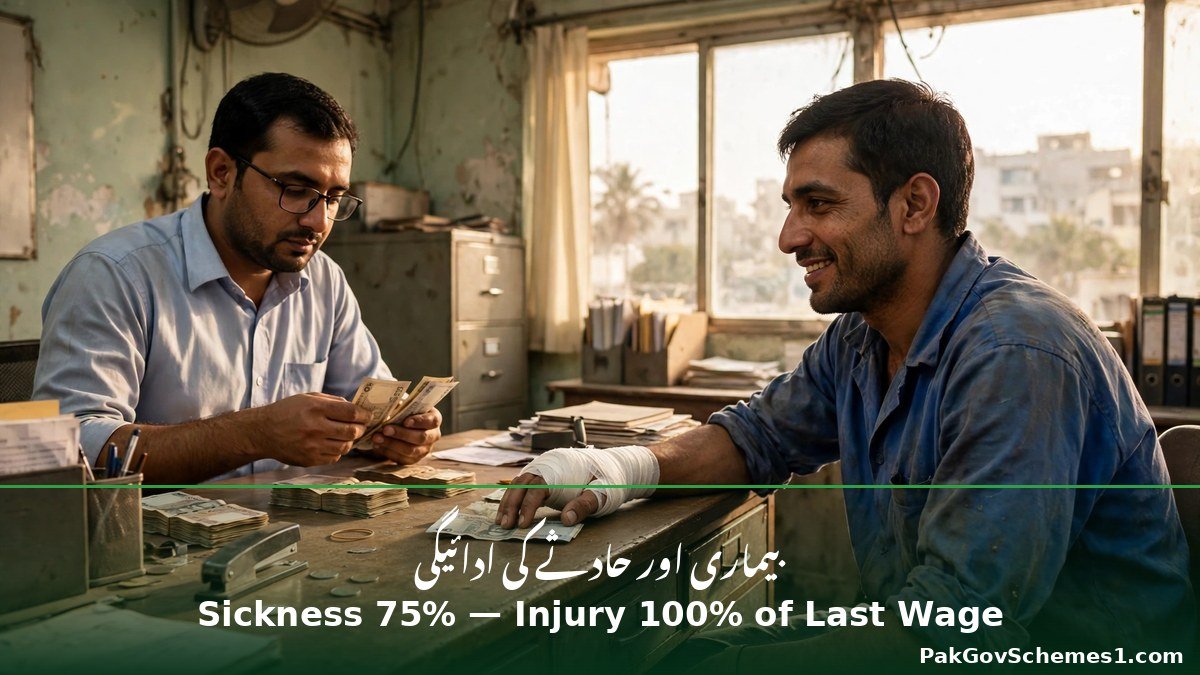
| Sickness | 75% of last wage; 100% for TB/cancer. Up to 121 days a year, 365 for TB/cancer. First 2 days unpaid, unless sick again within 15 days of a paid spell. | 7 days of the first certificate (M-1) |
| Work injury | 100% of last wage, up to 180 days. | 7 days of the first certificate (M-1); employer reports on form B-3 within 24 hours |
| Maternity | 100% of last wage for 12 weeks (6 before, 6 after birth). | 15 days of the B-6 certificate |
| Iddat | 100% of last wage for the iddat period. | 15 days of the husband’s death |
| Death grant | At least Rs 15,000, or 30 days of sickness benefit if higher. | 15 days of the death |
| Survivors’ pension | Shares of 75% of last wage: widow(s)/needy widower three-fifths; each child one-fifth (two-fifths if both parents died); parents one-fifth. | 15 days of the death |
| Disablement | Lump sum up to 20%; partial pension 21–66%; full pension at 67%+, set by a Medical Board. | No separate claim; treating officer refers you to the Board |
Qualifying periods matter as much as rates. For sickness, contributions must cover 90 days in the 6 months before you fell ill; for maternity, 180 days in the last 12 months. Certificates must come from a SESSI medical officer — a private note does not count — and later sickness visits use M-2 and M-3, verified by a consultant. For maternity, the officer certifies the expected date on B-6 and the birth on M-9; the employer signs B-2 and B-20. For iddat, use B-28 with B-28A.
Medical treatment is the other half of the scheme; SESSI reports spending over 70% of its budget on medical care for secured workers. One blog source puts the network at 39 dispensaries, 5 medical centres and 4 hospitals — reported, not confirmed on SESSI’s current pages, so treat it as scale only. Confirm the facility is a SESSI facility first.
Required Documents
- Original CNIC, plus family CNIC/B-Form details.
- Employment proof: employer details, attendance/wage record where asked.
- Your Benazir Mazdoor Card, or older R-5 card if that is what you hold.
- Sickness/injury claim: M-1, M-2, M-3, employer form B-2, and for injury, B-3.
- Maternity claim: B-6, then M-9, plus employer B-2 and B-20.
- Iddat claim: B-28 and B-28A, both CNICs, death certificate, marriage certificate.
- Death grant: B-7 attested by the employer, death certificate, original card, B-2, marriage certificate if the widow claims, funeral-cost proof, affidavit.
How to Check Registration Problems
Employer says you are registered but SESSI has no record. Get the registration reference and contribution record from your employer and take both to your directorate.
Card lost or damaged. Report it at your directorate with your CNIC and ask about a replacement.
Sickness claim refused over a private certificate. SESSI requires its own medical officer’s certificates — get the M-1 at a SESSI dispensary or hospital.
You missed the 7-day or 15-day window. Go to the directorate anyway, explain the delay in writing, and keep proof of your first medical visit. A late claim may fail; an unexplained one will.
Employer will not file the B-3 accident report. The 24-hour rule binds the employer, not you. Tell the directorate yourself.

Your pension stops. Pensioners paid at their home town must visit the directorate yearly, or send a life certificate each June and December.
The portal does not load. Use the directorate or helpline instead of a lookalike site.
Official Helpline and Complaint Procedure
These contacts were verified on SESSI’s homepage at sessi.gov.pk on 28 October 2026: toll-free 0800-33772, UAN 021-111-173-774, info@sessi.gov.pk, head office +92 21 99243813. If your claim is delayed, start at your directorate — 14 in total, including SITE East, Korangi, Hyderabad, Kotri and Sukkur — then use the helpline.

When complaining, keep copies of every form and note the officer you spoke to. If a directorate does not act, take it to the Sindh Ombudsman. Old-age pension is not SESSI’s job — that is federal EOBI. For scams, see the safety notice and our BISP 8171 fake SMS alert guide: a real benefit never asks for a fee via an agent.
Common Mistakes to Avoid
- Applying as an individual online. No confirmed worker self-registration form exists; registration runs through your employer.
- Paying anyone for registration or a card. No official page lists a unit fee, and registration is reported as free. Any fee demand is a scam flag.
- Sharing your CNIC photo or OTP with strangers. Never send a CNIC image, OTP, or password to someone promising registration, a card, or payment.
- Using a private doctor’s certificate. Only a SESSI medical officer’s certificates count; a private note will not support a claim.
- Missing the claim window. Sickness and injury claims run in 7 days; maternity, iddat, death grant and survivors’ in 15 days. File as soon as you hold the first certificate.
- Mixing up the two Sindh worker cards. The SESSI card pays cash benefits; the WWBS card is separate health insurance. Claiming under the wrong scheme wastes the window.
- Assuming an old announcement is current. The 2021 launch and January 2022 biometric start are history. Confirm the current position at a directorate or helpline.
Frequently Asked Questions
What is the Benazir Mazdoor Card?
It is the reported name for SESSI’s worker card in Sindh. Since January 2022, SESSI has recorded workers’ biometrics and family details through NADRA at field offices, and the worker then receives the card, shown for treatment and cash claims.
Who is eligible for the Benazir Mazdoor Card?
Any worker whose employer has registered them with SESSI and pays contributions qualifies as a “secured worker”. If your employer has not registered you, you are not yet covered, and registration must come first before any benefit can be claimed.
Can I apply for the card online by myself?
No confirmed worker self-application exists for this card. Your employer registers the business and then registers you, and you complete biometrics at a SESSI field office. Do not trust websites offering a personal online application form for workers on their own.
Is there any fee for registration?
No fee is reported for registering a unit with SESSI, and no official page lists a worker registration fee. Anyone demanding payment for registration, or for issuing the card itself, should be treated as a scam risk and reported to the directorate.
How much is SESSI sickness benefit?
Reported rates are 75% of your last wage for ordinary illness and 100% for tuberculosis or cancer, paid up to 121 days in a year, or 365 days for TB or cancer. Claims are due within 7 days of the first certificate.
What does SESSI pay for a work injury?
A work injury pays a reported 100% of your last wage for up to 180 days. Your employer must report the accident on form B-3 within 24 hours, and you must file within 7 days of your first medical certificate.
How long is SESSI maternity benefit paid?
Maternity benefit pays a reported 100% of last wage for 12 weeks, six weeks before and six after birth. Contributions must cover 180 days in the last 12 months, and the claim is due within 15 days of the B-6 certificate.

What is the SESSI death grant?
The death grant is reported as at least Rs 15,000, or 30 days of sickness benefit if higher. The claim, on form B-7 attested by the employer, is due within 15 days of the death, and dependants may also qualify for survivors’ pension.
What if I still hold the old R-5 card?
You can keep using it without any problem at all. SESSI’s forms accept either the earlier Social Security Registration Card, form R-5, or the Benazir Mazdoor Card, so holding the older card does not leave you uncovered in any way.
How do I check my Benazir Mazdoor Card status?
There is no verified online CNIC status portal for this card. Ask your employer for your registration and contribution record, visit your SESSI directorate with your CNIC and card, or call the toll-free helpline 0800-33772 for guidance on your case today.
Important Safety Notice
Use only verified channels: sessi.gov.pk, your directorate, and the helpline above. Never share OTPs, passwords, or personal details with strangers, and never pay an agent promising registration or a benefit. PakGovSchemes1.com is independent, not a government department; rates here are reported via a third-party guide.
Conclusion
The Benazir Mazdoor Card 2026 is SESSI’s worker card for Sindh’s registered workers; its value lies in the cash benefits behind it: sickness pay, full injury pay, 12 weeks of maternity pay, and family support after death or disablement. The card is only proof of a registration your employer must make and keep paying for. Check with your employer, complete NADRA biometrics at a field office, keep your card safe, and file claims inside the 7-day or 15-day window. If unsure, call 0800-33772.
Official Sources
- SESSI official website, sessi.gov.pk — checked 28 October 2026; verifies 0800-33772, 021-111-173-774, info@sessi.gov.pk. Retrieved text omitted the card name.
- pakera.pk, SESSI Benefits Sindh (October 2026) — third-party guide reporting SESSI’s pages; verifies rates, windows, forms, January 2022 biometrics, the portal route, no-fee registration, R-5 acceptance.
- pakera.pk, Ehsaas Labour NADRA Portal Closed (September 2026) — verifies SESSI’s helpline numbers; confirms the card name was absent from its homepage.
- Business Recorder (APP), Sindh govt to issue ‘Benazir Mazdoor Card’ (2020) — verifies the 2020 SESSI–NADRA agreement and the 1 January 2021 first card.
- Sindh Investment Department, Ease of Doing Business Portal — confirms the portal address and SESSI’s place among its departments.
Disclaimer: PakGovSchemes1.com is an independent informational website and is not affiliated with any government department. Information is compiled from available official announcements and other identified sources and may change. Please verify eligibility, registration status, payment details, and deadlines through the relevant official government website before taking action.

