
Punjab Dhee Rani Programme Next Phase 2026 — 5,000 Mass Weddings From October, Salami & How to Apply
The Punjab Dhee Rani Programme next phase 2026 will arrange mass weddings for 5,000 deserving girls beginning in October 2026, Punjab’s Social Welfare Department confirmed at a ministerial review meeting in September 2026. This news update explains what was actually announced, what the latest reported salami and gift figures are, who can apply, and how applications, verification and district ceremonies work. It is not a rewrite of the programme’s evergreen guide: for the full Phase 1 and Phase 2 background, see our related guide linked at the end of this article.
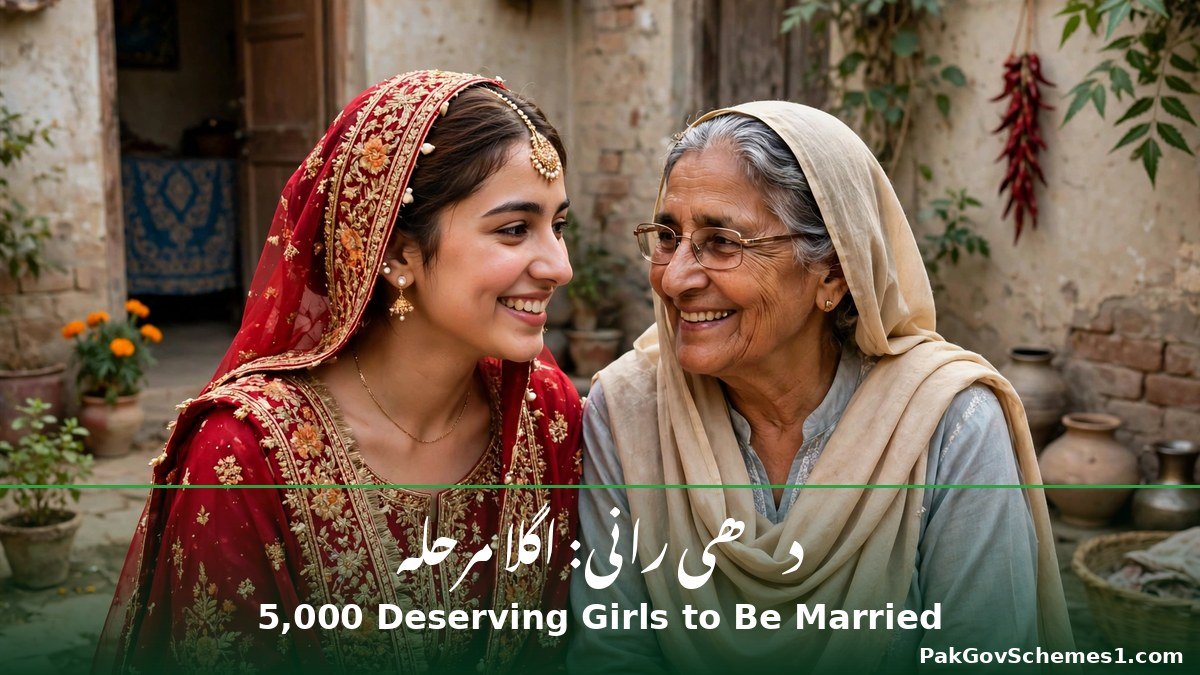
Dhee Rani Next Phase 2026 — Quick Overview
| Information | Details |
| Program Name | Punjab Dhee Rani Programme (Collective Marriages Programme) |
| Responsible Department | Social Welfare and Bait-ul-Maal Department, Government of Punjab |
| Purpose | Dignified collective weddings for girls from low-income families |
| Next-Phase Target | 5,000 mass weddings beginning in October 2026 (reported, September 2026) |
| Previous Seasons | 3,000 weddings in 2024–25; 5,000 in 2025–26 (reported at the September 2026 meeting) |
| Who Can Apply | Punjab-resident brides aged 18–40 from low-income families; priority to orphans, destitute girls and daughters of disabled persons |
| Latest Reported Benefit | Rs 200,000 salami + Rs 121,000 gift package on a Bank of Punjab ATM card (reported, September 2026; see the conflicting-figures section) |
| Registration Status | Applications for the next phase were received through the Maryam Ko Batain app; the portal was reported as showing registration closed on September 28, 2026 — a fresh window has not been officially announced |
| Registration Method | Maryam Ko Batain app, cmp.punjab.gov.pk, or Deputy Director Social Welfare district offices |
| Required Documents | NADRA CNICs of bride, groom, father, mother or guardian; affidavit of unmarried status; Punjab domicile; proof of orphan, destitute or disability status where applicable |
| Official Helpline | 1312 |
| Official Website | https://cmp.punjab.gov.pk/ |
| Last Updated | October 25, 2026 |
Latest Update: 5,000 Weddings From October 2026 — What the September Meetings Actually Said
On September 3, 2026, Punjab Minister for Social Welfare and Bait-ul-Maal Sohail Shaukat Butt chaired a meeting to review arrangements for the next phase of the Dhee Rani Programme. According to the official statement carried by Dawn on September 4, 2026, mass weddings for 5,000 deserving girls would be arranged during the current fiscal year in phases scheduled to begin from the next month — October 2026. Secretary Social Welfare Saira Umar and Director General Dr Shehenshah Faisal Azim attended, with departmental and divisional directors.
The meeting also set out recent history as reported by the department: 3,000 girls married in 2024–25 and 5,000 in 2025–26, with this year’s target matching last year’s. Applications for the next phase had already been received through the Maryam Ko Batain app and would be scrutinised and verified before eligible applicants were included. The minister directed transparency, merit and effective monitoring at every stage.
A follow-up review on September 9, 2026, reported by The Nation, added practical detail: the minister ordered timely preparation of Bank of Punjab ATM cards for eligible beneficiaries and directed divisional directors to complete preparations for coming events well in advance.
District news made the October start concrete in at least one division: on September 23, 2026, APP reported Multan division’s fourth phase starting October 3, 2026, with 550 marriages — 150 in Multan, 150 in Khanewal, 100 in Lodhran and 150 in Vehari — and the Multan ceremony expected on November 16, 2026. The minister was expected to attend as chief guest.
What has not been announced matters too. Exact district-wise wedding dates for the whole province, final verified applicant numbers, per-district quotas, eligibility income thresholds, the per-beneficiary cost and the applications-to-places ratio are not officially announced. The September 3 report itself notes that the department has not published eligibility thresholds, per-beneficiary cost, or the applications-to-places ratio. We state that openly: it is a gap in the official record, not a detail this article can fill.
One Warning Before You Read Further: Phase Numbers and Figures Conflict Across Sources
Dhee Rani reporting does not agree with itself, and this article will not pretend otherwise. The September 2026 meeting figures — 3,000 weddings in 2024–25 and 5,000 in 2025–26 — are the latest reported figures, and they are the ones used in this article’s headline numbers. But other outlets describe Phase 1 as 1,500 weddings and Phase 2 as 1,500 more, and APP calls the Multan division’s October 2026 round its “fourth phase” while other reports describe a “Phase III” launch. Phase labels are used inconsistently across sources: treat any single phase number as reported, not settled.
The same applies to money, dealt with in full in the next section. Whenever this article gives a figure, it names its date and source status — latest reported, earlier-phase, or unconfirmed — so you can judge it for yourself. A social media post giving one figure with no date and no source is unconfirmed.

Salami and Gift Package: Latest Reported Figures vs Earlier-Phase Figures
The latest reported figures, carried in September 2026 reporting on the programme portal, are a Rs 200,000 salami (the cash gift given at a wedding) plus a Rs 121,000 gift package, both loaded on a Bank of Punjab ATM card. APP’s September 23, 2026 Multan report independently confirms the Rs 200,000 salami figure. The government also arranges the venue and the ceremony, and reporting describes meals for guests at the collective events.
| Detail | Verified Information |
| Salami (latest reported, September 2026) | Rs 200,000 per bride, via Bank of Punjab ATM card |
| Gift package (latest reported, September 2026) | Rs 121,000, via Bank of Punjab ATM card |
| Gift before April 19, 2025 | Household goods worth Rs 206,000 instead of the Rs 121,000 cash gift (reported) |
| When the card and gifts are handed over | At the wedding ceremony itself, not before (reported, programme FAQ) |
| Payment schedule detail | Not officially announced beyond the ATM card mechanism |
Now the conflicts, stated plainly. The programme portal’s own FAQ is older than its home page: one FAQ answer still says the ATM card holds Rs 100,000. Older 2025 reporting likewise describes a Rs 100,000 salami plus a Rs 120,000 bank transfer, and the launch-era package was Rs 100,000 via ATM plus furniture, household utensils, clothes and meals for up to 20 guests. A separate October 2026 report describes a Rs 164,000 couple package with lunch for 20 guests. These are earlier-phase or conflicting figures — not the latest reported package.
The honest position: Rs 200,000 salami is the best-supported current figure, confirmed by two independent September 2026 reports, while the Rs 121,000 gift figure rests on September 2026 portal reporting. Because the department has not published a current official payment schedule, confirm the exact amount on your own ATM card and ceremony invitation before making financial plans. If your card shows a different balance, ask the ceremony officials — portal reporting itself gives that advice where its own FAQ and home page disagree.

Who Is Eligible for the Dhee Rani Next Phase?
Eligibility for the next phase follows the programme’s established core, which is consistent across sources:
- Punjab residence: the bride must be a permanent resident of Punjab; Punjab domicile is required.
- Age: the bride must be aged 18 to 40 years.
- Low-income family: the programme is for deserving, low-income families. No income threshold has been published for this phase — that figure is not officially announced, and any income cap circulating online (such as older Rs 30,000 claims) is unconfirmed for the current phase.
- Priority groups: priority is reported for orphan girls, destitute girls and daughters of disabled persons. Minority-community daughters are included on equal terms, as the minister stated at the Phase III launch.
- Who may apply: the bride herself, or her father, mother or legal guardian.
- Marital status: the bride must be unmarried, confirmed by affidavit.
No eligibility rule in this section is borrowed from BISP or any other scheme. Dhee Rani has no PMT score and no 8171 check; anyone telling you to “check 8171” for Dhee Rani is confusing two different programmes.
How to Apply for the Dhee Rani Next Phase: Step by Step
Applications for the next phase were received through the Maryam Ko Batain app, according to the September 2026 ministerial meeting. The portal cmp.punjab.gov.pk and in-person district offices are the other reported routes. Follow these steps:
- Start only at the official routes. Use the Maryam Ko Batain app, type cmp.punjab.gov.pk directly into your browser, or visit your district’s Deputy Director Social Welfare office. Do not start from a WhatsApp link, Facebook ad or blog “Apply Now” button.
- Check whether a window is actually open. Portal reporting on September 28, 2026 showed registration as closed. The next phase’s applications were already received via the app, and no fresh window has been officially announced since. If the portal shows no open form, there is no live window — do not pay anyone to “open” one.
- Register with the bride’s details. Create the application with the bride’s name, CNIC, district and mobile number, then complete the form with personal, family and eligibility details.
- Upload documents. Attach clear copies of the documents listed below. Blurry or mismatched documents commonly cause delay.
- Save your confirmation. On submission, an SMS confirming receipt is reported. Save that SMS and any application reference for every later query.
- Wait for verification. A Tehsil Verification Committee reviews the application and may conduct a home visit. Verified applications go to the Programme Steering Committee for final approval.
- Watch for balloting if oversubscribed. If applications exceed places, selection is reported to be by electronic balloting. Selection is not first-come, first-served, and no agent can reserve a place.
- Attend the ceremony if selected. Selected brides are invited to the organised collective wedding ceremony, where the salami and gift are handed over.
There is no registration fee. Dhee Rani applications are free. Anyone asking for money to register, verify, select or speed up an application is running a scam — this exclusion is absolute, and it is repeated in the safety notice below.

CNIC Check and Application Status
Dhee Rani has no SMS code check like BISP’s 8171 service, and no number you can text to check eligibility. Do not send your CNIC to any SMS or WhatsApp number claiming to check your Dhee Rani status — that is not part of this programme.
Instead, the reported routes are: track an existing application on the portal at cmp.punjab.gov.pk using the bride’s CNIC, call helpline 1312 for guidance on a status that shows no clear update, or visit the Deputy Director Social Welfare office in the applicant’s own district. Keep your application reference and the submission SMS safe; officials will ask for them.
One reported dashboard snapshot gives a sense of scale, though it moves daily: 11,781 applications received, 9,910 visited by verification teams, 966 fully verified, 1,907 nikah completed, 512 found not eligible and 1,036 withdrawn, with no wedding events or disbursements yet recorded for that phase. Treat those as a snapshot, not current totals.
Required Documents
- Valid NADRA CNICs of the bride, groom, father, mother or guardian (certified copies)
- Affidavit confirming the bride is unmarried and willing to participate in the collective wedding ceremony
- Proof of Punjab domicile
- Proof of orphan, destitute or disability status, where applicable (for priority claims)
- Recent passport-size photograph of the bride
- Registered mobile number for the application account and SMS confirmation
The official advertisement or department may specify additional documents for a particular district ceremony. Keep originals ready as well as copies; verification teams visit homes, and a detail that differs between your form and your documents can hold up an application.

Troubleshooting: Common Problems
The portal shows registration closed. That was the reported position on September 28, 2026, and no fresh window has been officially announced. Wait for a department announcement rather than trusting a third-party “open now” claim.
Your application stays under verification. Home visits and committee review take time, and no processing timeline has been published. Do not create a second application or pay an agent to speed it up.
Your card shows a different amount from Rs 200,000. The portal’s own FAQ still carries the older Rs 100,000 figure, and earlier phases paid different packages. Ask the ceremony officials about your own card rather than assuming a reporting error in either direction.
You are told you are ineligible, or your name is missing from a list. Ask the district Deputy Director Social Welfare office which requirement was not met and whether an appeal route exists for that round. Reporting describes an appeal process, but its current terms are not officially published — confirm them at the district office, not from social media.

Someone asks for a fee, or offers a guaranteed place. Applications are free and selection is merit-based, with balloting if oversubscribed. Stop contact, keep the messages, and report the account on the platform that contacted you.

Official Helpline and Complaint Procedure
The programme’s helpline is 1312. It is reported consistently across launch reporting, programme guides and the portal’s own help routes, for guidance on eligibility, registration or application status, for following up a complaint not resolved through the portal, and for help when you are unsure which eligibility category applies. For families without reliable internet access, the helpline and the district Deputy Director Social Welfare office are the direct alternatives to the online portal.
Grievance offices are also reported at district level for complaints during the application process. When you complain, keep your application reference, the submission SMS and copies of your documents ready — and never share your ATM PIN, OTP or bank password with anyone who calls claiming to be from the programme.
Common Mistakes to Avoid
- Paying a registration or verification fee. There is none. Any fee demand is a scam.
- Applying through a fake portal. Only cmp.punjab.gov.pk, the Maryam Ko Batain app and district Social Welfare offices are reported routes.
- Quoting an old salami figure as current. Rs 100,000 and Rs 164,000 figures belong to earlier or conflicting reporting; the latest reported package is Rs 200,000 salami plus Rs 121,000 gift.
- Confusing phase numbers. 1,500, 3,000, 5,000 and “Phase III” versus “fourth phase” labels conflict across sources — check the date of any figure before repeating it.
- Checking status via 8171 or a WhatsApp number. Dhee Rani has no SMS check; use the portal, helpline 1312 or the district office.
- Sharing CNIC photos, OTPs or ATM PINs. Never send these to agents, Facebook pages or WhatsApp numbers, however official they look.

Frequently Asked Questions
What is the Punjab Dhee Rani Programme next phase 2026?
It is the next round of Punjab’s collective-marriage programme, run by the Social Welfare and Bait-ul-Maal Department. At a September 2026 ministerial meeting, the department set a target of 5,000 mass weddings for deserving girls beginning in October 2026, following 3,000 weddings in 2024–25 and 5,000 in 2025–26.
When do the next-phase Dhee Rani weddings start?
The province-wide phases were scheduled to begin from October 2026, according to the September 2026 meeting. District dates vary: Multan division’s round was scheduled from October 3, 2026, with its ceremony expected on November 16, 2026. Other districts’ exact dates are not officially announced.
How much salami does Dhee Rani pay in the next phase?
The latest reported figure is Rs 200,000 salami plus a Rs 121,000 gift package, both on a Bank of Punjab ATM card handed over at the ceremony. Older figures of Rs 100,000 and Rs 164,000 belong to earlier or conflicting reporting, so confirm your own card amount with ceremony officials.
Who can apply for the Dhee Rani next phase?
Punjab-resident brides aged 18 to 40 from low-income families can apply, with priority reported for orphans, destitute girls and daughters of disabled persons. The bride herself, or her father, mother or legal guardian, may submit the application with an affidavit of unmarried status.
How do I apply for Dhee Rani online?
Applications for the next phase were received through the Maryam Ko Batain app, and the portal cmp.punjab.gov.pk and district Deputy Director Social Welfare offices are the other reported routes. Portal reporting showed registration closed on September 28, 2026, and no fresh window has been officially announced since.

What documents are needed for Dhee Rani?
You need NADRA CNICs of the bride, groom, father, mother or guardian, an affidavit confirming the bride is unmarried and willing to join the collective ceremony, proof of Punjab domicile, proof of orphan, destitute or disability status where applicable, and a recent photograph.
How can I check my Dhee Rani application status?
There is no SMS or 8171 check for Dhee Rani. Track the application on cmp.punjab.gov.pk using the bride’s CNIC, call helpline 1312, or visit the Deputy Director Social Welfare office in your district. Keep your application reference and submission SMS for every query.
Is there any fee for Dhee Rani registration?
No. Dhee Rani applications are completely free, and selection is merit-based, with electronic balloting if applications exceed places. Anyone asking for money for registration, verification, selection or faster processing is running a scam and should be reported.
What is the Dhee Rani helpline number?
The helpline is 1312. It is reported consistently across launch reporting and programme guides for help with eligibility, registration, application status and complaints. For families without internet access, the helpline and the district Social Welfare office are the direct alternatives to the portal.
Where can I read the full Dhee Rani guide?
This article is a news update on the next phase only. For the programme’s full background, including Phase 1 and Phase 2 detail, read our evergreen guide, Dhee Rani Program 2026 — Apply Online, linked in the related guides below. That guide remains the reference for the programme’s history.
Important Safety Notice
Use only cmp.punjab.gov.pk, the Maryam Ko Batain app and your district Social Welfare office for Dhee Rani information and applications. Never share OTPs, passwords, CNIC images or ATM PINs with unknown individuals, and never pay anyone for an application, verification or place in the programme. PakGovSchemes1.com is an independent informational website and is not affiliated with the Punjab Social Welfare Department or any government department.
Conclusion
The Punjab Dhee Rani Programme next phase 2026 is a substantial, genuinely new development: 5,000 mass weddings from October 2026, building on 3,000 weddings in 2024–25 and 5,000 in 2025–26, with a latest reported package of Rs 200,000 salami plus a Rs 121,000 gift on a Bank of Punjab ATM card. But the honest position on October 25, 2026, is that applications for this phase were already received via the Maryam Ko Batain app, the portal showed registration closed on September 28, and district dates beyond Multan division are not officially announced. Check the official portal and helpline 1312 before travelling to any office, and confirm your own ceremony invitation and card amount in person.
Sources
- Dawn — “5,000 marriages under Dhee Rani Programme” (September 4, 2026) — verifies the September 3 ministerial meeting, the 5,000 target from the next month, 3,000 in 2024–25 and 5,000 in 2025–26, applications via the Maryam Ko Batain app, and the transparency and merit directions.
- Lahore Times — “Punjab Sets October Start for Next Dhee Rani Phase” (September 3, 2026) — verifies the same meeting and figures, and discloses that eligibility thresholds, per-beneficiary cost and the applications-to-places ratio have not been published.
- The Nation — “Arrangements reviewed for 5,000 collective marriages under Dhee Rani Programme” (September 9, 2026) — verifies the follow-up review, Bank of Punjab ATM card preparation, and divisional directors’ advance preparations.
- APP via UrduPoint — “550 Mass Weddings To Be Arranged Under Dhee Rani Program” (September 23, 2026) — verifies the Multan division round from October 3, the 550 district breakdown, the expected November 16 Multan ceremony, and the Rs 200,000 salami via ATM cards.
- Pakera — “Punjab Dhee Rani Programme: Eligibility, Salami, Register” (checked September 28, 2026) — reported source for the Rs 200,000 salami + Rs 121,000 gift figures, the pre-April 2025 Rs 206,000 household-goods variant, the stale Rs 100,000 FAQ answer, and the portal showing registration closed.
- Jhang News — “Punjab Dhee Rani Programme 2026” (dashboard snapshot) — reported source for the live-dashboard snapshot (11,781 applications, 9,910 visited, 966 fully verified, 1,907 nikah completed) and the balloting, portal-tracking and helpline-1312 process detail.
- Minute Mirror — Dhee Rani applications reporting (October 2026) — conflicting reported source for the Rs 164,000 package variant, cited here only as a conflicting figure, not as the current package.
- Dhee Rani official portal — cmp.punjab.gov.pk — official application portal and status-check route cited by all programme reporting.
Related Guides
- Dhee Rani Program 2026 — Apply Online (Evergreen Guide)
- CM Punjab Bewa Sahara Card 2026 — Bewa Card Apply
- CM Punjab Minority Card 2026 — Apply
Disclaimer: PakGovSchemes1.com is an independent informational website and is not affiliated with any government department. Information is compiled from available official announcements and other identified sources and may change. Please verify eligibility, registration status, payment details, and deadlines through the relevant official government website before taking action.

